
How do you choose a water damage cleanup company after a sudden leak or flood?
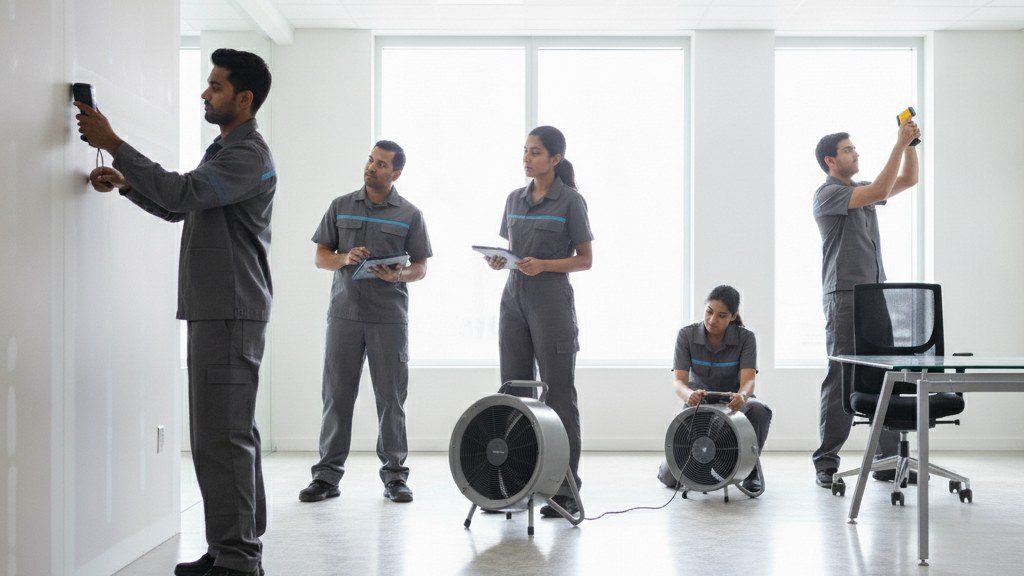
A water damage cleanup company should handle extraction, drying, moisture checks, contamination control, and repair planning before mold or structural damage spreads. The real fix is fast, documented mitigation from an IICRC-certified team that can also manage reconstruction and insurance paperwork, not just fans on wet carpet.
What does a water damage cleanup company actually handle?
A water damage cleanup company is the team you call when water has already crossed the line from annoyance to property damage. It is not just about mopping up. It is about extraction, drying, moisture detection, and stopping hidden damage before it turns into a larger repair problem.
The useful version of this service starts with water removal and then moves quickly into diagnostics. A competent team looks beyond what you can see because the visible puddle is rarely the whole story. Water migrates under flooring, behind baseboards, into drywall, and into places homeowners do not inspect on a normal day.
That is why cleanup and restoration are connected. Cleanup addresses the immediate loss. Restoration addresses the building materials and systems that were affected. If the scope is larger, reconstruction may enter the picture so the space can be put back correctly instead of patched in a way that fails later.
In Atlanta, sudden water damage often comes from burst pipes, supply line leaks, appliance failures, or flooding that reaches more than one room. The better companies do not guess. They document what is wet, how far it spread, and what needs to be addressed now versus monitored.
The short version is this: if a provider only talks about drying equipment and never about moisture mapping, contamination risk, or repair planning, you are probably not talking to a full cleanup company. You are talking to a narrow vendor with a limited answer.
Bullets can be a useful reality check when you are comparing providers:
- Emergency water extraction from standing water and saturated surfaces
- Moisture inspection for floors, walls, cabinets, crawl spaces, and insulation
- Drying and dehumidification to reduce secondary damage
- Contamination assessment when the water source is unsafe or unclear
- Repair and reconstruction planning if materials have to be removed
How do near-me searches for water damage cleanup services in Atlanta really get sorted?
When someone types a local emergency query, Google is not trying to reward the prettiest website. It is trying to decide which company is close, relevant, and credible enough to show in the map pack. That is why local signals matter as much as the service page itself.
For a homeowner, the search usually starts with urgency. You are looking for immediate help in Atlanta, Marietta, Decatur, Sandy Springs, or a nearby area, and you want a company that can actually show up. Search engines read that intent through location signals, service relevance, and business profile consistency.
The Google Business Profile matters because it tells Google what the company does, where it works, and how customers interact with it. If the categories, services, description, reviews, and location details do not line up, the business becomes harder to trust algorithmically. This is not theory. It affects whether the company appears in the map pack at all.
NAP consistency also matters. Name, address, and phone number should match wherever the business is listed online. If they do not, local systems get mixed signals. That can weaken visibility for searches like water damage cleanup Atlanta GA or a nearby emergency cleanup query.
Then there is review velocity and service relevance. A restoration company that earns steady, specific reviews about water damage, emergency response, and communication sends a much stronger local signal than a generic contractor profile with vague praise and no service context.
If you are a homeowner, the practical takeaway is simple: the company you can find quickly is not always the company you should hire. You want the one whose local presence matches the exact problem you have right now.
Bullets that separate strong local listings from weak ones:
- Service categories that match restoration, not generic home repair
- A complete Google Business Profile with accurate hours and service area
- Consistent NAP details across directories and citations
- Reviews that mention water loss, responsiveness, and cleanup quality
- Location relevance for the Atlanta metro area and nearby communities
Why does fast water removal matter before mold and structural damage spread?
Because water does not politely wait for your schedule. It keeps moving into materials, and the longer it sits, the more expensive and invasive the job usually becomes. Fast removal is not just about comfort. It is about limiting the chain reaction that follows water intrusion.
Moisture is opportunistic. It wicks upward in drywall, settles into seams, and hides in low spots where airflow is poor. That means the damage you can see often understates the damage you actually have. A fan in the room does not solve that problem by itself.
The mold issue is the one most homeowners understand too late. Once materials stay wet long enough, you are no longer dealing with water alone. You are dealing with conditions that support microbial growth, odor, and indoor air quality concerns. That is why cleanup has to be fast and methodical, not improvised.
Structural concerns follow the same logic. Wood swells. Subfloors weaken. Drywall breaks down. Cabinets and trim can lose integrity. The longer the water stays, the more likely you are to move from cleanup into demolition and reconstruction.
This is where a real restoration company earns its keep. The job is not to make the room look dry. The job is to verify that the building has been stabilized. That means hidden moisture checks, controlled drying, and clear documentation of what needs further work.
If a company treats every water loss like a surface-cleaning issue, it is missing the point. Water damage is a systems problem, not a housekeeping chore.
Bullets to watch for when speed matters:
- Standing water removed quickly before it migrates farther
- Drying equipment placed based on moisture readings, not guesses
- Materials monitored for hidden saturation behind walls and under floors
- Mold risk reduced by acting before wet materials sit too long
- Structural issues documented before they become repair surprises
Elevated Operations provides 24/7 water, fire, mold, storm, and sewage damage restoration across Metro Atlanta.
Get a free quoteWhat should you ask before hiring a cleanup team?
Ask the boring questions. That is usually where the truth shows up. A serious cleanup company can explain its process, its credentials, and how it handles the handoff from emergency mitigation to repair without making you decode vague sales language.
Start with certification. IICRC-certified technicians know the standards that govern water mitigation and drying practices. That matters because you are not just hiring labor. You are hiring judgment about how wet materials behave, what can be saved, and what needs to come out.
Then ask what happens after extraction. A lot of companies are fine at removing water and awkward at everything that follows. If they cannot explain moisture monitoring, contents handling, or reconstruction planning, you may end up coordinating multiple vendors yourself. That is where projects stall.
You should also ask how they handle insurance communication. Water damage is stressful enough without becoming the middleman between the adjuster, the mitigation crew, and the repair team. Clear invoicing and claim support reduce friction and help the job move forward more cleanly.
Finally, ask whether the company can handle the full scope if the loss expands. A one-call solution is not a buzzword when a ceiling has to be opened, drywall removed, or reconstruction scheduled. It is the difference between continuity and chaos.
Good questions usually reveal whether you are dealing with a real restoration partner or a temporary labor dispatch.
Bullets for the phone call:
- Are your technicians IICRC certified?
- Do you provide both cleanup and reconstruction if needed?
- How do you document moisture and drying progress?
- Will you help coordinate insurance claim paperwork and invoicing?
- Can you respond to an emergency in the Atlanta metro area?
How does water damage cleanup connect to insurance paperwork and claims?
It connects more than most homeowners expect. Once the room is wet, you are not only managing the property. You are managing documentation, scope, estimates, and communication with the carrier. If the paperwork is messy, the claim gets messier.
The restoration side of the process depends on clean records. Photos, moisture readings, loss notes, and material scope all help establish what happened and what was required. That is why companies that understand insurance workflows usually move more smoothly than teams that only know how to dry a room.
Homeowners often get stuck because they are trying to translate a technical loss into claim language. They do not know what should be documented, what the adjuster needs, or how to keep the file moving. A restoration company that manages the claim process removes some of that friction.
This matters even more when the project includes both mitigation and reconstruction. One vendor can dry the home, another can repair it, and a third can bill for contents or cleanup. Without coordination, the homeowner becomes the project manager by default. That is a bad job to inherit after a loss.
A cleaner process usually means fewer surprises, fewer unanswered questions, and a more straightforward path from emergency response to final repair. That is not flashy. It is just what good operations look like when people are already stressed.
Bullets that make claim handling easier:
- Photo documentation of visible damage and hidden moisture
- Clear scopes for mitigation, repair, and reconstruction
- Invoices and notes that support insurance review
- Fewer handoffs when one team manages the whole process
- Less back-and-forth between the homeowner and the adjuster
Why one team for cleanup, repair, and reconstruction usually saves headaches
Because the handoff is where projects get messy. When one company dries the home, another repairs it, and a third has to explain the scope, details get lost. A single coordinated team reduces the chance that something gets blamed on the wrong phase.
This is especially true after water damage because the early decisions affect the later ones. If the mitigation team removes the wrong material or misses a hidden wet area, the repair team inherits a problem. If the repair team is not involved early enough, the scope can shift halfway through the job.
A one-stop restoration model is not about convenience as a slogan. It is about continuity. The same company can move from emergency water removal to drying, then into reconstruction, without forcing the homeowner to repeat the story three times.
That continuity matters in a city like Atlanta, where storms, leaks, and plumbing failures can damage multiple areas at once. Kitchens, basements, crawl spaces, and shared walls often need different responses. When one team manages the whole chain, the property gets a more coherent solution.
It also helps with accountability. If the same company is responsible for the work from start to finish, there is less room for finger-pointing later. The homeowner knows who owns the outcome.
Bullets that show the difference:
- Fewer handoffs between mitigation and rebuilding
- Consistent documentation from the first visit to final repair
- Less homeowner time spent coordinating separate contractors
- Clearer accountability when the scope changes
- Better continuity in materials, scheduling, and communication
When should you call a cleanup company instead of waiting it out?
| Situation | What to do | Why |
|---|---|---|
| Water is visible on floors, drywall, or ceilings | Call for emergency extraction and moisture inspection right away | Visible water usually means hidden water too, and waiting lets it spread |
| The affected area smells damp or musty | Request drying and contamination evaluation | Odor often signals trapped moisture and the start of mold risk |
| The source was a burst pipe, sewer backup, or unknown leak | Get a professional assessment before touching everything yourself | Source type changes the cleanup protocol and the safety risk |
| You may need repairs after cleanup | Choose a company that can also handle reconstruction | One coordinated scope avoids gaps between mitigation and rebuilding |
Doing it yourself vs bringing in Elevated Operations
| Doing it yourself | With Elevated Operations | |
|---|---|---|
| First response | You may mop, run fans, and hope you caught it early, but that rarely tells you how far moisture traveled. | We respond with water extraction, drying, and a damage assessment that looks beyond the surface. |
| Hidden damage | You can miss moisture in walls, under floors, and in crawl spaces unless you have the right tools and training. | Our IICRC-certified technicians look for concealed moisture and plan the next step from there. |
| Insurance and documentation | You have to photograph, track, and explain the loss while also dealing with the mess. | We help manage the claim process, documentation, and communication so you are not carrying all of it alone. |
| Repair continuity | If the home needs reconstruction, you may need to find and coordinate another contractor. | We provide a one-stop path from emergency response through reconstruction when the job requires it. |
Frequently Asked Questions
How do I know if my home needs cleanup or full restoration?
If the water is limited to a surface area and dried quickly, cleanup may be enough. If drywall, flooring, cabinets, insulation, or ceilings are affected, restoration is often needed too. The distinction depends on how far the water moved and what materials were exposed. A proper inspection is the only honest way to know.
Can a cleanup company handle a burst pipe in an Atlanta home?
Yes. Burst pipe damage is one of the most common reasons homeowners call for emergency water removal. A cleanup company should remove the water, dry the structure, check for hidden moisture, and determine whether repairs or reconstruction are needed after the immediate loss is stabilized.
What should I do before the crew arrives?
If it is safe, stop the water source, avoid electrical hazards, and move valuables away from the wet area. Do not pull up materials or start demolition unless you know what you are doing. The main goal is to reduce risk and let the restoration team assess the loss properly.
How much does professional cleanup cost?
The cost is custom because every loss is different. The source of the water, the amount of saturation, the materials involved, and whether reconstruction is needed all affect the scope. The simplest next step is to book a call for a free quote so the damage can be assessed correctly.
Why should I consider Elevated Operations for water damage cleanup in Metro Atlanta?
If you want one team that can handle emergency response, drying, insurance coordination, and reconstruction, Elevated Operations is built for that workflow in the Atlanta metro area. The practical advantage is fewer handoffs and a clearer path from loss to repair. Book a call for a free quote and get the next step handled.
Get a free, no-obligation restoration estimate
Elevated Operations provides 24/7 water, fire, mold, storm, and sewage damage restoration across Metro Atlanta.
Get a free quoteCall (770) 404-6895Last updated October 18, 2026