
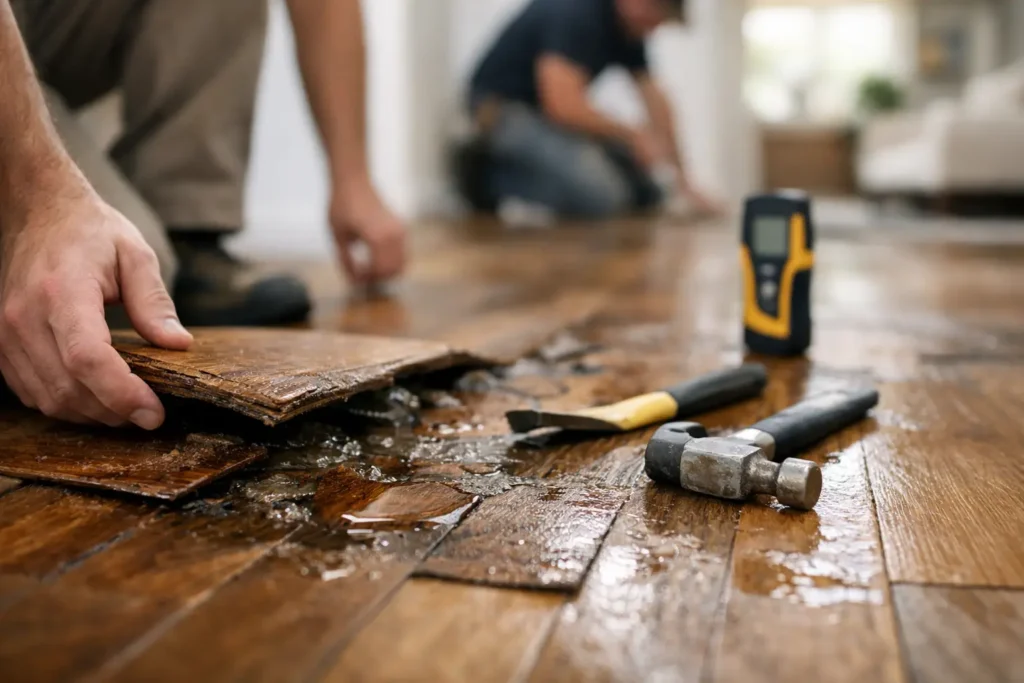
A dishwasher leak can soak beneath a kitchen floor long before the surface looks alarming. A burst pipe can send water under laminate planks in minutes. By the time flooring starts to buckle, smell musty, or separate at the seams, the issue may be larger than what you can see.
Knowing when to replace water damaged flooring helps protect the structure below it, prevent mold growth, and keep an insurance claim from becoming more complicated. The answer is not always immediate replacement. Some floors can be professionally dried and saved when the water is clean, the response is fast, and moisture has not reached the subfloor. Others need to come out because drying the visible surface will not remove the risk underneath.
The first question: what kind of water caused the damage?
Before deciding whether flooring can stay, identify the water source. Restoration professionals classify water damage by contamination level, and that classification matters as much as the amount of water.
Clean water from a recently broken supply line or overflowing sink may allow for drying and restoration if addressed quickly. Gray water from a washing machine discharge, dishwasher, or toilet overflow without feces carries more contamination and requires greater caution. Black water from sewage, floodwater, or a toilet backup with waste is a health hazard. Porous materials exposed to black water, including carpet padding, laminate, engineered wood, and many wood flooring systems, generally require removal.
Do not assume water is clean just because it looks clear. A floor affected by a sewage backup or outdoor flooding is not a candidate for simple surface cleaning. Safe removal, disinfection, controlled drying, and reconstruction are the right path.
7 signs it is time to replace water damaged flooring
1. The floor is buckling, lifting, or separating
Cupped hardwood boards, raised laminate edges, loose vinyl tiles, and gaps between planks all indicate that moisture has changed the material or weakened the adhesive. A few mildly cupped hardwood boards may flatten after careful drying, depending on the species and how long they were wet. But severe crowning, widespread buckling, or planks pulling away from the subfloor usually means replacement is necessary.
Laminate is especially vulnerable. Its core absorbs water, expands, and often does not return to its original shape. Once edges are swollen or seams are lifted, replacement is usually more reliable than trying to force the material flat.
2. Moisture remains below the surface
A floor can feel dry underfoot while the subfloor, underlayment, baseboards, or wall cavities remain wet. That is why professional moisture mapping matters. Technicians use moisture meters and thermal imaging to compare affected areas with dry materials and identify where water traveled.
If elevated moisture remains after extraction and controlled drying, flooring may need to be removed to access the materials below. Covering trapped moisture can lead to deteriorated plywood, loose adhesives, warped framing, and mold growth that appears weeks later.
3. There is a musty odor or visible mold
Musty odors are not just unpleasant. They often signal microbial growth in padding, beneath flooring, or along baseboards. Mold can begin developing quickly in wet conditions, particularly when a leak goes unnoticed or a basement stays humid after flooding.
Visible mold, staining at seams, or a persistent odor after drying should be evaluated before repairs begin. Replacing only the top flooring layer without addressing contaminated backing, subflooring, or drywall can leave the source behind. Proper remediation focuses on the affected materials and the moisture condition that allowed growth.
4. The subfloor is soft, stained, or deteriorating
Walk slowly across the affected area. Soft spots, flexing, squeaks that were not there before, or a spongy feeling can point to subfloor damage. Plywood and oriented strand board can delaminate after prolonged saturation. Particleboard is even less forgiving and may swell, lose strength, and crumble.
A damaged subfloor cannot provide a stable base for new flooring. Reinstalling finish flooring over compromised material may create movement, premature wear, and future failure. In these cases, the correct repair includes removing damaged flooring, replacing weakened subfloor sections, drying the surrounding assembly, and then rebuilding.
5. The flooring was wet too long
Time changes the decision. A clean-water spill addressed within hours has a much better chance of being restored than a floor that stayed wet for several days. Water can migrate under walls, cabinets, appliances, and trim, even when the visible puddle seems small.
There is no universal hour-by-hour rule because flooring type, water volume, indoor humidity, and the construction beneath it all matter. Still, the longer moisture remains, the more likely replacement becomes. Quick extraction and professional drying can reduce the amount of material that has to be removed.
6. The material itself is not salvageable
Different flooring responds differently to water. Solid hardwood can sometimes be dried slowly and refinished if it has not warped severely. Tile may survive, but water can compromise grout, underlayment, or the subfloor beneath it. Luxury vinyl can be durable, though trapped water and failed adhesive may still require removal.
Carpet can occasionally be cleaned and dried after a clean-water event, but wet padding is commonly replaced because it holds moisture and contaminants. Laminate and many engineered wood products often need replacement after significant saturation. The goal is not to save every plank at all costs. It is to restore a dry, stable, healthy floor system.
7. The loss involves sewage or contaminated floodwater
This is the clearest replacement trigger. When sewage or floodwater reaches flooring, health and sanitation take priority over appearance. Porous flooring and padding can absorb contaminants that cannot be reliably removed through ordinary cleaning. Even materials that appear intact may have contamination beneath edges, seams, or transitions.
A qualified restoration team can establish containment, remove affected materials safely, clean structural surfaces, document the loss, and prepare the area for reconstruction. This protects occupants and gives the insurance carrier clear records of what was affected and why replacement was required.
When water damaged flooring can be saved
Replacement is not the only outcome. Fast action can make a major difference after a clean-water event. If the floor has not swelled, separated, or developed odor, professional extraction and drying may preserve it.
The process should involve more than fans placed in the room. Effective mitigation starts with stopping the source and extracting standing water. Technicians then check moisture in the flooring, subfloor, walls, and adjacent rooms, set commercial drying equipment, and monitor readings until materials return to an acceptable dry standard.
Hardwood is the most nuanced case. It may look damaged during the drying process and improve over time. Removing it too early can create unnecessary cost, while waiting too long to address severe distortion can worsen the repair. Measurements, not guesswork, should guide that call.
Do not replace flooring before the structure is dry
Installing new flooring over a wet slab, damp wood subfloor, or inadequately dried crawlspace can void manufacturer warranties and create another failure. Before reconstruction begins, the underlying materials must be tested and documented as dry. Baseboards, cabinets, drywall, insulation, and trim may also need attention if moisture traveled beyond the floor.
This is where a one-team approach helps. Elevated Operations can manage extraction, moisture mapping, structural drying, insurance documentation, and the reconstruction work that follows. Instead of coordinating separate cleanup and flooring contractors, property owners can move from emergency response to a finished repair with a clear record of what was done.
What to do immediately after a floor gets wet
First, stop the water source if it is safe to do so. Move furniture and valuables away from the affected area, but avoid walking through sewage or floodwater. Do not run household fans over contaminated water, and do not pull up flooring before the loss is documented if insurance coverage may apply.
Take photos of the source, standing water, and affected rooms. Then arrange professional extraction and an inspection as soon as possible. For Metro Atlanta homeowners, landlords, and property managers, a prompt response can reduce the scope of demolition, protect the subfloor, and provide the documentation needed for the claim.
A damaged floor is disruptive, but it does not have to leave you guessing. Get the moisture beneath the surface checked before choosing a repair or replacement, and make sure the work restores the full floor system – not just the part people can see.