What to Expect From Water Damage Restoration in Georgia
Homeowners in Georgia can expect water damage restoration to move through inspection, extraction, several days of drying with equipment running in the home, cleaning, and reconstruction, with a certified crew documenting everything for the insurance claim. Elevated Operations, an IICRC-certified contractor in Mableton, responds within 60 minutes across Metro Atlanta, bills insurance directly, and keeps you updated at each phase. Call today for a free inspection.
What Happens in the First Hour After You Call?
In the first hour, expect a crew to arrive, locate and stop the water source, inspect the affected area with moisture meters, and begin extraction. This early window is the most important, because fast water removal limits how far the damage spreads and keeps the loss in a lower, less costly class.
Elevated Operations targets a 60-minute response across Metro Atlanta specifically because the first hour sets the trajectory of the entire job. Technicians classify the water as clean, gray, or black, which determines the safety steps and the scope, then start pulling standing water immediately. They also begin documentation right away with photos and moisture readings, since the insurance claim is built from what the loss looked like before cleanup, not after.
How Long Will Equipment Be Running in Your Home?
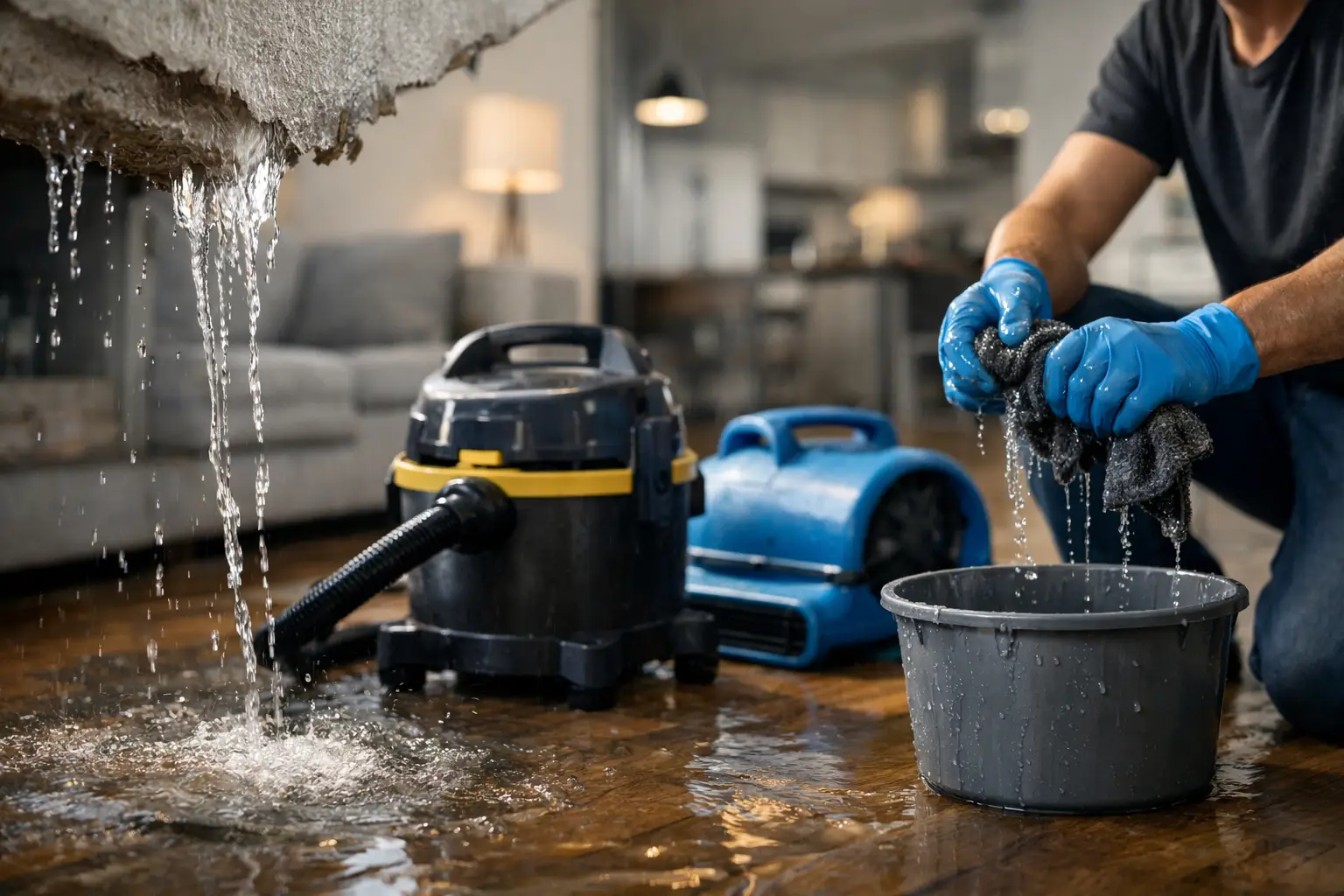
Expect commercial air movers and dehumidifiers to run continuously for roughly three to five days, sometimes longer for a heavily saturated loss. The equipment is noticeable and runs day and night, because drying is verified by daily moisture readings, not by how surfaces feel.
This is the phase most homeowners underestimate. The drying equipment stays in place until readings confirm the subfloor, drywall, and framing have returned to a dry standard, and removing it early is what leads to hidden mold later. Technicians check moisture levels each day and adjust the equipment, so the timeline is driven by how wet the materials actually are. A contained clean-water loss may dry in a few days, while a saturated Category 3 loss takes longer, and the water damage restoration process cannot safely move to reconstruction until drying is complete.
Can You Live in Your Home During Restoration?
For a contained clean-water loss, most homeowners can stay, though they should expect noise from drying equipment and restricted access to the affected rooms. A Category 3 sewage or flood loss, or one requiring significant demolition, may make temporary relocation the safer choice until the area is cleaned and secured.
The deciding factors are the water category and the extent of demolition. Clean water confined to one area rarely forces a family out, but contaminated black water requires disinfection and disposal that can make part of the home temporarily unsafe. Technicians will tell you honestly which situation you are in during the inspection phase, so you can plan around it rather than being surprised mid-project.
Not sure what to expect for your specific loss? A free on-site inspection walks you through the plan and timeline before anything starts.
Get a Free InspectionWho Handles the Insurance Claim?
Expect the restoration contractor to handle the technical side of the claim. Elevated Operations documents the loss with moisture readings, photos, and a room-by-room scope, then bills the insurance carrier directly and assists with deductibles up to $1,000, so homeowners are not paying the full repair up front while waiting on reimbursement.
The Insurance Information Institute notes that homeowners policies cover sudden, accidental losses, and the way a claim is documented often decides how smoothly it pays. Direct billing removes the common gap where a homeowner pays a contractor and then waits weeks for the insurance check. For a full breakdown of what a Georgia policy will and will not cover, see our guide on whether homeowners insurance covers water damage.
What Should You Do — and Not Do — Before the Crew Arrives?
Before the crew arrives, safely stop the water source, move small valuables and electronics away from the water, and photograph the damage for the claim. Do not use a household vacuum on standing water, do not enter rooms with sagging ceilings, and avoid electrical devices in wet areas.
Quick, safe action protects both your home and your claim. Photographs taken before cleanup document the loss at its worst, which is what adjusters want to see, and keeping receipts for any emergency steps helps, since those costs are often reimbursable. Leave the actual extraction and drying to professionals, because standing water can hide electrical hazards and contaminated water requires protective handling that household tools are not built for.
How Does Elevated Operations Keep You Informed?
Expect clear communication at each phase: what the water category means, how long drying will take, when the structure is verified dry, and when reconstruction begins. The same IICRC-certified crew handles the job from extraction through rebuild, so there is one accountable point of contact rather than a handoff between companies.
Keeping the whole process under one roof is what makes the timeline predictable. Daily moisture readings give a factual answer to “how much longer,” and because Elevated Operations completes the reconstruction in-house, there is no waiting weeks for a separate contractor to bid the rebuild. Every completed repair carries a 12-month workmanship warranty across Cobb, Fulton, DeKalb, Douglas, Clayton, Henry, and Paulding counties.
What Should You Expect at Each Phase?
The table below shows what a homeowner will typically notice at each phase and what their role is, from the first call through the final rebuild. Timing depends on the water category and how saturated the structure is.
| Phase | What You Will Notice | Your Role |
|---|---|---|
| Inspection | Crew maps moisture, classifies the water, explains the plan | Point out the source, share what happened |
| Extraction | Standing water removed quickly with commercial equipment | Keep the area clear and safe |
| Drying (3–5 days) | Loud air movers and dehumidifiers run day and night | Leave equipment running; expect noise |
| Cleaning | Surfaces treated, odor controlled, contaminated items removed | Approve disposal of unsalvageable items |
| Reconstruction | Drywall, flooring, and finishes rebuilt to pre-loss | Confirm final scope and finishes |
Sources
What Do Real Georgia Restoration Experiences Look Like?
Three common Metro Atlanta situations show how the experience differs: a clean-water pipe burst where the family stays home, a slow leak that expands the project, and a Category 3 backup that may require temporary relocation.
Clean-Water Pipe Burst
The family usually stays home. Expect a few days of drying equipment noise in one area, minimal demolition, and a covered claim that leaves the homeowner paying mainly the deductible.
Slow Leak Found Late
Expect a longer, more disruptive project. Weeks of saturation mean more demolition and drying, and the cleaning phase expands to replace materials that cannot be dried and reused.
Category 3 Sewage Backup
Expect the most disruption. Disinfection and disposal of contaminated materials come first, and part of the home may be temporarily off-limits until the affected area is cleaned and secured.
Frequently Asked Questions
For a contained clean-water loss, disruption is usually limited to noise from drying equipment and restricted access to the affected rooms for a few days. Larger or contaminated losses are more disruptive because they involve demolition, disinfection, and reconstruction. Elevated Operations positions equipment to keep as much of the home usable as possible and explains up front which rooms will be affected and for how long, so families can plan around the work.
Not usually for a small, contained clean-water loss, where most families stay home through the drying phase. Temporary relocation is more likely with a Category 3 sewage or flood loss, or one that requires significant demolition, because those situations can make part of the home temporarily unsafe until it is cleaned and secured. Technicians assess this during the inspection phase and give you a straight answer so you can plan, rather than being surprised partway through.
Commercial air movers and dehumidifiers running continuously for several days do use electricity, and this is a normal, expected part of restoration. The equipment stays only as long as daily moisture readings show it is needed, then it is removed. On covered insurance claims, the restoration scope is what the carrier pays against, and running the equipment long enough to fully dry the structure is what prevents a far more expensive mold problem later.
Reconstruction begins once daily moisture readings confirm the structure has returned to a dry standard, which typically takes three to five days of drying but can be longer for a saturated loss. Because Elevated Operations completes the rebuild in-house with the same crew, there is no waiting weeks for a separate general contractor to bid and schedule the work. That single-team approach is what keeps the overall timeline predictable from the first call to the final finish.
Hidden damage behind walls or under flooring is common with water losses, and a professional crew documents anything it uncovers with photos and moisture readings so the insurance scope can be updated. That is one reason documentation matters: the claim is adjusted based on what is actually found, not just what was visible at first. Elevated Operations communicates any additional findings to both the homeowner and the adjuster before expanding the work.
Know Exactly What to Expect — Start With a Free Metro Atlanta Inspection
Elevated Operations responds to water damage calls across Cobb, Fulton, DeKalb, Douglas, Clayton, Henry, and Paulding counties in under 60 minutes, with IICRC-certified technicians, clear phase-by-phase communication, direct insurance billing, deductible assistance up to $1,000, and a 12-month workmanship warranty on every restoration project.
Get a Free Inspection24/7 Emergency Line: (770) 404-6895IICRC-Certified · Direct Insurance Billing · 12-Month Warranty · 4.9 Stars (35+ Reviews) · Serving Cobb, Fulton, DeKalb, Douglas, Clayton, Henry & Paulding CountiesContent reviewed and last updated: September 2026 · Elevated Operations, LLLP · Mableton, GA · Serving Metro Atlanta