
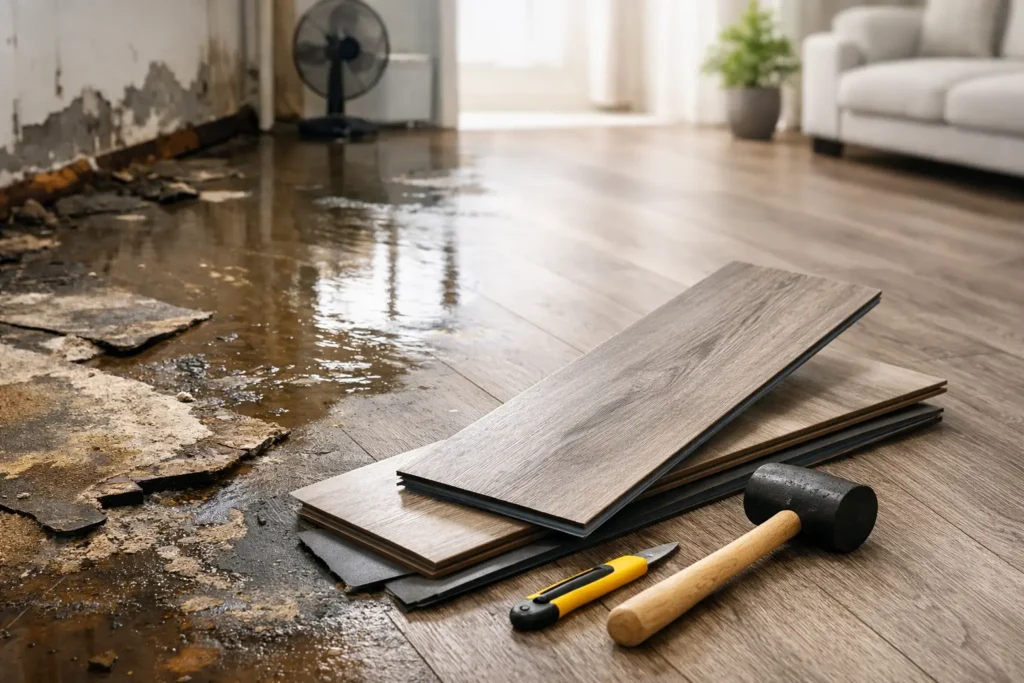
A flooded kitchen can leave homeowners focused on the visible mess: warped planks, soaked rugs, and a floor that suddenly feels soft underfoot. But choosing waterproof flooring is only part of the recovery. Before a new surface goes down, the moisture below it has to be found, measured, and fully addressed. Otherwise, a beautiful new floor can trap a much more expensive problem underneath.
For Metro Atlanta property owners recovering from a burst pipe, appliance leak, slab leak, sewer backup, or storm intrusion, flooring decisions should begin after proper mitigation, not before. The right material can make future cleanup easier. It cannot correct a wet, contaminated, or unstable subfloor.
What Waterproof Flooring Actually Protects Against
Waterproof flooring is designed to resist water passing through the finished surface. Spills, pet accidents, wet shoes, and many everyday leaks can sit on the material for a period without causing the planks or tiles to swell, buckle, or lose their shape. That makes it a practical choice for kitchens, bathrooms, laundry rooms, entryways, basements, rental properties, and commercial spaces with frequent foot traffic.
The word “waterproof,” however, can create a false sense of security after a major loss. Water can still enter around the perimeter of the room, through seams that were not installed correctly, beneath baseboards, or through openings around cabinets, toilets, and appliances. Once moisture reaches the underlayment, wood subfloor, wall framing, or insulation, the floor covering above does not stop the damage already in progress.
That distinction matters most after a flood or pipe break. A waterproof vinyl plank may survive while the plywood beneath it absorbs water. In some cases, the floor can be carefully removed, dried, and reinstalled. In others, the material, underlayment, or subfloor needs replacement. The decision should be based on moisture readings, material condition, contamination level, and the length of time water was present, not on appearances alone.
Dry the Structure Before Replacing the Floor
After water damage, speed protects the property. Standing water should be extracted quickly, but extraction is only the first step. Professional restoration involves moisture mapping, thermal imaging when appropriate, humidity monitoring, controlled drying, and documentation that shows whether affected materials have returned to an acceptable dry standard.
A floor can look dry while moisture remains under cabinets, inside wall cavities, beneath glued-down material, or in the subfloor. That hidden moisture can lead to cupping, adhesive failure, odors, mold growth, and deterioration of structural materials. It can also complicate an insurance claim if the damage is not documented before reconstruction begins.
There are situations where removing flooring is the safest path. Carpet and padding exposed to contaminated water generally require removal. Hardwood often needs prompt evaluation because it can absorb water quickly and may buckle or cup as it dries. Laminate flooring commonly swells at the edges after significant moisture exposure and is rarely a dependable salvage candidate.
For clean-water losses caught early, some resilient flooring may be recoverable. The key is not guessing. A certified restoration team can determine where water traveled, identify materials that can realistically be dried, and create a repair scope that supports both the property and the claim.
Best Waterproof Flooring Options After a Loss
The best replacement depends on the room, the condition of the structure, the amount of future water exposure, and the look the property owner wants. Price matters, but installation requirements and subfloor preparation matter just as much.
Luxury Vinyl Plank and Luxury Vinyl Tile
Luxury vinyl plank, often called LVP, is one of the most common choices for homes and rental properties. It provides the look of wood or stone while resisting surface water, and individual damaged planks can sometimes be replaced without redoing the entire room. It is also comfortable underfoot and available in a wide range of colors and textures.
Its biggest advantage is versatility. LVP works well in living areas, bedrooms, kitchens, hallways, and many below-grade spaces when installed over a dry, level, properly prepared subfloor. But not every product performs the same. Lower-cost products may dent more easily, show wear sooner, or have weaker locking systems. A quality wear layer and professional installation are worth discussing, especially in high-traffic homes or commercial spaces.
Sheet Vinyl
Sheet vinyl creates fewer seams than plank flooring, which can make it an excellent option for bathrooms, laundry rooms, and utility areas. When properly installed and sealed at vulnerable edges, it offers strong water resistance and easy cleanup. It is often more budget-friendly than premium LVP or tile.
The trade-off is repairability. A damaged section of sheet vinyl is harder to replace cleanly than a single vinyl plank or tile. Subfloor imperfections can also show through over time, so preparation remains essential.
Porcelain or Ceramic Tile
Tile is a durable long-term choice for bathrooms, entries, kitchens, and commercial areas. Porcelain is particularly dense and well suited to moisture-prone rooms. With properly installed grout, backer board, waterproofing where needed, and sound subfloor support, tile can handle routine water exposure better than most alternatives.
Tile is not automatically the right answer for every project. It is harder and colder underfoot, labor costs can be higher, and cracks may develop if the subfloor moves or lacks proper support. Grout also needs maintenance. For a quick rental turnover or a large living area, quality vinyl may provide a more practical balance of cost, comfort, and durability.
Waterproof Laminate: Read the Fine Print
Some laminate products are marketed as water-resistant or waterproof. These products can perform well against everyday spills when installed exactly as specified by the manufacturer. They are not the same as a floor built to tolerate prolonged floodwater or moisture beneath the boards.
If laminate is being considered after a water loss, review the warranty conditions closely. Many warranties exclude standing water, plumbing failures, flooding, improper installation, and moisture rising from below. For properties with recurring leak risk or below-grade moisture concerns, vinyl or tile is often the more forgiving choice.
Match the Material to the Room and Risk
A flooring decision should reflect how the space is used. A primary bathroom needs a different level of water tolerance than a formal dining room. A basement with a history of seepage needs a different plan than a second-floor bedroom damaged by an overflowing washing machine.
For bathrooms and laundry rooms, prioritize materials that tolerate splashes and simple cleanup, while addressing leak detection and proper sealing around fixtures. In kitchens, choose a surface that can handle dropped dishes, food spills, and appliance leaks, but do not ignore the condition of the floor beneath the dishwasher and refrigerator. For basements, determine whether moisture is coming from a one-time incident, a foundation issue, a plumbing source, or humidity before selecting the finished floor.
Landlords and investors may favor LVP because it is attractive, durable, and easier to maintain between tenants. Homeowners may place more value on comfort, design continuity, or resale appeal. Business owners may need slip resistance, cleaning compatibility, and minimal downtime. There is no single best material for every property, but there is a right sequence: stop the water, dry the structure, document the loss, then rebuild with a material suited to the space.
Do Not Cover Up a Sewer Backup or Mold Concern
Not all water losses are clean-water losses. Sewage backups and water that has traveled through contaminated areas require a different level of care. Porous materials may need removal, affected surfaces need cleaning and disinfection, and the reconstruction plan should begin only after the area is safe for rebuilding.
Mold concerns deserve the same caution. New waterproof flooring installed over a damp subfloor does not remove mold or eliminate the conditions that allow it to grow. It may hide the evidence until odors, staining, or material failure appear later. Proper containment, removal of affected materials when necessary, and verified drying protect the people using the space as well as the investment in repairs.
Rebuild With One Clear Plan
The most efficient recovery avoids a handoff between unrelated contractors. A water mitigation team should document what was affected and what was removed, while the reconstruction plan accounts for the repaired subfloor, baseboards, cabinetry, drywall, paint, and finished flooring. That continuity reduces surprises and helps keep the scope aligned with insurance requirements.
Elevated Operations helps property owners move from emergency extraction and structural drying through reconstruction, including flooring replacement. Our team uses moisture-focused diagnostics before repairs begin, so decisions are based on the condition of the property rather than a quick visual inspection.
If water has reached your floors, protect the structure before choosing a finish. A fast professional assessment can preserve materials that are salvageable, identify damage that is not visible yet, and give your new floor the dry, stable foundation it needs to perform.