
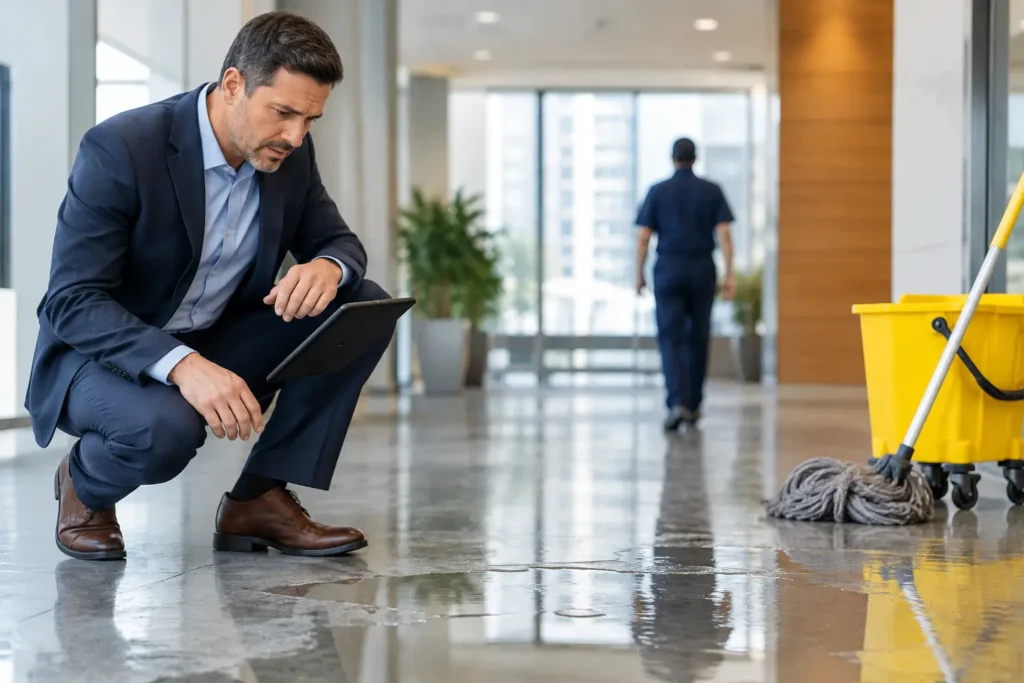
A burst supply line above a tenant suite can turn from a maintenance issue into a business interruption in minutes. This commercial water loss response guide gives property managers and owners a clear order of operations: protect people, stop the source when safe, document conditions, and begin professional drying before moisture spreads behind finishes.
Water does not stay where it first appears. It can travel through wall cavities, under flooring, above suspended ceilings, and into electrical systems. A quick mop-up may make the space look better while hidden moisture continues damaging materials, supporting mold growth, and extending downtime. The first decisions made on site determine how much of the building, inventory, and operating schedule can be protected.
The first hour: secure people before property
Start with life safety. Keep employees, customers, tenants, and visitors away from wet areas, especially where water may have reached outlets, panels, equipment, or ceiling tiles. If a ceiling is sagging, do not stand beneath it or attempt to puncture it. If the water source cannot be isolated safely, or if electrical hazards are present, contact the appropriate utility or emergency professional.
If it is safe to do so, shut off the local fixture valve or building water supply. For a roof leak during a storm, move people and vulnerable contents away from the affected area, then use temporary containment only if conditions allow. Do not send untrained staff onto a wet roof, into standing water near power, or into a structurally compromised space.
Assign one person to coordinate the response. In a larger facility, that may be the property manager, facilities director, or designated building engineer. A single point of contact prevents mixed instructions, missed updates, and confusion with tenants, vendors, and insurers.
Commercial water loss response guide: what to document
Before extraction begins, capture the condition of the loss. Take wide photos that show the room and close photos of affected finishes, equipment, furnishings, inventory, and visible source of water. Record the time the loss was discovered, who reported it, when the source was shut off, and which areas may be affected.
This record supports the insurance claim, but it also helps restoration professionals build an accurate drying plan. Note whether the water came from a clean supply line, a dishwasher or toilet overflow, a roof opening, a drain backup, or an exterior flood event. The source changes the safety controls, cleaning requirements, and what materials may need to be removed.
Keep invoices, emergency service authorizations, tenant communications, and a log of business interruption impacts in one file. For retail, office, medical, hospitality, and multifamily properties, those impacts may include closed areas, canceled appointments, lost revenue, temporary relocation, or added labor. Good documentation makes the claim easier to explain and gives ownership a clearer picture of the actual loss.
Stop spread and protect critical operations
Once the area is safe, protect what can be moved without creating risk. Elevate boxes and furnishings off wet flooring, relocate electronics and paper records, and move stock to a dry location. Avoid dragging saturated furniture across unaffected carpet or flooring, which can spread contamination and moisture.
For an occupied commercial building, the response plan should account for continuity. Can the affected suite be isolated while the rest of the facility remains open? Can tenants work remotely or move temporarily to another area? Is there a safe route for customers and employees that does not cross the work zone? These are operational decisions, not just cleanup details.
Containment matters. A professional team may use barriers, negative air equipment, and controlled access to keep dust, odors, and contaminants out of unaffected spaces. This becomes especially important after sewage backups, stormwater intrusion, or water losses involving a potentially contaminated drain line.
Extraction and drying are not the same job
Removing standing water is urgent, but extraction alone is not restoration. Water can remain in carpet padding, subfloors, drywall, insulation, baseboards, cabinets, and framing after the visible surface is dry. Commercial-grade extraction equipment removes bulk water quickly, then dehumidifiers and air movers reduce moisture in affected materials and the surrounding air.
A proper response uses moisture meters and thermal imaging to identify water migration that cannot be seen. Technicians establish drying goals, take repeated readings, and adjust equipment as conditions change. That documentation matters because drying is complete when materials meet appropriate moisture targets, not when the room feels dry to the touch.
The right approach depends on the building and the water category. A clean-water supply line caught quickly may allow more materials to be dried in place. Water from a sewer backup or exterior flooding may require removal of porous materials and a higher level of cleaning and disinfection. Waiting to determine the source can lead to the wrong cleanup method and unnecessary exposure.
Avoid the shortcuts that create larger claims
Commercial losses often grow because someone tries to save time with the wrong fix. Opening windows may help in limited conditions, but Georgia humidity can add moisture to the building rather than remove it. Household fans may circulate air but do not provide the controlled dehumidification needed for structural drying.
Do not cover wet carpet with plastic, repaint stained drywall, or reinstall baseboards before moisture testing confirms the area is dry. Avoid using bleach as a catch-all response to mold or sewage contamination. It does not replace source removal, proper cleaning, or controlled drying, and it can create additional indoor air concerns when used improperly.
Another costly shortcut is delaying the insurance notification. Contact the carrier or broker early, provide factual information, and ask what emergency mitigation documentation is required. Emergency work should not wait for an adjuster when conditions are actively worsening, but clear records and communication protect everyone involved.
Coordinate tenants, vendors, and the insurance claim
Commercial property recovery is as much about communication as equipment. Tell tenants what happened, which areas are restricted, what steps are underway, and when the next update will be provided. Avoid promising a reopening time before moisture conditions, repairs, and safety requirements are known. A realistic update builds more trust than an optimistic date that changes.
Your restoration provider should be able to communicate with the insurer, provide moisture records and photos, and explain the scope of emergency mitigation. If demolition is necessary, ask how the affected area will be documented before materials are removed. If reconstruction is needed, determine early whether the same team can manage repairs, finishes, and any code-related upgrades. Using separate mitigation and construction vendors can work, but it adds handoffs at a time when accountability matters most.
For Metro Atlanta property owners, Elevated Operations can provide a 24/7 emergency response, IICRC-certified mitigation, moisture mapping, insurance coordination, and reconstruction through one recovery team. That continuity helps reduce delays between the initial water removal and the work required to return the space to service.
Build the plan before the next loss
The best time to prepare for a commercial water emergency is before water is moving through the building. Identify main and local shutoff valves, label them clearly, and make sure after-hours staff know who has access. Keep current contacts for ownership, facilities, key tenants, insurance representatives, plumbers, electricians, and a qualified restoration provider.
Review high-risk areas regularly: mechanical rooms, kitchens, restrooms, sprinkler risers, vacant suites, roof drains, and spaces below aging plumbing. A small recurring leak, a slow drain, or staining around a ceiling penetration deserves attention before it becomes an overnight loss.
When water enters a commercial property, speed matters, but disciplined action matters more. Protect the people in the building, preserve the evidence, and bring in qualified help before hidden moisture turns an interruption into a long-term repair problem.