
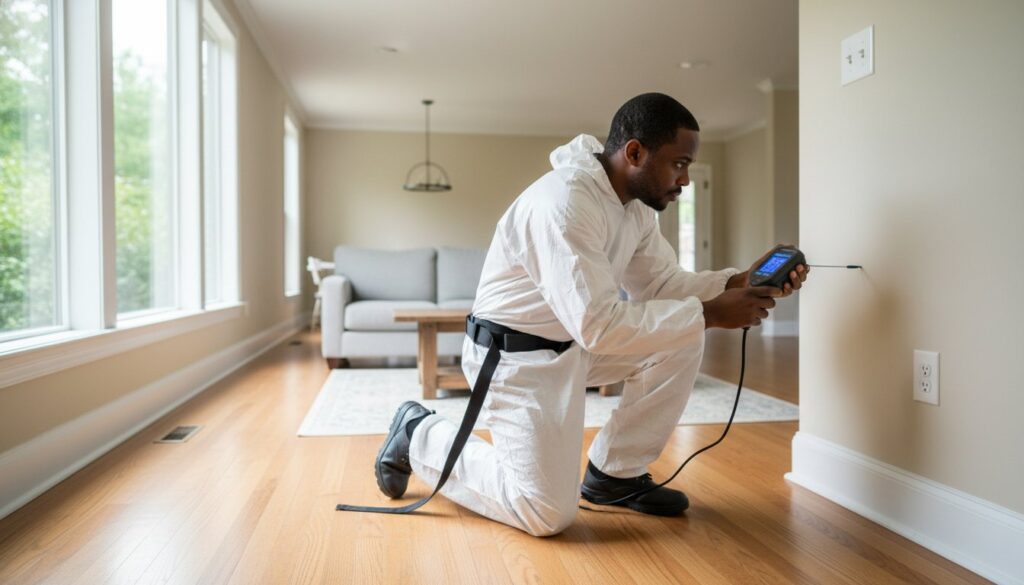
The discovery of black mold within your property is more than a maintenance issue; it’s a significant disruption that can compromise your family’s health, your home’s structural foundation, and your peace of mind. The path forward can seem obscured by anxiety over structural integrity and confusion about insurance coverage in Cobb County. This is where a methodical, professional plan for black mold removal in Austell becomes not just a service, but a critical roadmap to restoring order and safety.
This guide is designed to provide that strategic clarity. We will move beyond the initial alarm, presenting a structured framework for identifying the contamination, executing a professional remediation, and navigating your insurance claim successfully. You will gain the insights needed to not only eliminate the immediate threat but also to optimize your property’s infrastructure, ensuring a secure, healthy, and resilient living environment for the future. Consider this your definitive plan for total property restoration.
Key Takeaways
- Understand the “Austell Humidity Factor” and why a strategic approach is essential to protect your property’s foundational health from recurring mold.
- Learn why common DIY methods like bleach can actually worsen a mold problem and why professional remediation offers a superior long-term ROI.
- Uncover the strategic roadmap to professional black mold removal austell residents can use, from forensic inspection to building a robust insurance claim.
- Explore the “Ash to Asset” philosophy that moves beyond simple mitigation to strategically reconstruct and elevate your property’s value after mold damage.
Understanding the “Austell Humidity Factor”: Why Black Mold Thrives in Cobb County
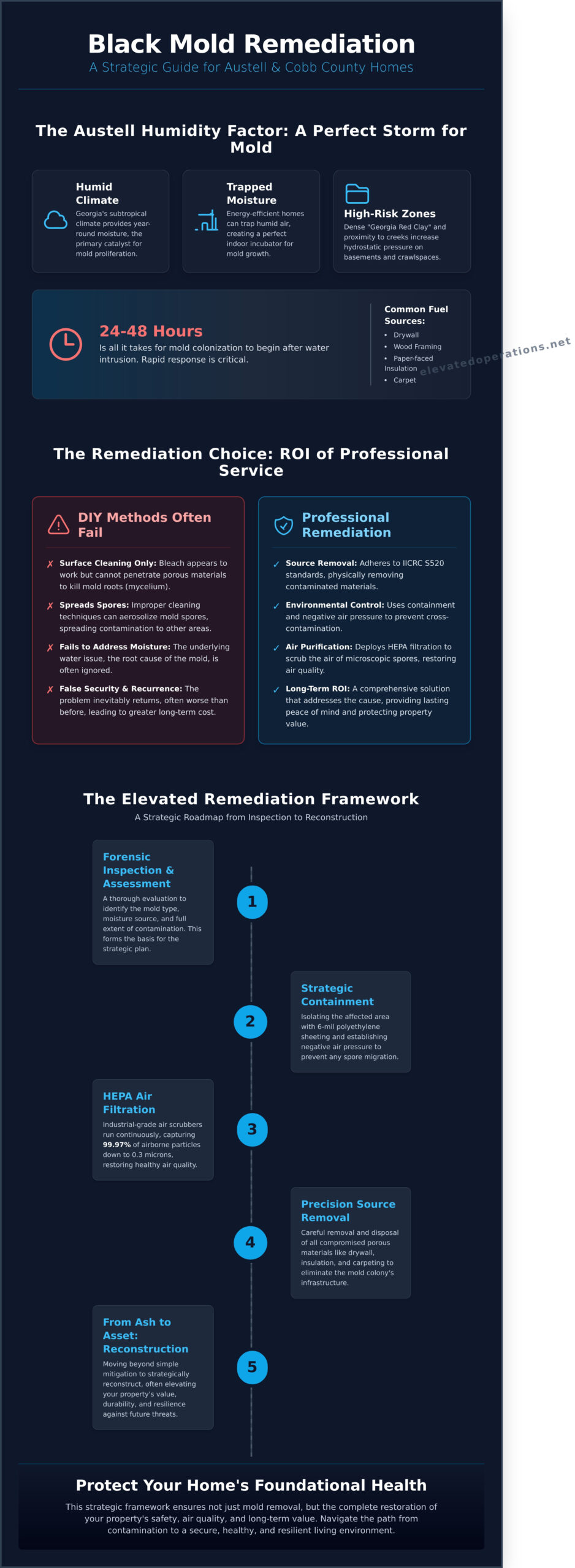
Austell’s position within Georgia’s humid subtropical climate zone creates a persistent environmental pressure on local homes. This constant moisture in the air is the primary catalyst for mold proliferation, a problem that goes far beyond simple mildew. The most significant threat is toxigenic mold, specifically Stachybotrys chartarum (black mold), which requires a consistent source of moisture to colonize. In Cobb County, that moisture is an abundant, year-round resource, turning indoor air quality into a major concern for homeowners.
Ironically, modern home infrastructure, designed for energy efficiency, can exacerbate the issue. Tightly sealed windows and high-performance insulation are excellent for temperature control but can inadvertently trap humid air inside. Without a robust and properly maintained ventilation or dehumidification system, this trapped moisture creates a perfect incubator for mold growth, compromising the very structure intended to protect your family.
The Science of Mold Growth in Georgia Residences
Following any water intrusion-a roof leak, a burst pipe, or even a minor appliance failure-a critical countdown begins. Mold colonization can start within a 24-48 hour window, a rapid timeline that often surprises property owners. The organic materials used to build our homes, such as drywall, wood framing, and paper-faced insulation, become a nutrient-rich fuel source once damp. This combination of moisture and food allows for rapid and often hidden proliferation. Mold spores are opportunistic organisms that require a strategic moisture-control response.
Austell Hotspots: From Sweetwater Creek to Local Basements
The local geography plays a significant role. Proximity to bodies of water like Sweetwater Creek contributes to elevated ambient humidity, which directly impacts the dew point inside your home and leads to condensation on pipes, windows, and cool concrete surfaces. This is particularly challenging in Austell’s older neighborhoods, where original grading and drainage systems may be insufficient. Furthermore, the infamous “Georgia Red Clay” soil is dense and retains water, creating relentless hydrostatic pressure against basement foundations and crawlspaces. These high-risk zones become prime targets for water seepage and, consequently, severe mold infestations, making professional assessment essential for effective black mold removal in Austell.
The Elevated Remediation Framework: Moving Beyond Surface Cleaning
Effective mold remediation is not a simple cleaning task; it is a strategic operation. Many homeowners mistakenly believe that spraying a bleach solution is enough, but this only addresses the visible symptoms. It fails to eliminate the microscopic spores and the underlying moisture problem that serves as the colony’s foundation. Our approach, The Elevated Remediation Framework, moves beyond surface-level tactics to dismantle the entire mold ecosystem. We don’t just kill mold; we architect a comprehensive solution that ensures it doesn’t return, adhering strictly to the rigorous IICRC S520 standards for professional mold remediation. This methodology is designed to restore not only your property but also its most critical, unseen asset: its air quality.
Strategic Containment and HEPA Filtration
The first step in any successful black mold removal in Austell is to establish absolute control over the environment. Our technicians construct a precisely engineered containment zone using heavy-duty, 6-mil polyethylene sheeting. This creates a physical barrier that isolates the affected area. We then establish a negative air pressure environment within this zone, ensuring that contaminated air cannot escape into unaffected parts of your home. This disciplined setup is a clear visual indicator of a professional operation. To elevate the air quality itself, we deploy industrial-grade HEPA (High-Efficiency Particulate Air) scrubbers that run continuously, capturing 99.97% of airborne particles, including mold spores as small as 0.3 microns.
Precision Removal and Antimicrobial Foundation
Our philosophy is centered on complete source removal. Porous materials like drywall, insulation, and carpet that have been compromised are carefully removed and discarded according to industry protocols. Simply cleaning these surfaces is ineffective, as the mold’s root-like structures (mycelium) are often embedded deep within. This source-removal approach is a core principle of effective remediation, as detailed in the comprehensive EPA guide to mold cleanup, because it eliminates the colony’s infrastructure. Once contaminated materials are gone, we apply an EPA-registered antimicrobial treatment to the remaining structural elements. This crucial step neutralizes any remaining spores and inhibits future growth. Finally, we implement a structural drying process to ensure moisture levels are returned to normal, creating a stable and optimized foundation for safe reconstruction.
The ROI of Professional Remediation: Why DIY Often Fails in Georgia Homes
The primary barrier for many homeowners is the perceived cost of professional services. However, viewing expert remediation as a capital investment rather than an expense reveals its true, long-term value. A DIY approach, while seemingly cost-effective initially, often creates a cycle of recurring problems and hidden costs. A prime example is the pervasive “Bleach Myth”-the belief that household bleach eradicates mold. While bleach may decolorize surface mold, its high water content actually feeds the mold’s root system within porous materials like drywall and wood, often exacerbating the underlying infestation.
The Hidden Risks of Incomplete Mold Removal
Amateur attempts frequently disturb mold colonies, releasing millions of spores into your HVAC system and leading to widespread cross-contamination. This creates a significant operational bottleneck, as the core issue-the moisture source-is rarely addressed, guaranteeing regrowth. Such efforts fall critically short of the containment and removal protocols found in the EPA guidelines for mold cleanup, creating substantial liability risks, especially for Austell landlords and property managers. A failed DIY job often leaves behind clear warning signs:
- A persistent, musty odor that returns days after cleaning.
- Visible spots or discoloration reappearing in the same or adjacent areas.
- New instances of peeling paint, bubbling wallpaper, or warped drywall.
Health Infrastructure: Protecting Your Household Ecosystem
Effective remediation is about more than just aesthetics; it is about rebuilding your home’s health infrastructure. While not all species of black mold produce mycotoxins, prolonged exposure can pose health risks, particularly for vulnerable residents like children, the elderly, or those with compromised immune systems. Our comprehensive strategy for black mold removal in Austell is designed to restore your home’s entire ecosystem. We don’t just remove a stain; we elevate your property back to a foundation of safety, providing a protective layer that ensures the well-being of your family.
Beyond biological threats like mold, a truly healthy home is free from all environmental stressors. For those interested in a holistic approach to home wellness that addresses issues like electrosmog and geopathic radiation, you can discover Radiation-Free Living.
Ultimately, professional certification provides documented proof of proper remediation-a critical asset when selling a property in the competitive Metro Atlanta market. It transforms a potential liability into a testament of responsible ownership, protecting your investment and ensuring lasting peace of mind.
Navigating the Restoration Roadmap: From Inspection to Insurance Claims
Successful mold remediation is not just about demolition; it is a meticulously planned operation. We approach every project with a five-phase roadmap designed to restore your property’s structural integrity and ensure a seamless insurance process. This strategic framework provides a clear trajectory from initial audit to final reconstruction, returning your home to a safe and healthy environment.
Our proven process includes:
- Step 1: The Strategic Audit – Professional mold testing and moisture mapping.
- Step 2: Documentation – Creating a forensic paper trail for the insurance carrier.
- Step 3: Execution – Implementing the remediation and stabilization plan.
- Step 4: Clearance – Post-remediation verification (PRV) testing.
- Step 5: Restoration – Transitioning into the reconstruction phase.
Professional Assessment and Moisture Mapping
Before any materials are removed, we conduct a strategic audit. Using advanced tools like thermal imaging cameras and digital moisture meters, our technicians map the hidden moisture pathways behind walls and under floors. This data creates an accurate “roadmap” of the water damage, identifying the source and full extent of the problem. This forensic-level detail is crucial; it provides the undeniable evidence needed to justify the full scope of work to your insurance adjuster.
Strategic Insurance Coordination for Austell Homeowners
Navigating an insurance claim can be more complex than the remediation itself. In Georgia, policies often hinge on whether the damage was “sudden and accidental” versus “gradual.” We act as your advocate, providing meticulous documentation-from moisture maps to photographic evidence-that builds a robust case for your claim. Our team helps you communicate effectively with adjusters, ensuring the focus remains on restoring your property to its pre-loss condition, not just a minimal repair.
This structured approach ensures that every step, from containment to reconstruction, is handled with precision. For a comprehensive approach to black mold removal in Austell, a clear roadmap is the foundation of success. Discover how a strategic partner can elevate your restoration project and protect your investment.
From Mitigation to Reconstruction: Elevating Your Home’s Foundation
Many companies treat mold remediation as a single, isolated task. At Elevated Operations, we see it as the first step in a comprehensive property transformation. Our “Ash to Asset” philosophy dictates that we don’t just return your home to its previous state; we elevate its foundational integrity. Choosing a single partner to manage the entire ecosystem-from mitigation to final reconstruction-eliminates communication bottlenecks and ensures a cohesive, strategic vision for your property’s future.
Full-Scale Property Reconstruction Services
A successful black mold removal Austell project doesn’t end when the mold is gone. We transition your property from a stabilized site back into a beautiful, fully functional home. Our in-house artisans provide a full suite of reconstruction services tailored to your needs, including:
- Custom Carpentry: Meticulously restoring structural elements, trim, and custom finishes.
- Flooring Installation: Expertly laying everything from classic hardwood to modern luxury vinyl plank.
- Professional Painting: Applying premium finishes that align with Austell’s distinct home styles.
Our objective is not just repair; it’s to deliver a property that is safer, more resilient, and more valuable than before the damage occurred.
Future-Proofing: Moisture Control and Trajectory
True restoration involves optimizing your home’s infrastructure to prevent future issues. We analyze your property’s moisture trajectory to identify and eliminate vulnerabilities. This proactive approach includes installing permanent dehumidification systems and implementing crawlspace encapsulation to control ground-level humidity. Furthermore, we optimize attic ventilation to prevent the moisture bottlenecks that often lead to mold growth. By addressing the root cause, we set your home on a new, resilient trajectory. For a deeper look into this process, explore our guide on Atlanta Property Reconstruction: What You Need to Know.
By integrating mitigation and reconstruction, we provide a seamless, elevated experience that protects your most valuable asset. When you need a partner for black mold removal Austell homeowners trust, look to the team that sees the complete picture.
Elevate your property restoration today with a professional consultation.
Elevate Your Property Beyond Remediation: Your Strategic Next Steps
Navigating a black mold infestation requires a strategic approach, not just a superficial fix. As we’ve outlined, the unique humidity of Cobb County demands a professional framework that moves beyond simple cleaning. For comprehensive black mold removal austell homeowners can trust, a commitment to a full restoration roadmap-from meticulous inspection to final reconstruction-is not merely a repair; it is a critical investment in your property’s long-term health and foundational integrity.
With over 20 years of executive restoration experience and a team of IICRC Certified Remediation Specialists, Elevated Operations is prepared to lead this charge. Our 24/7 emergency response in Metro Atlanta ensures we are always ready to deploy a strategic solution for your property. Do not let mold compromise your foundation. Contact Elevated Operations for a Strategic Mold Assessment in Austell and begin the process of restoring your property with confidence. Your path to a secure, healthy, and elevated home starts now.
Frequently Asked Questions About Black Mold Removal
Is black mold removal covered by home insurance in Austell, GA?
Coverage for mold removal is contingent upon the source of the moisture. Most standard homeowner policies in Georgia cover mold damage if it results from a “covered peril,” such as a sudden pipe burst. However, mold stemming from gradual leaks, high humidity, or lack of maintenance is typically excluded. We recommend a thorough review of your specific policy and can provide the necessary documentation to support your claim when the damage is covered.
How much does professional mold remediation cost in Cobb County?
The cost of professional mold remediation in Cobb County varies based on the scope of the project. A small, contained area might cost $500-$1,500. More extensive contamination in a basement or crawlspace can range from $2,000 to $6,000 or more, especially if structural materials require removal. A detailed inspection is the foundational step to providing a precise and transparent estimate for your property.
Can I stay in my home during the black mold removal process?
Whether you can remain in your home depends on the location and extent of the mold infestation. For small, isolated projects, you can often stay by avoiding the contained work area. However, if the contamination is widespread or affects your HVAC system, we strongly advise temporary relocation. This ensures your safety from airborne spores and allows our technicians to work with maximum efficiency to restore your home’s air quality.
How long does it take to complete mold remediation and reconstruction?
The timeline is a function of the project’s complexity. The initial mold remediation phase-which includes containment, removal, and cleaning-typically takes one to five days. The subsequent reconstruction phase, which involves replacing drywall or other materials, will extend this timeline. We provide a clear project roadmap after our initial assessment, ensuring you have a predictable schedule from start to finish so you can plan accordingly.
What is the difference between mold mitigation and mold restoration?
These terms define two distinct phases of a single, comprehensive process. Mold mitigation is the immediate action taken to stop further damage; it involves containing the area, removing contaminated materials, and cleaning affected surfaces. Mold restoration is the subsequent phase of rebuilding and repairing the property. We mitigate the problem first, then we restore your home to its original, pre-damage condition, ensuring a complete and lasting solution.
How do I know if I have black mold or just “mildew” in my basement?
While both are fungi, their appearance and implications differ. Mildew is typically a surface-level fungus, appearing gray or white with a powdery texture. “Black mold,” such as Stachybotrys chartarum, often appears slimy or fuzzy and is dark green or black, suggesting a more significant water issue. Regardless of the type, any visible growth indicates a moisture problem that requires a professional assessment to prevent further degradation.
What certifications should I look for in an Austell mold removal company?
When selecting a partner for black mold removal Austell homeowners can trust, verify their credentials. The most critical certification is from the Institute of Inspection, Cleaning and Restoration Certification (IICRC), specifically the Applied Microbial Remediation Technician (AMRT) designation. This ensures the company adheres to the highest industry standards for safety, containment, and effective remediation protocols. Proper licensing and insurance are also non-negotiable foundational requirements.
Does black mold come back after professional remediation?
Professional mold remediation, when executed correctly, removes the existing mold colonies entirely. However, mold will return if the underlying moisture problem that caused it is not resolved. A core component of our strategic process is identifying and addressing the water source-whether a leak or humidity issue. By eliminating the moisture, we ensure the foundation for a permanently mold-free environment, protecting your investment for the long term.