
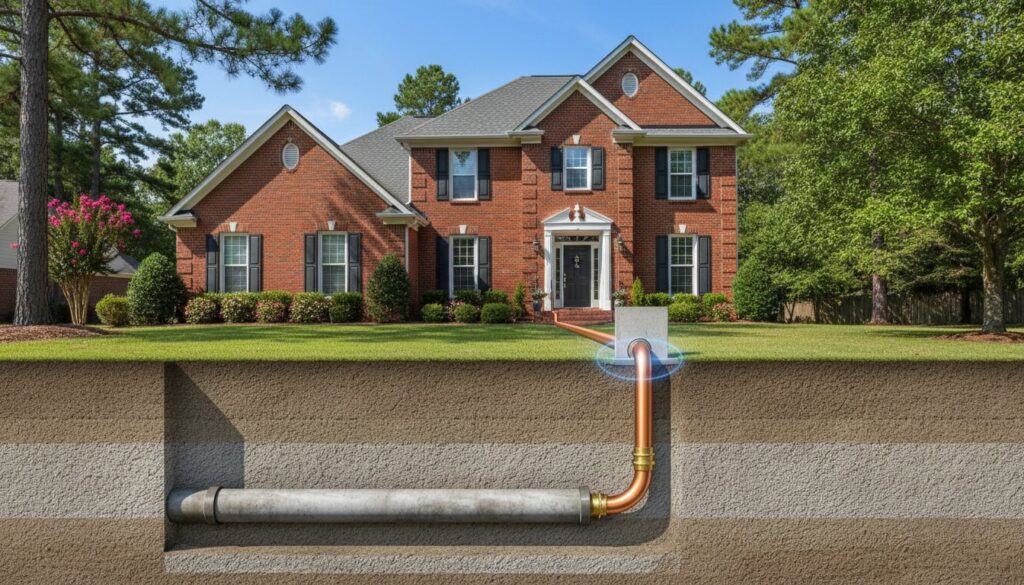
In 2026, statistics indicate that 65% of local property owners remain unaware they’re financially responsible for the service lines connecting their homes to the municipal main. This hidden infrastructure often remains ignored until a crisis forces a sudden, expensive confrontation with your austell water utility. You’ve invested significant capital and effort into your home; a lack of operational clarity shouldn’t put that foundation at risk.
We understand that managing utility shut-offs and property flooding feels like leading an organization through a period of unmitigated chaos. It’s a high-pressure environment where every minute of delay can increase restoration costs by an average of $200. This guide provides a strategic framework to help you regain control. We’ll outline the exact contact protocols for the city, define the limits of your liability, and provide a professional roadmap to elevate your property with executive precision.
Key Takeaways
- Identify the primary contact points and billing protocols for the austell water system to manage your utility infrastructure with professional clarity.
- Delineate the demarcation point between city-maintained lines and private liability to proactively protect your property from unexpected maintenance gaps.
- Implement a strategic roadmap for water damage emergencies, focusing on the vital 24-hour window required to stabilize your property’s structural trajectory.
- Leverage the “Operations as the Foundation” approach to partner with a restoration expert who treats property recovery as a high-level strategic project.
Austell Water Utility Essentials: Billing and Contact Information
A robust municipal infrastructure requires more than just pipes; it demands clear communication and precise administrative oversight. The austell water system serves a targeted ecosystem of approximately 3,300 customers, acting as the local distributor for resources sourced through the Cobb County-Marietta Water Authority. This strategic partnership ensures that while the water travels through regional infrastructure, the management remains local and accessible to the community.
Administrative operations reside at City Hall. Residents can reach the utility billing department at (770) 944-4300 to resolve account discrepancies or verify current rates. Maintaining this direct line of communication helps prevent small billing errors from escalating into larger operational bottlenecks. The city’s staff provides the necessary clarity for founders and residents who need to understand the mechanics of their local utility ecosystem.
Efficiency relies on timely contributions. A 10% late charge applies to any balance not settled by the monthly due date. It’s a standard fiscal safeguard that ensures the system’s continued scalability. If an account remains delinquent beyond the established grace period, the city initiates disconnection protocols. These measures aren’t merely punitive; they’re essential for maintaining the financial foundation of the city’s water infrastructure.
Online Bill Payment and Account Management
Managing your austell water account in 2026 is streamlined through the official Austell GA online payment portal. This digital interface offers electronic bill presentment, allowing users to audit their usage history and trajectory from any device. Payments made via VISA or MasterCard incur a standard convenience fee, while electronic checks provide a reliable alternative for monthly optimization. Switching to paperless billing doesn’t just save resources; it provides a real-time roadmap of your utility expenses.
New Service and Disconnection Procedures
Establishing a new connection requires a structured approach to ensure the operational foundation is set correctly from day one. New residential and commercial applicants must provide a valid government ID and a signed lease or deed at City Hall. Deposit fees are calculated based on the service type and account history. When moving, customers should request a final meter reading at least 48 hours in advance. This ensures a clean handoff and prevents the outgoing tenant from being held responsible for future consumption.
City Responsibility vs. Homeowner Liability in Austell
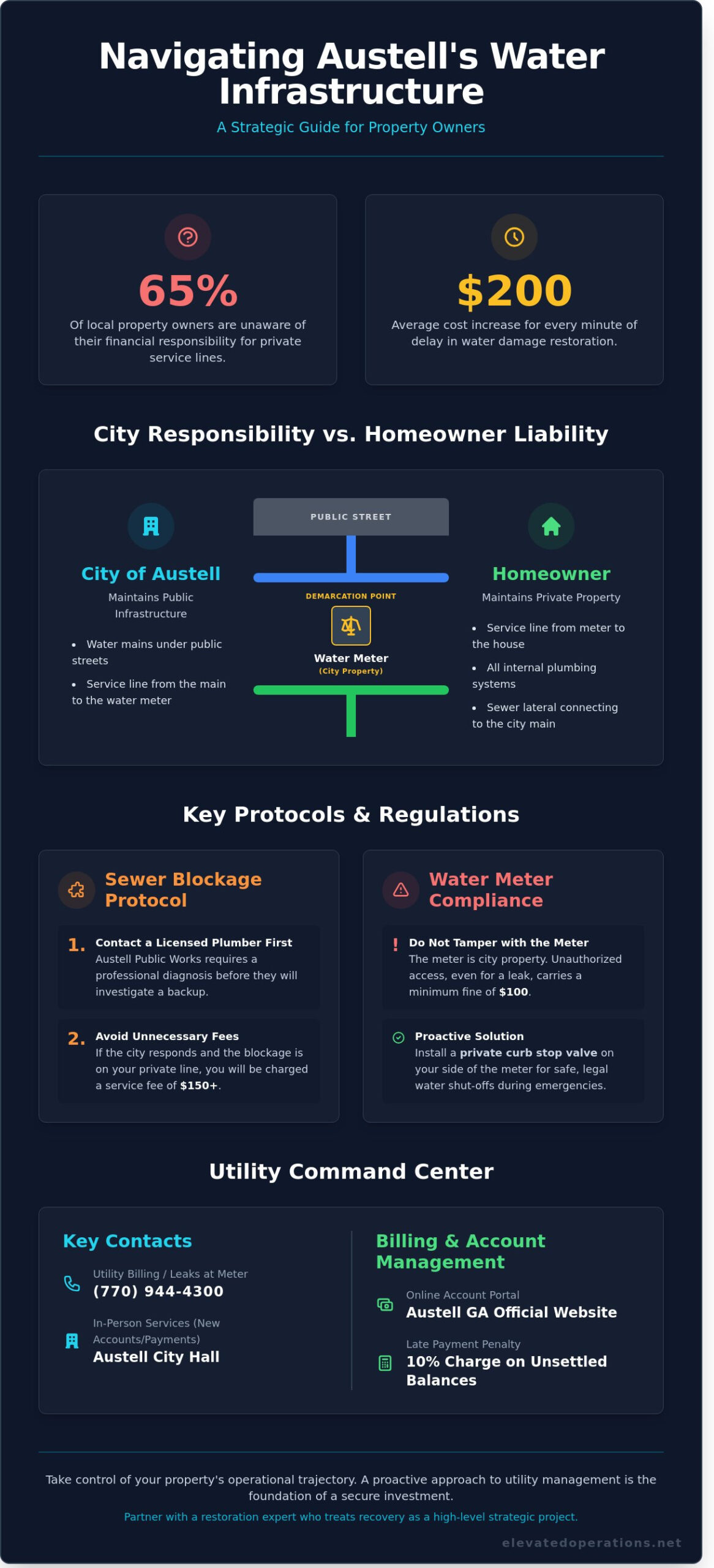
The infrastructure of austell water systems relies on a clear demarcation point. This boundary dictates who pays when a pipe fails. The City of Austell maintains the main lines under public streets and the service line up to the water meter. Once the line crosses that meter toward your home, the financial burden shifts to the property owner. This responsibility includes the service line, all internal plumbing; and the sewer lateral connecting to the city main.
In subdivisions established within the last five years, developers typically manage the infrastructure under a maintenance bond. Once this bond expires, usually after 24 months, the city assumes the public lines. However, the homeowner’s liability for the private portion remains constant. When a breach occurs on the private side, the law requires a certified plumber or a restoration expert to handle the repairs. This ensures the work meets the 2024 Georgia State Minimum Standard Plumbing Code. Establishing a relationship with a professional before a crisis occurs helps you maintain a stable operational trajectory for your property.
The Sewer Blockage Protocol
Austell Public Works requires residents to contact a licensed plumber before requesting city assistance for a sewage backup. This protocol ensures that the blockage isn’t located within the private lateral line. If the city responds and determines the issue exists on private property, the homeowner faces a service fee, often exceeding $150 per call. A professional assessment provides the necessary data to determine if the city ecosystem is at fault or if a private restoration expert is required to stabilize the property. It’s a structured approach that prevents unnecessary city expenditures while identifying the root cause of the bottleneck.
Water Meter Tampering and Compliance
The water meter is city property. Unauthorized access, even to shut off water during a leak, carries legal risks. Austell Municipal Code Section 12-21 mandates a minimum fine of $100 for tampering with city infrastructure. Property owners should install a private curb stop valve on their side of the meter to manage their own shut-offs safely. If you notice a leak at the meter, report it to the Austell Water Department at 770-944-4300. Taking a proactive approach to infrastructure management helps elevate your property’s operational health and prevents costly regulatory friction. This strategy allows you to focus on high-level property maintenance rather than navigating avoidable legal penalties.
Managing Water Damage Emergencies in Austell, GA
Property owners in Austell face distinct environmental challenges that can compromise structural integrity. Data from 2024 indicates that burst pipes and slab leaks account for 28% of local water damage claims, often occurring during the unpredictable Georgia freeze-thaw cycles. Severe weather events, such as the intense spring storms of 2025, frequently lead to flash flooding and external water intrusion. We treat these incidents as critical infrastructure failures. The first 24 hours represent a vital window for intervention. If you fail to stabilize the environment within this timeframe, the probability of irreversible structural rot and microbial growth increases by nearly 70%.
Elevated Operations provides a 24/7 emergency response framework designed to manage austell water emergencies with executive-level precision. We don’t simply extract water; we implement a strategic recovery roadmap. Our team audits the site, identifies the source of the breach, and deploys the necessary resources to stabilize your property’s trajectory. This structured approach ensures that the immediate chaos doesn’t evolve into a long-term operational bottleneck for your home or business. Effective austell water mitigation requires a partner who understands that speed must be matched by technical accuracy.
Emergency Water Extraction and Drying
Rapid extraction is the foundation of any successful restoration project. Our technicians utilize industrial-grade pumps capable of moving 50 gallons per minute to clear standing water. Once the surface water is removed, we apply the science of structural drying. We deploy high-velocity air movers and LGR dehumidifiers to pull moisture from deep within the building’s ecosystem. We monitor moisture levels in porous materials like drywall and flooring daily, targeting a specific dry-standard of 10% to 12% to ensure a total dry-out.
Identifying Different Water Categories
Strategic mitigation depends on an accurate assessment of water quality. We categorize water into three distinct tiers to determine the necessary safety protocols:
- Category 1 (Clean): This water originates from sanitary sources, such as broken supply lines or sink overflows. It poses the lowest risk but can degrade quickly.
- Category 2 (Gray): This includes discharge from washing machines or dishwashers. It contains chemical or biological contaminants that require specialized handling.
- Category 3 (Black): This is grossly unsanitary water from sewage backups or rising floodwaters. These scenarios are treated as biohazard emergencies requiring rigorous disinfection.
By identifying these categories early, we elevate the safety standards of the restoration process. Our goal is to move your property from a state of crisis to a stabilized, healthy environment through disciplined execution and technical expertise. We focus on the granular details so you can focus on the big picture of your recovery.
The Restoration Roadmap: From Mitigation to Reconstruction
Restoration isn’t a series of random tasks. It’s a controlled sequence of engineering and hygiene. When austell water breaches your property’s perimeter, the first 60 minutes determine the final cost of recovery. Our team begins with a rigorous safety inspection. We check for structural integrity and electrical hazards before any equipment enters the site. We audit the damage, identify the moisture source, and implement a high-capacity extraction plan to remove standing water immediately.
Efficiency matters here. We utilize industrial-grade dehumidifiers and air movers to stabilize the environment. Following IICRC S500 standards, we sanitize every affected surface to eliminate pathogens and bacteria. This isn’t just about drying; it’s about restoring a healthy ecosystem. Once the environment is dry and sterile, we move to the final reconstruction phase. We ensure your home or office returns to its pre-loss condition with zero operational bottlenecks.
- Initial Assessment: Thermal imaging and moisture mapping to identify hidden pockets of intrusion.
- Stabilization: Rapid extraction and humidity control to prevent secondary damage.
- Sanitization: Application of antimicrobial treatments to all porous and non-porous surfaces.
- Reconstruction: Structural repairs that align with the original architectural vision.
Strategic Mold Remediation After Leaks
Georgia’s 70% average humidity creates an ideal incubator for fungal growth. Mold spores can colonize porous materials within 48 hours of an initial leak. We deploy strict containment strategies, using HEPA filtration and physical barriers to prevent cross-contamination during the cleaning process. If you suspect your property’s health is compromised, review our guide on mold remediation in Mableton and Austell to understand the strategic path forward. Speed is the only defense against microbial escalation.
Navigating Insurance Claims in Georgia
Recovering from austell water damage requires precise administrative execution. Most Georgia policies cover “sudden and accidental” events, but they require robust evidence to trigger a payout. We provide the digital photo documentation and moisture mapping reports that adjusters need to approve your claim. We act as your strategic partner, ensuring no detail is overlooked during the filing process. To master the paperwork, consult our property damage insurance claim guide for local homeowners. We help you bridge the gap between damage and reimbursement.
Elevate your property recovery strategy by partnering with our professional restoration team today.
Elevated Operations: Austell’s Strategic Recovery Partner
When an infrastructure failure occurs, the path to restoration requires more than just a quick fix; it demands a strategic roadmap. Elevated Operations approaches every austell water emergency with the precision of a seasoned executive. We believe that operations serve as the foundation for recovery. This philosophy ensures that your property isn’t just dried out but is strategically restored to a state of long-term stability. For over 22 years, we’ve served the Cobb County community, bringing a level of executive oversight to the restoration industry that national franchises often fail to provide.
Why a Local Partner Matters
Proximity dictates the success of any emergency response. We maintain a 60-minute response window for Austell, Mableton, and Powder Springs. This speed ensures that water intrusion is contained before structural integrity is compromised. Our team has spent two decades navigating the specific municipal requirements and building codes unique to the local area. This deep-rooted expertise allows us to bypass the common bottlenecks that delay progress in larger, less agile organizations. You’re never a case number in a distant database. You’re a local partner receiving personalized, high-level attention from a team that understands the local landscape.
Comprehensive Property Reconstruction
True recovery goes beyond the initial extraction and drying phase. While many companies stop once the moisture meters hit zero, we view mitigation as only the first phase of the restoration ecosystem. Our team manages the entire trajectory from initial damage assessment to final craftsmanship. We specialize in reconstruction services in Atlanta and Austell, ensuring that every repair enhances the property’s market value. We audit the damage, optimize the repair schedule, and implement high-quality finishes that exceed original standards. This integrated approach eliminates the need for multiple contractors, providing a seamless transition from operational chaos to a fully restored structure.
We don’t just repair walls; we rebuild the foundation of your home or business with an eye toward future scalability and resilience. Our commitment to excellence means utilizing materials that withstand the test of time and local environmental factors. By choosing a partner that handles both the cleanup and the rebuild, you ensure a consistent vision and a higher standard of accountability throughout the project.
Don’t let an austell water crisis derail your stability. You need a partner who understands the mechanics of a professional restoration and the importance of a structured recovery plan. We invite you to experience a process that is as organized as it is effective. Contact Elevated Operations immediately for emergency assistance and a strategic assessment of your property. Our team is ready to lead the charge in your recovery, providing the calm authority you need to move forward with confidence.
Securing Your Property Trajectory in 2026
Navigating the complexities of austell water utilities and property liability requires a proactive strategy rather than a reactive scramble. You’ve now identified the critical boundaries between city responsibility and homeowner obligations, alongside the essential steps for immediate emergency mitigation. At Elevated Operations, we apply over 20 years of restoration experience to transform chaotic damage into a structured recovery roadmap. Our IICRC Certified Technicians prioritize precision, ensuring every phase of your restoration meets rigorous industry standards. We handle the heavy lifting of comprehensive insurance documentation support, which removes the administrative bottlenecks that typically slow down property reconstruction. It’s about more than just fixing a leak; it’s about restoring the operational integrity of your home or business with a partner who understands the high stakes of property management. You don’t have to navigate the aftermath of a water crisis alone when professional expertise is a single step away.
Elevate your property recovery—Contact our 24/7 emergency team now.
Your property’s resilience is built on the decisions you make today, and we’re here to ensure those choices lead to a stronger, more stable foundation.
Frequently Asked Questions
How do I pay my Austell water bill online?
You can pay your austell water bill through the city’s secure municipal payment portal available 24 hours a day. This digital infrastructure streamlines your monthly obligations by accepting Visa, Mastercard, and electronic checks. Most residents complete this transaction in under 3 minutes; this ensures their utility foundation remains secure. If you prefer automated optimization, you can establish recurring payments to prevent late fees or service interruptions throughout 2026.
What should I do if I have a water leak in Austell after hours?
You must immediately contact the Austell Public Works emergency dispatch at 770-944-4320 for any leaks occurring outside of standard 8:00 AM to 5:00 PM business hours. This strategic response ensures that city technicians can isolate the external break before it compromises your property’s foundation. Quick action during the first 60 minutes of a burst pipe can reduce total restoration costs by approximately 40 percent.
Does the City of Austell fix leaks inside my house?
The City of Austell maintains the infrastructure only up to the water meter; repairs inside the home are the owner’s responsibility. This clear division of operational duties means any plumbing issues from the meter to the house fall under your private maintenance roadmap. We recommend auditing your internal pipes annually to identify vulnerabilities. Professional restoration partners can help you navigate these internal failures to elevate your home’s safety and structural integrity.
Why is my Austell water bill higher than usual this month?
A sudden spike in your austell water bill typically signals a silent leak or a 15 percent increase in seasonal irrigation. You should first perform a foundational check on your toilets, as a faulty flapper valve can waste 200 gallons of water per day. If your consumption data shows an unexplained 2,000 gallon jump, it’s time to hire a leak detection specialist to audit your underground lines.
Who do I call for a sewage backup in Austell, GA?
You should call the Austell Public Works Department at 770-944-4325 to report a sewage backup during the day or the police non-emergency line after hours. Their team will determine if the bottleneck exists within the city’s main line or your private lateral pipe. Identifying the source within 2 hours is critical to preventing biohazard contamination and protecting the long-term trajectory of your property value.
How long does the water restoration process take?
A standard water restoration project follows a 3 to 5 day timeline for the initial drying and stabilization phase. Once the environment is dry, the reconstruction phase typically requires an additional 7 to 14 days depending on the material availability. This structured approach ensures the structural ecosystem is fully remediated. Following this roadmap prevents secondary damage and helps elevate the safety standards of your living space.
Is mold coverage included in my Georgia homeowners insurance?
Most Georgia homeowners insurance policies include a limited mold endorsement that typically caps remediation coverage at $5,000. You must review your specific policy declarations page to see if you’ve opted for an elevated rider that increases these limits. Since mold can manifest within 48 hours of a leak, acting quickly is the most strategic way to stay within these foundational coverage boundaries.
Can I turn my own water off at the meter in an emergency?
You should use your home’s private main shut-off valve rather than the city’s meter to avoid a potential $150 fine for damaging municipal property. The city’s valve requires a specific curb key and is part of the public utility infrastructure. Locating your private shut-off valve is a vital step in your emergency preparedness plan. This simple execution allows you to stabilize the situation instantly without waiting for a city technician to arrive.