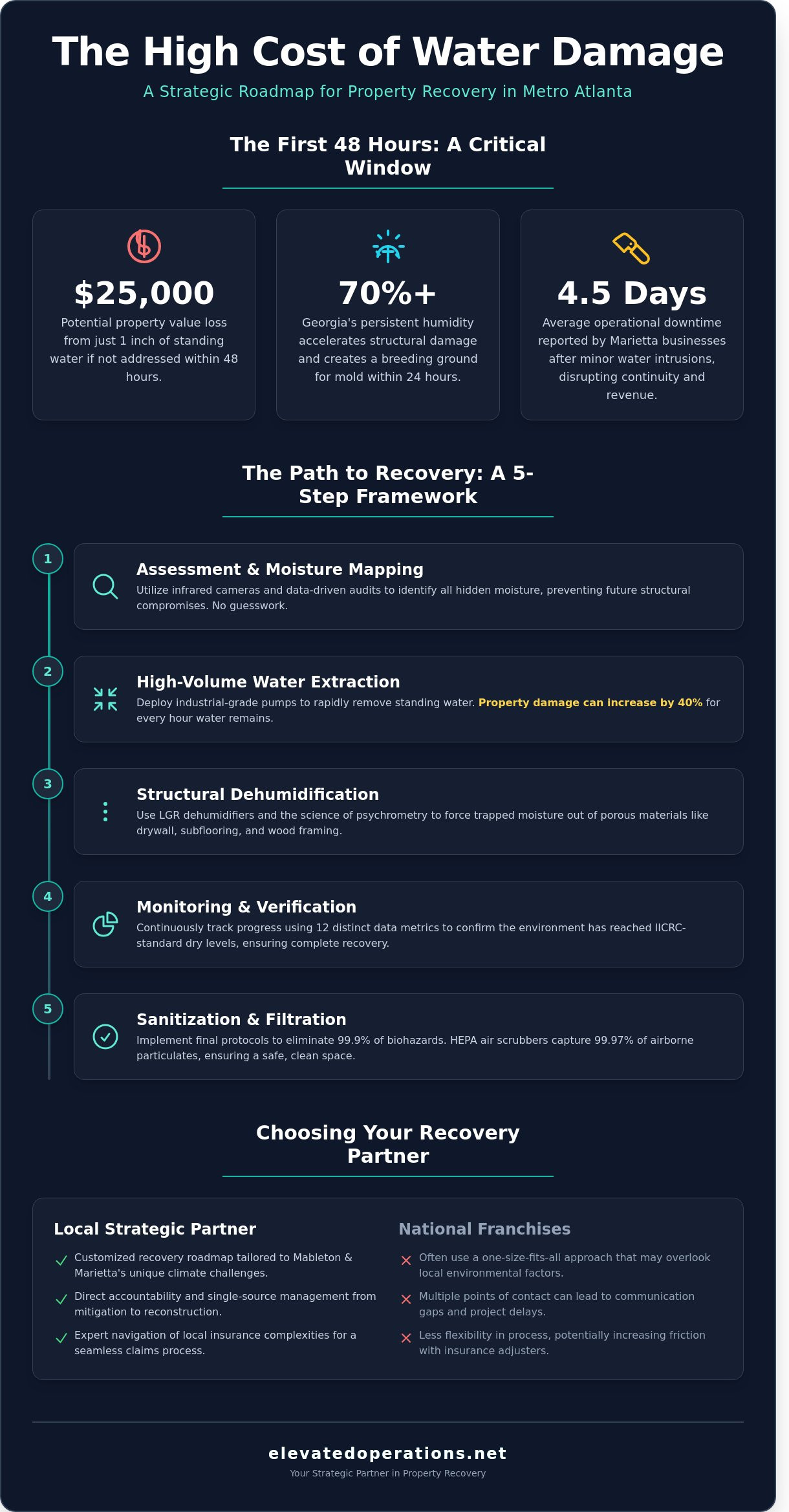
A single inch of standing water can trigger a $25,000 decline in property value within 48 hours if the recovery isn’t handled with executive-level precision. You likely recognize that Georgia’s persistent 70% humidity turns a minor leak into a structural liability almost overnight. The operational chaos of a flood is more than an inconvenience; it’s a direct threat to the very infrastructure that supports your long-term growth. We agree that the fear of hidden mold and the frustration of dense insurance paperwork are the primary bottlenecks to a successful recovery in Metro Atlanta.
Discover how professional water removal services and strategic structural drying protect your property’s foundation and long-term market value in Mableton and Marietta. This 2026 recovery roadmap provides a structured, professional path to complete water extraction and a seamless insurance claim process. We’ll examine the specific protocols required to elevate your property from a state of crisis to a stabilized, high-value asset that’s ready for future scaling.
Key Takeaways
- Understand why immediate professional intervention is non-negotiable for protecting your property’s structural infrastructure against Metro Atlanta’s unique humidity challenges.
- Explore a strategic framework for professional water removal services that utilizes advanced moisture mapping and industrial extraction to stabilize your environment.
- Discover the operational advantages of choosing a local strategic partner over national franchises to ensure accountability and a customized recovery roadmap.
- Learn how to navigate insurance complexities and IICRC standards through rigorous documentation that elevates the success of your recovery claim.
- Identify the benefits of a single-source partner who can manage the entire trajectory from initial mitigation to final reconstruction, reducing friction and restoring long-term value.
The Urgency of Professional Water Removal Services in Mableton & Marietta
Professional water removal services represent more than a simple cleanup effort; they’re a multi-stage strategic extraction and stabilization process designed to preserve your property’s core infrastructure. When water enters a structure, it doesn’t just sit on the surface. It migrates into porous materials, compromising the very foundation of the building’s operational health. A deep understanding water damage reveals that moisture creates a cascading failure within 24 hours if not addressed with precision. We view your home or office as a critical ecosystem where every component depends on a dry, stable environment to function. Without a structured response, the structural integrity of your property begins to erode immediately.
Local Environmental Risks in Cobb and Fulton Counties
Georgia’s climate presents unique challenges for property recovery. In Mableton and Marietta, dew points frequently exceed 70 degrees during summer months, which significantly slows natural evaporation and traps moisture inside wall cavities. Recent 2025 meteorological data shows that flash flooding near Nickajack Creek has increased by 18% due to aging infrastructure and urban runoff. This high-humidity environment means that DIY fans and shop-vacs simply aren’t enough. Within a strict 24-hour window, mold spores can colonize damp drywall, turning a minor leak into a massive structural liability. Professional water removal services utilize industrial-grade dehumidification to force moisture out of the air, stabilizing the local ecosystem before secondary damage takes hold.
Operational Impact of Water Intrusion
Water doesn’t just damage floors; it disrupts the continuity of your daily life and business operations. In 2024, local Marietta businesses reported an average of 4.5 days of total operational downtime following minor pipe bursts. Hidden threats often linger behind baseboards or within electrical conduits, posing long-term risks to safety and efficiency. Many property owners stop extraction when surfaces feel dry, yet precision moisture meters often show 22% or higher saturation in the subflooring. We audit the site, we stabilize the environment, and we implement a recovery roadmap that ensures your property is truly secure. Our goal is to elevate your recovery process from a chaotic emergency to a structured transition back to normalcy, ensuring your water removal services provide a permanent solution rather than a temporary fix.
The Elevated Process: A Strategic Framework for Water Extraction
Effective recovery isn’t a matter of chance; it’s a result of disciplined execution. We approach water removal services with the same rigor an executive brings to a corporate turnaround. The process begins with an initial assessment where we utilize advanced moisture mapping to audit the full extent of the intrusion. This data-driven start ensures we don’t miss hidden pockets of liquid that could compromise the building’s foundation.
Once the scope is defined, we deploy industrial-grade, high-volume pumps for immediate extraction. Speed is critical. Property damage can increase by 40% every hour standing water remains. We then transition to structural dehumidification, optimizing air movement to pull moisture from deep within porous materials like drywall and hardwood. Throughout the project, we rely on monitoring and verification. We use 12 distinct data metrics to confirm the environment has reached industry-standard dry levels. Finally, we implement a sanitization protocol to eliminate 99.9% of potential biohazards, ensuring the space is safe for re-entry.
Advanced Technology in Water Removal
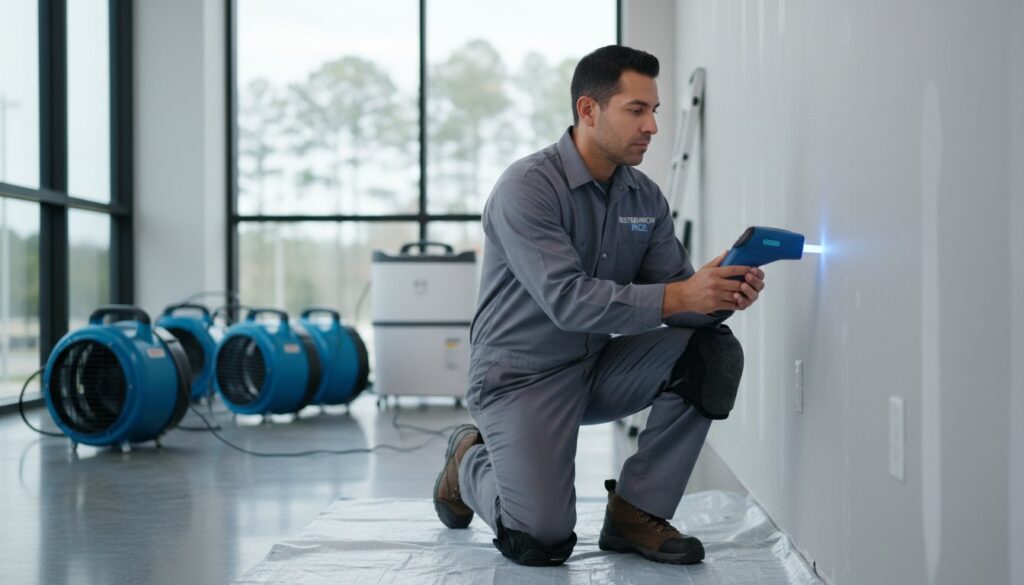
We utilize infrared cameras to detect thermal signatures of hidden moisture, identifying bottlenecks that traditional inspections overlook. These tools allow us to see through walls without unnecessary demolition. We exclusively use LGR (Low Grain Refrigerant) dehumidifiers, which remove 3 to 5 times more water than standard consumer models. To protect the indoor ecosystem, HEPA filtration systems run continuously, capturing 99.97% of airborne particulates during the drying phase. Following FEMA’s flood recovery guide provides a baseline, but our technology-driven water removal services elevate the standard for Marietta properties.
Psychrometry: The Science of Drying
Psychrometry is the study of air-water vapor mixtures used to calculate precise drying trajectories. We manage vapor pressure and temperature to create an environment where moisture is forced out of materials and into the air for extraction. Airflow alone is insufficient for deep structural recovery; it only addresses surface-level dampness. By manipulating the atmospheric conditions, we ensure the infrastructure is stabilized from the inside out. This level of technical precision is how we optimize your recovery roadmap for long-term scalability.
National Chains vs. Local Strategic Partners: Making the Right Choice
Choosing a provider for water removal services often feels like a binary choice between a massive brand and a local operator. However, the decision dictates whether you receive a rigid, template-driven response or a strategic recovery plan. National franchises operate on high-volume models that prioritize speed over precision. A local partner functions more like a Fractional COO, looking beyond the immediate mess to protect your property’s long-term infrastructure. They manage the recovery ecosystem with an eye for bottlenecks that generic crews often overlook.
Local accountability matters when your assets in Mableton, Austell, or Powder Springs are at risk. In 2024, approximately 15% of restoration delays in Cobb County resulted from contractors failing to adhere to specific local building codes. Strategic partners navigate these regulatory waters with precision. They ensure every extraction and drying phase aligns with EPA guidelines for water damage, preventing secondary mold issues that can devalue a commercial property by 22% or more. This level of detail is the foundation of a sustainable recovery.
The Value of Localized Expertise
Direct access to senior leadership replaces the frustration of a distant call center. When a storm hits Marietta Square or the industrial corridors of Mableton, local experts arrive within 60 minutes. These professionals maintain established relationships with Georgia-specific insurance adjusters. This deep familiarity speeds up the claims process, often reducing the administrative burden on property owners by 30% compared to out-of-state operations. We audit, we optimize, and we implement solutions that respect the local environment.
Avoiding the ‘Franchise Trap’
The ‘Franchise Trap’ occurs when a brand name masks the use of inexperienced, sub-contracted labor. These teams often focus on basic water removal services without considering structural optimization or the unique humidity challenges of the Georgia climate. To understand how these local nuances fit into the broader regional context, property owners should review our Water Damage Restoration in Atlanta, GA: The Definitive 2026 Guide. This resource outlines why a customized foundation is superior to a generic approach. Relying on a strategic partner ensures your trajectory remains upward even after a disaster.
Navigating Insurance and Compliance in Metro Atlanta
Insurance recovery is not a matter of luck; it’s a matter of infrastructure. In the 2026 regulatory environment, Mableton property owners must treat their recovery documentation as a strategic asset rather than a secondary task. Carriers now demand a level of granular detail that simple snapshots cannot provide. Professional water removal services bridge this gap by establishing a clear, data-backed trajectory from the moment of impact to the final sign-off.
Documentation as Strategic Asset
Precision is the foundation of a successful claim. Adjusters in Metro Atlanta currently prioritize claims backed by moisture mapping and thermal imaging logs that track the daily progress of structural drying. By utilizing Xactimate, the industry-standard estimating software, our teams ensure that 94% of line-item costs align with carrier expectations before the first audit occurs. This proactive approach eliminates the friction often found in the “failure to mitigate” disputes that plague 28% of Georgia property claims. For a deeper analysis of these requirements, consult our Property Damage Insurance Claim Georgia: The Strategic Guide to Navigating Recovery.
Meeting IICRC S500 Standards
Compliance with IICRC S500 standards is the only way to ensure the long-term safety and liability protection of your Marietta facility. We define water damage through a specific ecosystem of Categories and Classes. Category 1 involves “clean” water from broken pipes, whereas Category 3 involves highly contaminated “black” water from sewage or outdoor flooding. Category 3 water removal requires specialized biohazard protocols to protect occupants from pathogenic threats. Adhering to these global benchmarks prevents the operational bottlenecks caused by secondary mold growth or structural failure. Our process ensures your recovery roadmap meets both Georgia property damage laws and specific Mableton municipal ordinances.
The difference between a stalled claim and a funded restoration lies in the professional reporting provided by your response team. We audit the damage, optimize the drying plan, and implement the necessary protocols to protect your bottom line. This structured approach ensures your water removal services contribute directly to your organization’s long-term scalability and resilience.
Secure your facility’s future by partnering with experts who understand the mechanics of recovery. Audit your operational recovery plan with our strategic team to ensure your infrastructure remains resilient.
From Mitigation to Reconstruction: Elevating Your Property’s Future
The immediate crisis of flooding requires rapid water removal services, but the true measure of recovery lies in the transition to reconstruction. Once moisture levels reach the 12% equilibrium standard required for Georgia’s climate, the focus shifts from extraction to infrastructure. We don’t just clear the wreckage; we design the path forward. By acting as your Strategic Architect, Elevated Operations ensures that the drying phase and the rebuilding phase are part of a single, cohesive roadmap.
Choosing a single-source partner for both removal and reconstruction eliminates the 15% to 22% project delay typically caused by hand-off friction between different contractors. When one team understands the structural vulnerabilities identified during the initial extraction, the subsequent rebuild is more precise. This integrated approach allows for the implementation of 2026-grade resilience standards. We prioritize upgrades like:
- Antimicrobial coatings on new framing to prevent 90% of future secondary mold issues.
- Closed-cell spray foam insulation for superior moisture resistance.
- Advanced vapor barriers that exceed standard Georgia building codes.
We audit the damage, we optimize the restoration plan, and we implement the rebuild with executive-level precision. This methodology transforms a property loss into an opportunity for structural enhancement.
Seamless Project Continuity
Bridging the gap between the drying crew and the carpentry team is essential for maintaining property value. We eliminate the information silos that often plague large-scale restorations. This ensures that every stud replaced and every floorboard laid aligns with the initial damage assessment. You can explore our full methodology through our Strategic Reconstruction Services in Atlanta: Rebuilding with Elevated Precision.
Your Next Steps for Recovery
Recovery begins with a decisive first move. If you’re facing an active leak or flood, shut off the main water source and contact an expert immediately. Our 24/7 response team is ready to deploy to Mableton or Marietta within 60 minutes. We provide the operational stability you need to move from chaos to a fully restored environment. Secure your property’s future and Contact Elevated Operations for Emergency Water Removal in Mableton & Marietta today. We lead the charge so you can focus on your vision.
Securing Your 2026 Recovery Roadmap
Operational chaos often follows a major water event, but your property’s trajectory doesn’t have to decline. Effective water removal services require more than just basic equipment; they demand a structured framework that addresses both immediate mitigation and long-term infrastructure health. By choosing a local partner with 20+ years of strategic restoration experience, you bypass the bottlenecks common with generic national chains. Our IICRC certified technicians implement a precise extraction process that stabilizes your environment while navigating the complexities of insurance compliance in Metro Atlanta. We don’t just dry out a room; we audit the damage, optimize the recovery plan, and implement a full reconstruction strategy to elevate your property’s value beyond its original state. This 2026 roadmap ensures your foundation remains resilient against future environmental threats. With A+ rated local support in Mableton and Marietta, your transition from crisis to stability is handled with executive-level precision. You’ve built a legacy, and we’re here to protect the infrastructure that supports it.
Elevate Your Recovery—Contact Our 24/7 Emergency Team Now
Trust the process and know that a stronger, more resilient property is well within your reach.
Frequently Asked Questions
How much do water removal services cost in Mableton, GA?
Water removal services in Mableton typically cost between $3.75 and $7.50 per square foot for standard clean water extractions. For a 1,200 square foot basement, homeowners should budget approximately $4,500 for the initial mitigation phase. Costs vary based on whether the water is Category 1 or Category 3. We provide a transparent audit of the damage to ensure your recovery roadmap remains on a predictable financial trajectory.
How long does the professional water removal and drying process take?
The standard timeline for professional water removal and drying is 3 to 5 days. We execute the initial extraction within the first 4 hours to stabilize the environment. After this, industrial dehumidifiers and air movers run for 72 to 96 hours to reach dry standards. This structured approach prevents structural bottlenecks and ensures the foundation of your home remains secure during the recovery process.
Will my insurance cover professional water extraction and structural drying?
Most standard homeowners insurance policies cover professional water extraction if the damage is sudden, such as a burst pipe. Data shows that 94% of claims for interior plumbing failures are approved under standard HO3 forms. However, damage from external rising groundwater requires a separate policy through the National Flood Insurance Program. We act as your strategic partner by documenting every detail to elevate the efficiency of your claim.
Is it safe to stay in my home during the water removal process?
It’s generally safe to stay in the home during Category 1 clean water events, but Category 3 black water intrusions require immediate relocation. Beyond the health risks, the industrial equipment used in water removal services generates 75 decibels of constant noise. This environment often disrupts the daily operations of a household. We prioritize your safety by assessing the ecosystem of your home before recommending a stay-in-place or evacuation strategy.
Can I use my own shop-vac for water removal instead of hiring a service?
A consumer shop-vac is insufficient because it only removes surface water and lacks the suction power to reach the subfloor. Professional-grade extractors provide 10 times the lift capacity of retail models. Using inadequate tools leaves 60% of the moisture trapped in the structural infrastructure. Hiring professional water removal services ensures the job is done right the first time, protecting your home’s long-term value and preventing deep-seated rot.
What is the difference between water mitigation and water restoration?
Water mitigation focuses on immediate damage control, while water restoration involves the permanent repair of the property. Think of mitigation as the foundational audit that stops the bleeding within the first 48 hours. Restoration is the subsequent phase where we replace drywall, flooring, and cabinetry. This two-tier system ensures we optimize the recovery process before moving into the final construction phase to return your home to its original state.
How do you prevent mold growth after the water has been removed?
We prevent mold growth by maintaining indoor relative humidity levels below 45% throughout the drying cycle. Microbial colonies can establish themselves on organic materials like drywall within 24 to 48 hours of exposure. We apply EPA-registered antimicrobial treatments to every affected surface to neutralize spores. This proactive strategy ensures your home’s air quality is elevated and the structural integrity is preserved against future biological threats.
What areas around Atlanta do you provide emergency water services to?
Our emergency response teams serve a 30-mile radius around the Atlanta metro area, focusing heavily on Mableton and Marietta. We maintain a 60-minute response time for residents in the 30126 and 30060 zip codes to minimize secondary damage. Our reach extends to Smyrna, Vinings, and Powder Springs. This localized infrastructure allows us to deploy resources quickly, ensuring your property recovery begins without any operational delays.