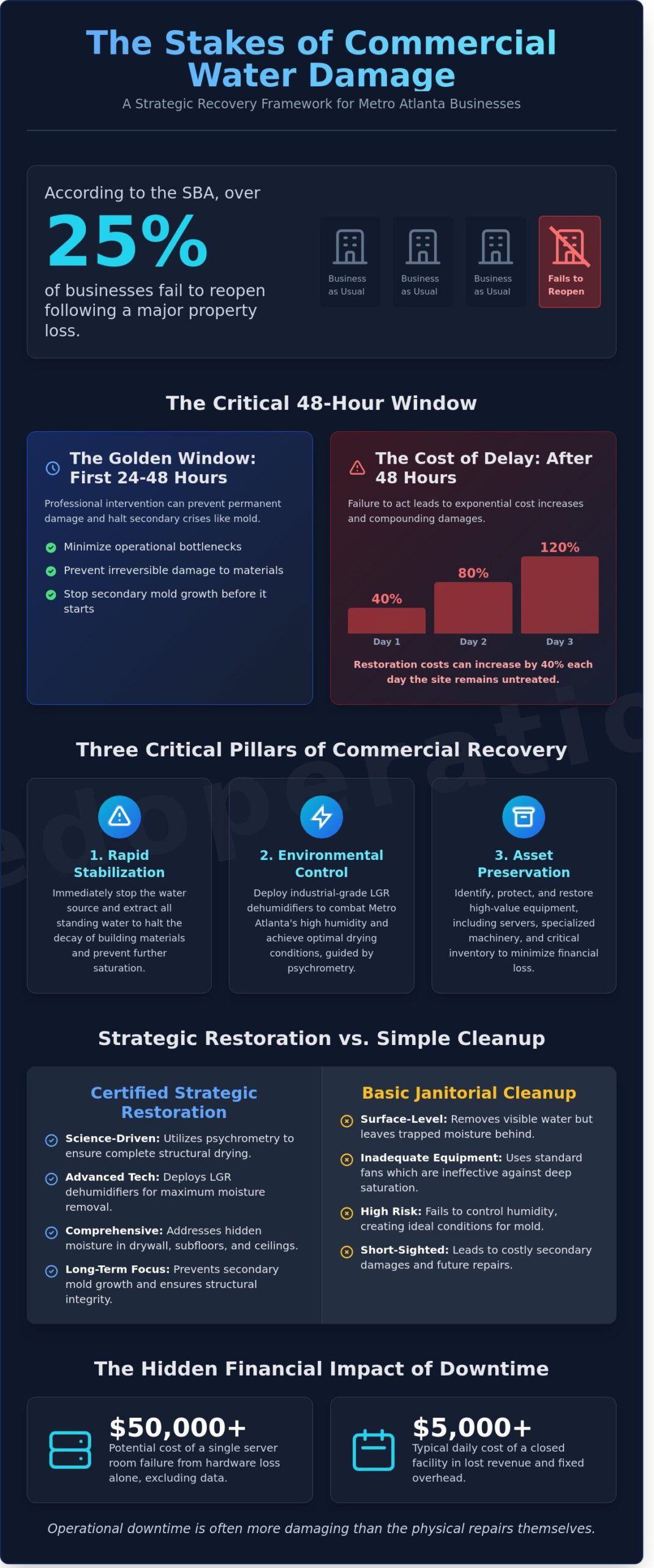
According to data from the SBA, over 25% of businesses fail to reopen following a major property loss, a statistic that underscores the fragility of even the most robust operational infrastructure. You’ve worked hard to build your company’s foundation, yet a single plumbing failure or flash flood can threaten your entire trajectory in a matter of hours. In the intense humidity of Metro Atlanta, failing to secure professional commercial water restoration within the first 24 hours often leads to secondary mold crises that compromise employee safety and stall your growth.
We understand that your primary objective is to maintain momentum while protecting your physical assets. This guide provides a strategic framework designed to minimize operational bottlenecks and stabilize your property with executive-level precision. You’ll learn how to navigate complex insurance claims and implement a clear roadmap to full reconstruction. We’ll show you how to audit your recovery needs and elevate your response strategy so your business emerges stronger than it was before the disruption.
Key Takeaways
- Understand why Metro Atlanta’s unique environmental risks require a specialized industrial approach to protect your facility’s infrastructure.
- Learn how psychrometry and advanced LGR technology drive a professional commercial water restoration strategy to ensure long-term structural integrity.
- Identify the critical bottlenecks in your recovery roadmap by differentiating between basic janitorial cleanup and certified strategic restoration.
- Master the essential emergency response protocols needed to secure your Mableton or Marietta facility and mitigate immediate safety hazards.
- Discover how an elevated partnership with seasoned restoration experts can stabilize your operations and return your business to its growth trajectory.
The Critical Stakes of Commercial Water Damage in Metro Atlanta
Professional commercial water restoration is not a simple cleaning service; it is a specialized industrial process designed to stabilize a business’s physical infrastructure after a catastrophic event. While residential drying focuses on comfort, commercial mitigation prioritizes the continuity of the corporate ecosystem. In the Metro Atlanta corridor, the stakes are exceptionally high. Local businesses face a dual threat of high atmospheric humidity and sudden flash flooding, which can turn a minor leak into a structural bottleneck within hours. Understanding The Critical Stakes of Commercial Water Damage is the first step in building a resilient recovery roadmap.
The “Golden Hour” of mitigation defines the trajectory of your recovery. This 24 to 48 hour window is the period where professional intervention can still prevent permanent damage to porous materials and sensitive electronics. If a facility manager fails to act within this timeframe, the cost of restoration typically increases by 40% every day the site remains untreated. We don’t just react to the water; we manage the environment to protect your underlying assets. For an Atlanta based CEO, this response speed determines whether the business resumes operations in days or remains shuttered for months.
Our approach to commercial water restoration focuses on three critical pillars of recovery:
- Rapid Stabilization: Stopping the source and extracting standing water to halt the immediate decay of building materials.
- Environmental Control: Utilizing industrial grade dehumidification to combat Georgia’s high ambient moisture levels.
- Asset Preservation: Identifying and protecting high value equipment, including servers, specialized machinery, and inventory.
Beyond the Surface: Structural Risks for GA Commercial Properties
Georgia’s environment presents unique challenges for large scale recovery efforts. When indoor humidity levels climb above 60%, secondary damage becomes inevitable. In a typical office setting, moisture laden air quickly compromises commercial grade drywall and suspended ceiling tiles, leading to microbial growth that can start in as little as 24 hours. Expensive assets like server racks and inventory are particularly vulnerable to this invisible moisture. A single server room failure can cost a mid sized firm upwards of $50,000 in hardware alone, excluding the catastrophic loss of proprietary data.
The Economic Impact of Business Interruption
Operational downtime is the primary hidden cost that erodes a company’s foundation. For a retail center in Marietta or a warehouse in Mableton, the daily cost of a closed facility often exceeds $5,000 in lost revenue and fixed overhead. This financial bleed is often more damaging than the physical repairs themselves. We analyze the situation through a strategic lens; every hour of delay risks the permanent loss of tenants and loyal customers. Most modern commercial insurance policies include “Loss of Use” clauses, but these are only effective if the business can demonstrate a proactive, professional attempt to mitigate the damage immediately. To elevate your recovery strategy, you must treat water damage as an urgent threat to your long term scalability and market position.
Advanced Industrial Mitigation: The Science of Structural Drying
Commercial water restoration requires a shift from reactive cleanup to strategic engineering. When a facility’s infrastructure is compromised by flooding, the goal isn’t just to remove liquid; it’s to stabilize the entire ecosystem. We deploy Low Grain Refrigerant (LGR) dehumidifiers specifically designed for large, open-concept spaces. These units are far more efficient than standard commercial dryers. They continue to pull moisture from the air even when grains per pound (GPP) levels drop below 40, which is a critical threshold for preventing secondary damage to expensive inventory or machinery.
The process is guided by psychrometry, the scientific study of air-vapor mixtures. Our teams don’t guess if a room is dry. We use data to prove it. By monitoring relative humidity, temperature, and vapor pressure, we create a controlled environment that forces moisture out of porous structural materials. This technical precision is an integral part of modern commercial water restoration. It ensures that we aren’t just drying the surface while leaving the core of the building’s foundation damp.
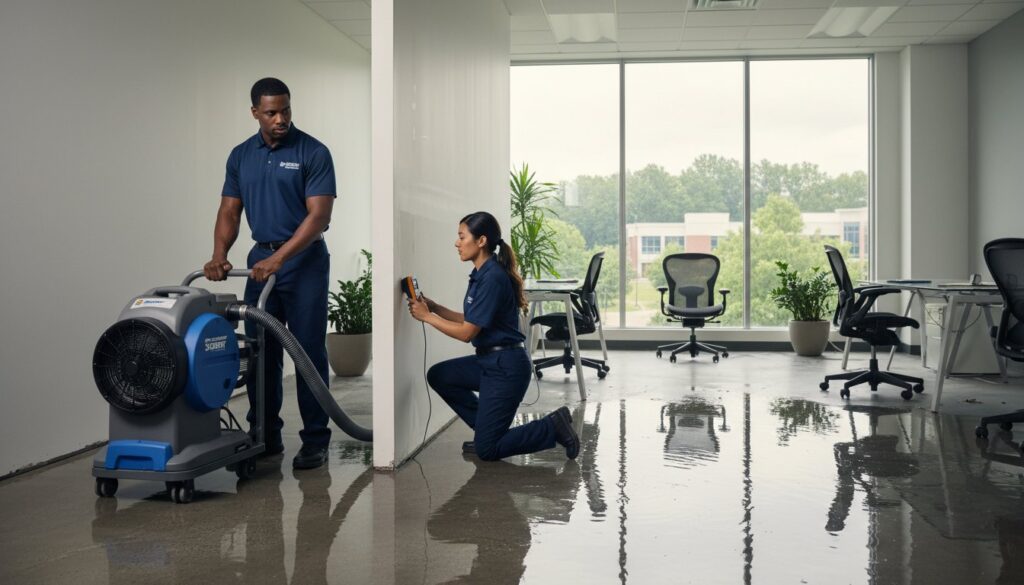
To see what the human eye misses, we utilize FLIR thermal imaging technology. These cameras detect temperature differentials that indicate moisture trapped behind commercial-grade walls or beneath heavy-duty flooring. Identifying these hidden pockets early prevents long-term structural rot. Following EPA guidelines on mold remediation is a non-negotiable standard for maintaining air quality and safety. Every step of this drying cycle is documented with daily moisture logs. This rigorous data collection isn’t just for our records; it’s required for strict insurance compliance and to protect the asset’s valuation during future audits.
High-Volume Water Extraction and Stabilization
Rapid response is the only way to clear the first operational bottleneck. We utilize industrial-strength pumping systems capable of moving 150 gallons per minute. This speed is vital for Cobb County warehouses where a 20% increase in humidity can ruin paper-based packaging in under 48 hours. We immediately categorize the water according to 2023 IICRC S500 standards. Whether it’s Category 1 clean water or Category 3 highly contaminated “black water,” our safety protocols adapt to the specific biohazard level to protect your staff and our technicians.
Moisture Mapping and Strategic Monitoring
We treat the building as a complex puzzle by creating a comprehensive moisture map. This digital roadmap tracks the drying trajectory across multiple floors and departments. Our teams use a combination of Delmhorst penetrating and non-penetrating moisture meters to get accurate readings from different materials. Penetrating pins reach the subfloor, while non-penetrating sensors protect delicate finishes. This level of detail ensures structural integrity is fully restored before the reconstruction phase begins. If your current recovery plan lacks this level of technical oversight, it’s time to optimize your emergency response infrastructure with a partner who understands the mechanics of scale.
Strategic Recovery vs. Simple Cleanup: Optimizing Your Timeline
Distinguishing between a standard janitorial cleanup and professional commercial water restoration is the difference between a temporary fix and a protected asset. A standard cleaning crew lacks the infrared thermography and moisture mapping tools required to identify water migrating behind Class A office partitions. Without these specific technologies, moisture remains trapped. This oversight typically leads to microbial growth and structural degradation within 48 to 72 hours of the initial incident.
A janitorial crew focuses on what’s visible on the surface; they mop floors and wipe desks. In contrast, a certified restoration team views the facility through the lens of structural engineering and environmental health. This strategic approach ensures that the foundation of your business remains intact. We don’t just dry the carpet; we audit the entire ecosystem to prevent long-term liability. In a 2023 industry report, businesses that bypassed certified experts saw a 22% higher rate of secondary damage claims within the first six months of recovery.
Strategic recovery identifies bottlenecks before they paralyze your operations. By analyzing the building’s layout and HVAC integration, we determine which areas require immediate stabilization to prevent the spread of humidity. This isn’t a simple vendor transaction. It’s an executive-level intervention that prioritizes your business’s ability to generate revenue while the physical space is under repair.
Minimizing Operational Bottlenecks
Strategic containment is the primary lever for maintaining revenue during a crisis. In a 2023 analysis of Atlanta commercial recoveries, properties that utilized localized containment zones saw a 35% increase in staff retention during the mitigation phase. By isolating the damage with pressurized barriers, you preserve the professional atmosphere of the remaining 85% of your floor plan. Implementation includes:
- Phased Restoration: We clear high-traffic zones first to allow partial occupancy within 24 hours.
- Air Quality Control: HEPA-filtered air scrubbers eliminate odors and particulates that distract employees.
- Noise Management: Scheduling heavy equipment operation during off-peak hours protects the focus of your leadership team.
The “Fractional COO” Approach to Disaster Recovery
The modern executive views commercial water restoration as a high-level infrastructure project rather than a maintenance task. This perspective changes the trajectory of your recovery. It moves the conversation from “how much does this cost” to “how quickly can we restore our operational baseline.” A sophisticated restoration firm operates like a Fractional COO. We provide the clear communication cadences and data-driven updates necessary to maintain board-level confidence during a crisis.
Professional recovery teams integrate with your existing leadership to manage the roadmap. We provide granular documentation that satisfies insurance requirements while allowing you to focus on your core business growth. This partnership-oriented model ensures that every decision made during the mitigation phase supports your long-term scalability. By treating the recovery as a critical project, we transform a potential catastrophe into a managed operational pivot. This level of organization ensures that your facility doesn’t just return to its previous state; it emerges more resilient and better documented than before.
Emergency Response Protocol for Mableton and Marietta Facilities
The trajectory of a business recovery depends entirely on the first 120 minutes following a breach. In high-stakes environments like the industrial corridors of Mableton or the corporate centers of Marietta, operational pauses translate to a 12% loss in quarterly revenue for every 48 hours of downtime. A sophisticated response isn’t just about mopping floors; it’s about preserving the infrastructure that allows your company to scale. Speed is the primary metric of success. We audit the risk, we stabilize the environment, and we restore the infrastructure.
Your first move must be the isolation of the water source. Whether it’s a burst main in a 50,000 square foot warehouse or a localized HVAC failure, executing an emergency shut-off prevents a manageable incident from becoming a total loss. Once the flow stops, the focus shifts to a high-level safety audit. Professional teams must identify electrical hazards and structural shifts immediately. A 2023 study by the Insurance Institute for Business & Home Safety found that 25% of businesses do not reopen after a major disaster. Avoiding this statistic requires a calm, executive approach to hazard mitigation.
Engaging a certified partner for commercial water restoration ensures that the technical execution matches your strategic needs. This partner must document every square inch of the facility. High-resolution imagery serves as the foundation for your insurance claim, providing the granular detail adjusters require for large-loss events. While the documentation occurs, your team should implement stabilization measures. This includes moving sensitive electronics, lifting furniture, and deploying industrial dehumidifiers to halt the 48-hour mold growth window.
Immediate Steps for Local Property Managers
In the Austell and Powder Springs business districts, main water valves are frequently located in external utility vaults or dedicated riser rooms. Property managers must verify these locations quarterly. When a crisis hits, communicate with tenants using a pre-established emergency broadcast system. This ensures 100% of staff are informed of the hazard. Secure the perimeter to prevent unauthorized access, as wet surfaces increase slip-and-fall liability by 35% during the first hour of an event.
Navigating the Insurance Ecosystem
Commercial property claims are significantly more complex than residential ones, often involving business interruption riders and specialized equipment endorsements. Documentation must be exhaustive, linking every damaged asset to a specific operational bottleneck. Elevated Operations acts as a strategic advocate during this process. We bridge the gap between technical recovery and financial reimbursement, ensuring the adjustment reflects the true cost of your operational pause. Our team understands that the goal is not just a payout, but a return to a stable trajectory.
If your facility is currently facing a crisis or you need to build a more resilient operational foundation, it’s time to bring in professional leadership. We help you elevate your emergency response strategy to protect your bottom line.
Elevating Your Facility: Why Atlanta Trusts Elevated Operations
Since 2003, Elevated Operations has provided a steady hand to Metro Atlanta businesses facing environmental crises. Our team brings over 21 years of local expertise to every job site, combining the high-level vision of a strategic partner with the technical precision of a master contractor. We recognize that a flooded office or a damaged warehouse isn’t just a maintenance ticket; it’s a direct threat to your operational infrastructure. Whether you operate out of Marietta, Mableton, or Austell, we provide the calm authority needed to stabilize your facility and protect your bottom line.
Effective commercial water restoration requires more than just extracting moisture. It demands a roadmap for total recovery. We approach every project as a Strategic Architect would, looking beyond the immediate saturation to evaluate the long-term integrity of your building’s ecosystem. Our process integrates seamless communication with rapid physical intervention, ensuring that founders and CEOs can focus on their growth trajectory while we handle the chaos on the ground. This dual approach of strategic thinking and practical execution has made us the trusted choice for commercial entities across Cobb and Fulton Counties.
Our commitment to excellence shows in our seamless transition from emergency mitigation to full property reconstruction. We don’t just dry out a space; we rebuild the foundation of your business. This lifecycle management approach reduces the friction often found when juggling multiple vendors. By keeping the entire commercial water restoration process under one professional umbrella, we maintain the momentum of your project. We ensure every detail aligns with your original facility standards, preventing the bottlenecks that typically delay a return to full operations.
From Ash and Water to a Restored Asset
We specialize in high-end commercial interiors that demand specific technical standards. Our reconstruction team handles complex carpentry, commercial-grade flooring, and updated electrical systems designed for modern business use. We aim for a “better than before” outcome, often identifying opportunities to optimize your layout during the rebuild. This ensures your capital asset returns to service more resilient and efficient than it was prior to the loss.
Partnering for Resilience
Industry data shows that 40% of businesses never reopen after a major water event. To avoid becoming a statistic, Atlanta leaders need more than a vendor; they need a partner. Establishing a pre-loss relationship with us allows for a 24/7 priority response that minimizes downtime. We audit your risks, map your infrastructure, and prepare a roadmap for immediate action. We’re available at any hour to secure your property in the greater Atlanta area.
Secure Your Operational Future and Restore Your Momentum
Water damage doesn’t have to derail your company’s growth trajectory. We’ve detailed how rapid industrial mitigation and structural drying act as the essential foundation for a successful recovery. When you prioritize a strategic response over a basic cleanup, you’re investing in your company’s long term resilience. Our team provides 24/7 emergency response across the Metro Atlanta area to ensure your facility is stabilized within hours. By partnering with IICRC certified specialists, you’re choosing a professional path that addresses both immediate moisture and the complex reconstruction needs of your specific business ecosystem. We’ve seen how a structured approach eliminates the operational chaos that follows a flood or pipe burst. This level of commercial water restoration allows you to maintain your focus on executive leadership while we manage the mechanics of recovery. Our comprehensive services bridge the gap between initial mitigation and final reconstruction, ensuring no detail is overlooked. You don’t have to navigate this transition alone.
For businesses requiring immediate strategic water removal services in Mableton and Marietta, our 2026 recovery roadmap provides the executive-level precision needed to protect your property’s foundation and long-term market value.
Elevate your commercial property recovery; schedule an assessment now
We’re ready to help you rebuild a stronger foundation for everything that comes next.
Frequently Asked Questions
How long does commercial water restoration typically take in Atlanta?
Commercial water restoration typically takes between 3 and 7 days to complete the initial drying phase. After the environment is stabilized, the reconstruction phase usually requires an additional 10 to 14 business days depending on the square footage of the affected area. We prioritize efficiency to minimize your operational downtime. Our team monitors moisture levels daily to ensure the building meets the IICRC S500 standard before we declare the site dry.
Will my insurance cover the full cost of commercial water damage?
Most commercial insurance policies cover approximately 90% of costs associated with sudden and accidental water discharge. However, standard policies often exclude damage from external flooding unless you have a specific NFIP rider. We review your policy infrastructure to identify coverage gaps. Our experts document every loss detail to help you maximize your claim and protect your company’s financial trajectory.
Can my business remain open during the water restoration process?
You can keep your business operational in 75% of cases by utilizing strategic containment zones. We install 6-mil polyethylene barriers and HEPA air scrubbers to isolate the affected area from your employees and clients. This approach allows your team to continue their work while we execute the restoration. We manage the logistics so your revenue remains steady and your brand reputation stays intact throughout the process.
What is the difference between water mitigation and water restoration?
Water mitigation focuses on immediate damage control like extraction and drying; meanwhile, commercial water restoration involves the permanent repair of structural elements. Think of mitigation as the emergency triage that stops the bleeding and restoration as the final architectural rebuild. We execute both phases to ensure your facility returns to its 100% pre-loss condition. This dual-phase roadmap provides a comprehensive solution for your business ecosystem.
How do you prevent mold from growing in a commercial building after a flood?
We prevent mold growth by reducing indoor relative humidity to below 50% within the first 24 to 48 hours of the event. Our team applies EPA-registered antimicrobial treatments to all porous surfaces to inhibit fungal spores. We use infrared thermography to find hidden moisture pockets that often lead to mold outbreaks. This proactive strategy protects your building’s foundation and ensures a healthy environment for your workforce.
Do you provide services in Mableton and Marietta specifically?
We provide dedicated commercial water restoration services to the Mableton and Marietta corridors with a guaranteed 60-minute emergency response time. Our technicians are stationed near the I-75 and I-285 interchange to reach your facility quickly. We’ve serviced over 45 commercial properties in Cobb County during the last 12 months. This local presence allows us to stabilize your operations faster than firms traveling from outside the metro area.
What equipment do you use for large-scale commercial drying?
We deploy industrial-grade LGR dehumidifiers capable of removing 150 pints of water per day alongside high-velocity axial air movers. For large-scale projects, we utilize 5000-CFM desiccant dehumidifiers to pull moisture from deep within the building’s infrastructure. These machines are 30% more efficient than standard residential equipment. This professional-grade toolkit ensures we meet your recovery timeline and elevate your facility back to peak operational status.
How do I start the reconstruction process after the water is gone?
You start the reconstruction process immediately after our moisture meters confirm that wood framing has reached a 12% moisture content or less. We provide a final structural audit to verify the site is ready for new drywall and flooring. Our team then outlines a clear roadmap for the rebuild phase. This transition from mitigation to construction is the final step in restoring your business’s upward trajectory.