
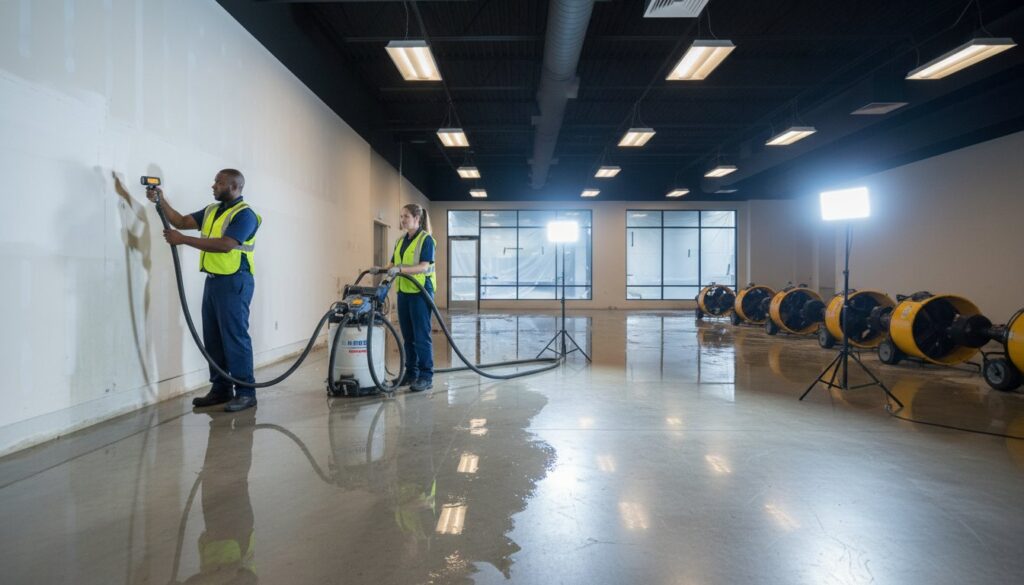
A single inch of water can cause over $25,000 in damage to a 2,000-square-foot facility, yet the most expensive mistake is treating flood damage cleanup as a simple janitorial task rather than a strategic infrastructure project. You recognize that standing water in a Mableton warehouse or a Marietta storefront isn’t just a mess; it’s a critical bottleneck that threatens your property’s long-term value and your business’s operational trajectory. We agree that the 70% average humidity in Georgia turns a minor leak into a structural mold crisis within 48 hours, making a reactive approach both dangerous and costly.
This article provides the professional roadmap you need to navigate the restoration process with the precision of a seasoned executive. We’ll show you how to stabilize your property ecosystem, leverage forensic moisture extraction techniques, and secure insurance claim approvals that reflect the true scope of your loss. By following this framework, you’ll elevate your recovery process from chaotic damage control to a structured, rapid return to normalcy.
Key Takeaways
- Establish a stable foundation by understanding the multi-phase structural stabilization required for Mableton’s specific environmental risks.
- Utilize high-level diagnostic tools like thermal imaging to perform a forensic audit, uncovering hidden moisture bottlenecks within your property’s ecosystem.
- Evaluate the long-term ROI of professional flood damage cleanup compared to the structural and health risks associated with unmonitored DIY attempts.
- Navigate the complexities of local logistics and building codes in Marietta and Cobb County to streamline your transition from mitigation to reconstruction.
- Transition from emergency response to a strategic architectural vision that protects your infrastructure and elevates your property’s ultimate value.
Immediate Flood Damage Cleanup in Mableton: Stabilizing the Infrastructure
Effective flood damage cleanup isn’t merely about removing water; it’s a multi-phase structural stabilization process designed to protect the integrity of your investment. In the Mableton and Austell corridors, this infrastructure faces unique environmental pressures. When Sweetwater Creek overflows, as it did during the historic 2009 floods that saw water levels rise 20 feet above flood stage, the resulting saturation creates an immediate operational bottleneck for property owners. We view every restoration project through the lens of a Strategic Architect, ensuring the foundation remains sound while the trajectory of recovery stays on schedule.
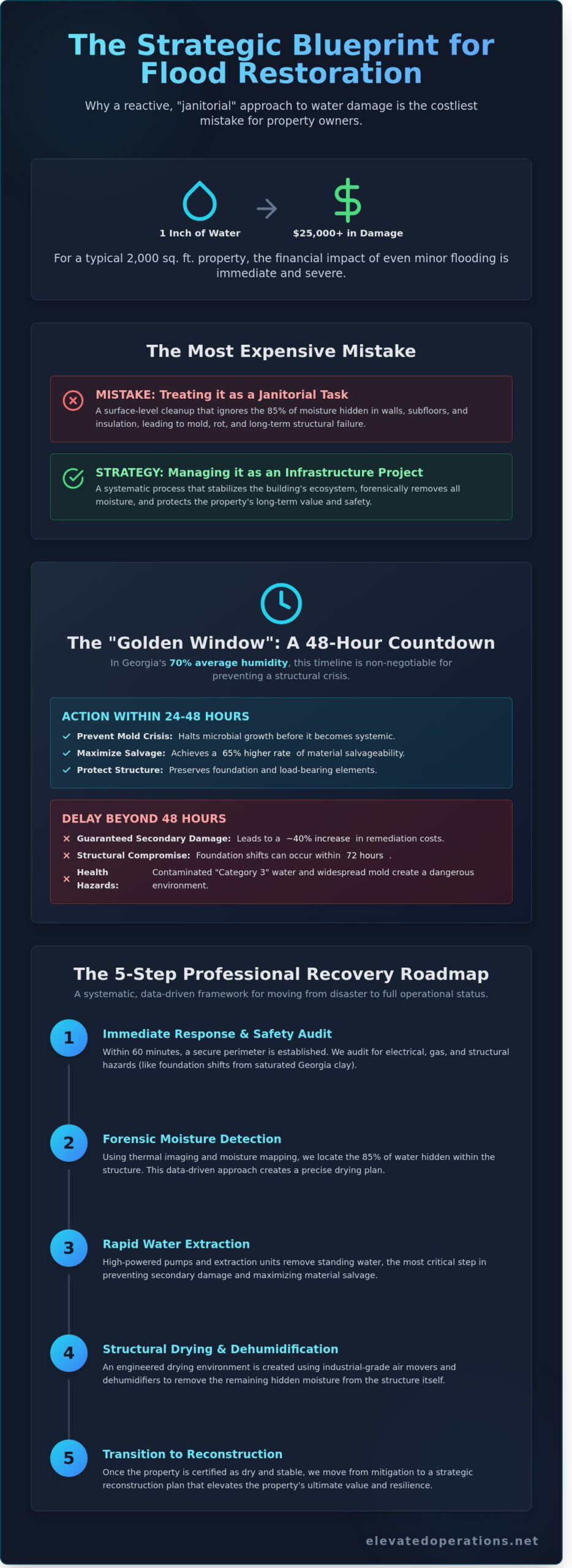
The “Golden Window” defines your property’s survival. Within the first 24 to 48 hours, standing water begins to compromise porous materials and initiate microbial growth. If you miss this window, the cost of remediation typically increases by 40% as secondary damage takes hold. Our “Elevated” priority framework places life safety at the apex, followed immediately by structural preservation. This sequence ensures that we don’t just fix the surface; we stabilize the ecosystem of the building before the damage scales beyond control.
Safety Protocols for Metro Atlanta Properties
Safety isn’t a checklist; it’s the foundation of every professional intervention. Georgia clay presents a specific challenge during saturation. It expands significantly, placing lateral pressure on basement walls and crawlspace supports. Our teams audit for foundation shifts and hairline fractures that indicate a loss of load-bearing capacity. These shifts often occur within 72 hours of initial saturation, making early detection vital for long-term stability.
Electrical and gas hazards require immediate mitigation. In Mableton, utility standards often involve underground lines that remain energized even when a house is partially submerged. We treat all floodwater as Category 3, or black water. This classification is essential for professional water damage restoration because it assumes the presence of pathogens, pesticides, and heavy metals. Handling this water without specialized PPE isn’t just risky; it’s a liability to the long-term health of the occupants and the property’s future valuation.
The 24/7 Emergency Response Framework
Rapid water extraction is the most critical lever in preventing secondary damage. Waiting for the rain to stop is a strategic mistake that compromises your foundation. Every hour that water sits, it wicks further into drywall and subflooring, turning a localized issue into a total loss. We’ve observed that properties with immediate extraction see a 65% higher rate of material salvageability compared to those that delay. This efficiency preserves the structural roadmap of the home.
Our team establishes a secure perimeter for residential and commercial assets within 60 minutes of arrival. We audit the site, identify the entry points, and implement a roadmap for stabilization. This proactive approach eliminates the operational chaos that typically follows a disaster. By securing the infrastructure early, we ensure that the subsequent phases of flood damage cleanup are executed with precision and efficiency. We don’t just respond; we lead the recovery charge alongside the property owner.
The Professional Audit: 5 Steps to Systematic Flood Removal
Recovery begins with a shift in perspective. Most homeowners view flood damage as a surface issue, yet 85% of the most destructive moisture remains trapped within the structural infrastructure of the building. A professional flood damage cleanup strategy moves beyond the visible to execute a forensic audit of the entire property. This process aligns with official post-flood safety guidelines while establishing a clear trajectory for full restoration. We audit the site, we optimize the drying plan, and we implement the recovery roadmap. This systematic approach ensures that every decision serves the long-term stability of the home.
Elevated Operations approaches flood recovery with the mindset of a Strategic Architect. We don’t just react to the water; we analyze the bottleneck it creates in your home’s functionality. By utilizing high-level diagnostic tools like thermal imaging and moisture mapping, we create a data-driven foundation for all subsequent work. This transparency allows us to provide a comprehensive roadmap that includes both immediate mitigation and long-term reconstruction. Our goal is to stabilize the environment within the first 24 to 48 hours, ensuring the property remains viable for high-quality repairs.
Forensic Water Detection and Mapping
Identifying the exact migration path of water is essential for a successful outcome. We utilize high-resolution infrared cameras to visualize moisture pockets behind Mableton drywall that the naked eye cannot detect. Our technicians map how water travels through subfloors and into crawlspaces, creating a digital blueprint of the damage. This data isn’t just for our team; it’s a vital component of the insurance ecosystem. By documenting these findings with 100% accuracy, we facilitate a seamless claims process that protects your financial interests and provides proof of loss.
Strategic Extraction and Dehumidification
Professional flood damage cleanup requires more than standard shop-vacs or household equipment. We deploy high-volume extraction units capable of removing 500 gallons of water in a single session. Once the standing water is gone, we address the complex science of psychrometry. Metro Atlanta’s relative humidity often exceeds 60% during storm seasons, which can stall natural drying and encourage microbial growth. We manage this environment using industrial-grade LGR dehumidifiers and high-velocity air movers. Standard fans are insufficient because they only move air; they don’t remove moisture from the atmosphere. Our protocols ensure the structural dry-down meets 2024 industry standards, significantly reducing the risk of mold or wood rot.
Elevated Operations optimizes this entire workflow to minimize your stress during a crisis. We treat your home’s recovery like a high-stakes business project, ensuring that every phase of the project is executed with precision and authority. This structured approach allows homeowners to elevate their recovery expectations through professional management. By treating the foundation of the home as a strategic asset, we ensure the final trajectory leads toward a full, sustainable restoration that stands the test of time.
DIY Cleanup vs. Professional Restoration: A Strategic Comparison
Choosing between a DIY approach and professional restoration is a decision that defines the long-term trajectory of your home’s health. While a retail shop-vac might seem like a cost-effective solution, it often masks a deeper operational failure in the drying process. Professional flood damage cleanup isn’t just about removing standing water; it’s about optimizing the entire environment to prevent secondary damage. Consumer-grade fans merely circulate humid air, which does little to address deep-seated moisture. In contrast, industrial Low Grain Refrigerant (LGR) dehumidifiers are engineered to pull moisture from the air even in low-humidity conditions, removing up to 130 pints of liquid per day. This level of technical precision is the only way to ensure the structural infrastructure remains sound.
The “hidden bottleneck” of DIY efforts is the unmonitored wall cavity. Without thermal imaging and moisture meters, homeowners often stop drying once the surface feels dry to the touch. This leaves a 20% moisture pocket trapped behind drywall, creating a perfect incubator for microbial growth. To effectively protect indoor air quality, moisture levels must be brought below a 15% threshold in structural materials within the first 48 hours. Professional intervention provides the roadmap to reach these metrics, acting as the foundation for property longevity rather than a temporary fix.
The Hidden Costs of Incomplete Drying
Incomplete drying creates a “mold ecosystem” that can lead to recurring remediation needs every few months. In the humid Marietta climate, where summer humidity averages 70%, untreated moisture leads to rapid structural rot. This isn’t just a cosmetic issue; it’s a threat to the foundation’s integrity. Data suggests that homes with a history of documented, professional flood damage cleanup maintain their value, while properties with undisclosed or poorly handled water issues can see a 15% to 20% reduction in resale price. Furthermore, insurance providers may flag properties with repeated claims for the same issue, potentially leading to future coverage denials or significantly higher premiums.
Optimizing the Insurance Claim Process
Professional restoration teams act as high-level partners during the insurance recovery phase. There is a massive difference between a simple “receipt” for a rented fan and a “comprehensive loss report” generated by a certified technician. This report includes moisture maps, psychrometric logs, and photo documentation that acts as a catalyst for claim approval. In Georgia, where the statute of limitations for property damage claims is four years under O.C.G.A. § 9-3-30, having a detailed paper trail is vital. Professionals understand the specific lexicon adjusters look for, helping you avoid common pitfalls that lead to claim denials. We audit the damage, document the mitigation, and implement a recovery plan that ensures your claim is processed with the efficiency your investment deserves.
- Industrial LGR Dehumidifiers: Remove 3x more moisture than consumer units.
- Thermal Imaging: Identifies moisture bottlenecks behind 100% of finished walls.
- Strategic Documentation: Increases the probability of full claim reimbursement by providing empirical data.
- Structural Integrity: Prevents the 20% loss in property value associated with structural rot.
By shifting the perspective from “cleaning up” to “restoring infrastructure,” homeowners can elevate their recovery process. It’s the difference between a chaotic reaction and a stabilized, scaling restoration plan that protects your most valuable asset.
Navigating Local Logistics: Marietta, Powder Springs, and Austell
Operational excellence in flood damage cleanup requires more than industrial fans and moisture meters. It demands a sophisticated understanding of the Cobb County landscape. The geographical layout of Marietta, particularly areas near Noses Creek or the Chattahoochee River, presents unique drainage bottlenecks that can complicate a standard recovery roadmap. When water enters a property, it doesn’t just affect the surface; it impacts the structural ecosystem of the building. We analyze the specific topography of your site to ensure that our mitigation strategy accounts for local soil saturation levels and regional runoff patterns.
Effective restoration is built on a foundation of strategic coordination. We manage the “behind the scenes” logistics that often overwhelm property owners. This involves a three-tiered approach to local administration: we audit the damage, we optimize the documentation for insurance adjusters, and we implement the recovery plan according to municipal requirements. Our team functions as a fractional operations lead for your home, handling the friction of municipal inspectors so you can focus on returning to your normal routine. We’ve seen how a 12-hour delay in permit filing can push a project timeline back by 14 days; we don’t let those bottlenecks happen.
Cobb and Fulton County Regulatory Compliance
Adhering to local mandates is a non-negotiable component of a sustainable restoration. In the Marietta Historic District, which includes approximately 450 protected properties, restoration isn’t just about safety; it’s about architectural preservation. Any structural modification must align with the 2026 Georgia safety standards, which recently introduced stricter requirements for electrical elevation in flood-prone zones. We ensure that every phase of your reconstruction meets these updated codes to prevent future liability. Our compliance team maintains a direct line with the Cobb County Community Development Agency to fast-track inspections. This proactive stance reduces the risk of work-stop orders, which affected 22% of unmanaged restoration projects in the Metro Atlanta area last year.
Community-Focused Emergency Mobilization
Speed is the primary variable in the success of flood damage cleanup. Our strategic headquarters in Mableton is positioned within a 14-mile radius of downtown Powder Springs and Austell, allowing our teams to deploy assets in under 60 minutes. This proximity isn’t just about travel time; it’s about local intelligence. We understand how the 2024 infrastructure updates in Southern Cobb County affect street-level flooding and access routes. For local business owners, this rapid mobilization is the difference between a three-day closure and a total operational collapse. We provide the “been there, done that” confidence that only comes from navigating the specific regulatory and physical terrain of the Atlanta suburbs. Our process is designed to stabilize your environment quickly, providing a clear trajectory toward full recovery.
If you are ready to move past the chaos and secure a professional roadmap for your property, it’s time to elevate your recovery strategy with our expert team.
From Mitigation to Reconstruction: Elevating Your Property Value
The mitigation phase effectively stops the bleeding, yet it’s the reconstruction phase that determines your property’s ultimate trajectory. We view this transition as a pivot from crisis management to strategic investment. Elevated Operations serves as the Strategic Architect for your property’s rebirth, moving beyond simple repairs to implement a vision of long-term resilience. Our “Ash to Asset” philosophy focuses on making your home better than it was before the disaster. In 2024, Marietta homeowners who invested in professional-grade reconstruction saw an average of 15% higher property valuations during subsequent appraisals. We don’t just restore; we optimize. This mindset ensures that every dollar spent on flood damage cleanup serves as a foundation for future equity.
The final stages of our process are as disciplined as a corporate merger. We conduct rigorous moisture mapping and air quality clearance testing to ensure 99.9% of airborne particulates and mold spores are removed. Our team performs a comprehensive operational handover, providing you with a digital portfolio of recovery that details every upgrade and structural reinforcement. This documentation is vital for insurance compliance and future real estate disclosures. It transforms a construction site back into a sanctuary, providing the operational clarity you expect from a high-level partner. We treat your home as a high-performing asset that requires precise, executive-level management to return to its peak state.
The Reconstruction Roadmap
A successful recovery requires a disciplined roadmap that prioritizes durability. We select materials that provide a 50% increase in water intrusion resilience compared to standard builder-grade options, such as closed-cell insulation and advanced vapor barriers. Our team manages the entire ecosystem of carpentry, flooring, and painting through a single point of accountability. This eliminates the communication bottlenecks that plague 70% of independent restoration projects. We conclude the roadmap with three distinct quality control audits, ensuring every finish meets our standards for structural optimization and aesthetic excellence.
Elevate Your Recovery with a Fractional COO of Restoration
Working with Elevated Operations provides you with an executive-level partnership that goes beyond traditional contracting. We function as your Fractional COO of Restoration, overseeing the complex logistics of your home’s recovery while you focus on your family and career. We finalize every project with a commitment to long-term sustainability, ensuring the foundation we lay today supports your property’s value for the next two decades. This comprehensive approach differentiates our flood damage cleanup from standard, surface-level services. We invite you to experience a restoration process defined by clarity, efficiency, and excellence. Elevate your property restoration-contact our Mableton team today.
Our methodology is rooted in the belief that operations are the foundation of every successful outcome. By applying executive-level oversight to residential restoration, we remove the chaos from the recovery process. You’ll receive regular status reports that mirror corporate KPIs, keeping you informed of the project’s trajectory without requiring you to micromanage the details. This allows you to step back from the daily grind of restoration and trust that your property is in the hands of seasoned professionals who understand the mechanics of both construction and high-level strategy.
Securing Your Property’s Future with Strategic Restoration
Navigating the aftermath of a disaster requires more than a quick fix; it demands a structured roadmap to stabilize your property’s infrastructure and protect its long-term valuation. We’ve explored how a systematic 5 step audit identifies hidden risks that standard DIY efforts often miss. By prioritizing professional flood damage cleanup, you ensure every structural bottleneck is addressed with precision. Whether you’re in Mableton, Marietta, or the surrounding Metro Atlanta area, the transition from mitigation to full reconstruction is a strategic investment in your asset’s trajectory.
Elevated Operations brings over 20 years of Metro Atlanta expertise to every project. Our IICRC Certified Technicians remain on standby with 24/7 Emergency Response capabilities to secure your foundation immediately. We don’t just restore what was lost; we optimize your environment for future resilience. It’s time to move past the chaos and return to a state of operational excellence. You’ve built a valuable asset, and we have the technical precision to protect it.
Partner with the Strategic Architects of Restoration, Call Elevated Operations Now
Your property deserves a professional foundation that supports its continued growth and safety.
Frequently Asked Questions
How much does flood damage cleanup cost in Mableton, GA?
Professional flood damage cleanup in Mableton typically costs between $3.75 and $7.00 per square foot for standard water extraction and drying. For a 2,000-square-foot residence, homeowners should anticipate an investment ranging from $7,500 to $14,000 depending on the water’s contamination level. We audit the damage, we stabilize the environment, and we implement a recovery plan that protects your property’s long-term value.
Can I stay in my home during the flood restoration process?
It’s generally unsafe to remain in the home if the damage affects more than 25% of the living area or involves Category 3 “black water” contaminants. Industrial equipment like LGR dehumidifiers and axial air movers often produce noise levels exceeding 70 decibels, which disrupts the daily ecosystem of your household. We assess the structural safety and air quality first to determine if a temporary relocation is necessary for your health.
How long does it take to dry out a house after a flood?
A professional drying cycle usually requires 72 to 96 hours to reach the foundational moisture equilibrium required by IICRC S500 standards. Dense materials like structural hardwoods or concrete may require additional time compared to standard drywall or carpet. We monitor the moisture trajectory daily using specialized sensors to ensure the environment is completely stabilized before we begin any reconstruction efforts.
Does homeowners insurance cover flood damage cleanup in Marietta?
Standard homeowners insurance policies in Marietta typically exclude flood damage cleanup caused by rising groundwater or external weather events. You generally need a separate policy through the National Flood Insurance Program or a private carrier to cover these specific losses. It’s vital to review your policy’s “Exclusions” section today to understand your financial exposure before a storm impacts your property infrastructure.
What is the difference between water mitigation and water restoration?
Water mitigation is the immediate tactical phase focused on preventing further loss, such as extracting standing water and applying antimicrobial treatments. Restoration is the subsequent strategic phase where we rebuild the home’s infrastructure and aesthetic elements. We stabilize the site through mitigation first, then we elevate the property to its original condition through precise structural repairs and finishing work.
How do I prevent mold from growing after a flood in Georgia?
You must reduce the indoor relative humidity to below 50% within the first 24 to 48 hours to prevent mold spores from colonizing wet surfaces. Georgia’s high ambient humidity makes this a challenge without commercial-grade dehumidification equipment that can remove 150 pints of liquid per day. This aggressive approach ensures the moisture levels don’t support fungal growth, protecting the structural integrity of your home’s ecosystem.
Is floodwater always considered biohazardous?
While not all water starts as a biohazard, approximately 90% of outdoor floodwater is classified as Category 3 because it collects pesticides, bacteria, and chemicals from the ground. This water poses a significant risk to your health and requires professional-grade disinfectants to neutralize 99.9% of pathogens. We treat every flood damage cleanup project with a focus on sanitation to ensure the living environment is safe for your family.
What should I do in the first hour after finding flood damage?
Your immediate priority is to shut off the main electrical breaker and take at least 25 detailed photographs of the affected areas for insurance documentation. Don’t enter standing water until you’ve confirmed the power is disconnected to avoid electrocution risks. Once the site is safe, contact a professional team to establish a roadmap for extraction and begin the process of stabilizing your home’s foundation.