
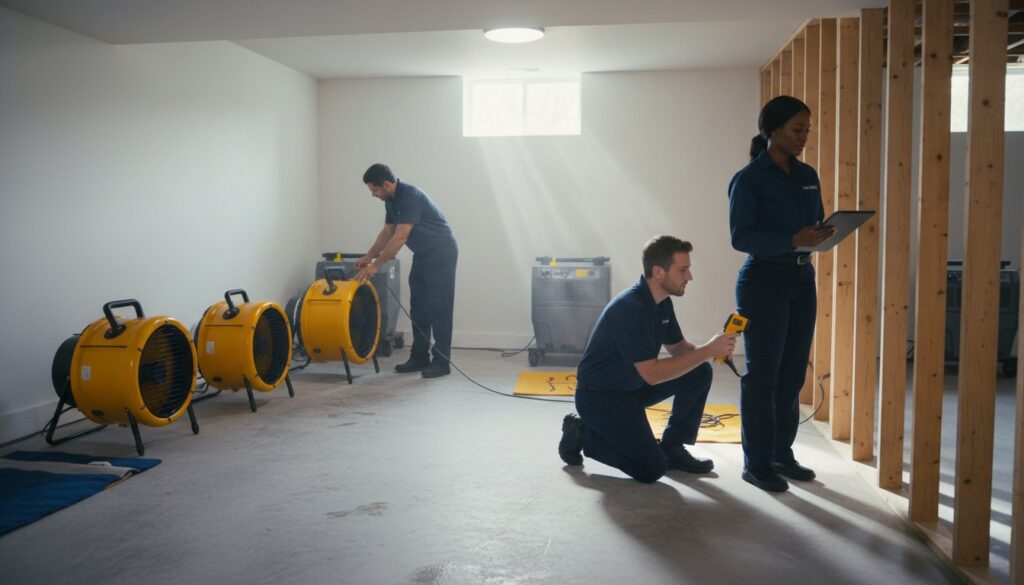
A flooded basement is more than a crisis; it’s a critical stress test on the foundational infrastructure of your most significant asset. The immediate chaos is just the surface. Beneath the water line lies a complex operational challenge threatening your property’s long-term value and structural integrity. It’s completely understandable to feel overwhelmed by the sudden disruption, the fear of what you can’t see, and the daunting prospect of navigating complex insurance claims. This chaos is a symptom of a system breakdown, not a personal failing.
This is where we elevate the response. Forget frantic, piecemeal fixes. We’re providing the definitive executive roadmap for Marietta flooded basement cleanup, a structured process designed to not only restore your space but to fortify it against future events and streamline your financial recovery. In the sections ahead, we will detail the three critical phases of professional restoration: immediate damage containment, comprehensive structural drying and sanitization, and strategic long-term prevention planning.
Key Takeaways
- Understand the critical difference between immediate damage mitigation and full-scale restoration to protect your home’s structural foundation.
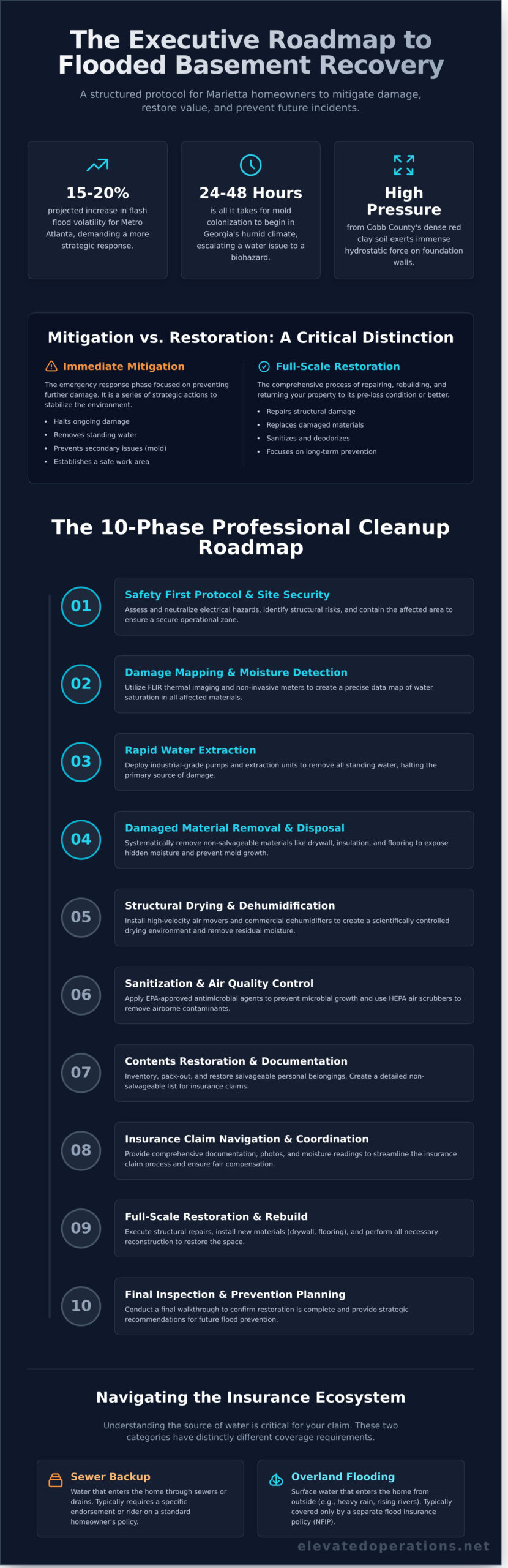
- Implement a professional marietta flooded basement cleanup using a structured 10-phase roadmap that prioritizes safety and operational efficiency.
- Identify the exact documentation needed to navigate the insurance ecosystem, distinguishing between “Sewer Backup” and “Overland Flooding” claims.
- Learn why the initial stabilization phase is the most critical step in protecting your property’s long-term value against Metro Atlanta’s weather patterns.
The Reality of Marietta Flooded Basements: Why Stabilization Matters
A flooded basement isn’t just a mess; it’s a critical failure of your property’s operational infrastructure. The first phase of recovery, known as stabilization, is the most important. It’s not about frantically removing water. It’s a strategic process designed to halt ongoing damage, assess the complete environmental and structural impact, and establish a secure foundation for a successful restoration. For Marietta homeowners, understanding this initial step is paramount, especially as local environmental factors create a unique risk profile.
Climate models projecting for 2026 and beyond indicate a 15-20% increase in flash flood volatility for the Metro Atlanta region. This means more intense, short-duration rainfall events that can overwhelm municipal storm drains and saturate the ground almost instantly. Simply “drying out” a basement in this new reality is an operational failure that guarantees a decline in long-term property value. It ignores moisture trapped within concrete, the contamination level of the water, and the potential for structural compromise. A professional marietta flooded basement cleanup protocol moves beyond surface-level solutions to protect your most significant asset.
This risk is not evenly distributed across Cobb County. Properties located near the Noonday Creek watershed or in the lower elevations of the Chattahoochee River basin face a significantly higher threat. These areas are not only susceptible to rising water levels but also to rapid groundwater intrusion following heavy rains, making proactive basement waterproofing and a rapid response plan essential components of homeownership.
The Hidden Costs of Delayed Operational Response
In Georgia’s humid climate, which often exceeds 75% relative humidity during summer months, the clock starts the moment water enters your basement. Mold colonization begins within 24 to 48 hours, transforming a water issue into a biohazard. This cascade of secondary damage extends to your home’s core systems. Water vapor and high humidity are pulled into HVAC ductwork, spreading contaminants, while submerged electrical outlets and wiring create immediate fire hazards. A comprehensive overview of water damage classifies these compounding issues, highlighting how quickly a manageable event can escalate into a complex, multi-system failure. In property restoration, time is the primary variable that dictates the complexity and cost of the recovery ecosystem.
Marietta Infrastructure: Why Local Basements Fail
The very ground your home is built on presents a challenge. Cobb County’s dense red clay soil has an extremely low absorption rate, causing rainwater to pool and exert immense hydrostatic pressure against foundation walls. This pressure forces water through even the smallest cracks in concrete and masonry. In historic neighborhoods around Marietta Square, this problem is compounded by aging sewer lines, some dating back over 60 years, that can back up during deluges. Furthermore, the rolling topography of adjacent areas like Mableton and Austell naturally channels surface runoff toward lower-lying properties, creating a perfect storm of conditions that can lead to catastrophic basement flooding.
The 10-Phase Roadmap for Professional Basement Cleanup
A flooded basement isn’t a mess; it’s a critical systems failure demanding a structured operational response. Treating it as a series of chores invites long-term risk, from structural decay to persistent microbial threats. A professional restoration roadmap transforms chaos into a controlled, multi-phase project designed to stabilize the environment and protect your property’s foundational integrity. The process begins with an unwavering “Safety First” protocol. Before any work starts, our technicians assess and neutralize electrical hazards and identify potential bio-contaminants from sewage or groundwater, adhering to guidelines for Staying Safe After a Flood. This initial step ensures the entire operation is built on a secure foundation.
The success of any marietta flooded basement cleanup hinges on a precise, data-driven strategy. We don’t guess where the water went; we map its trajectory. Using advanced FLIR thermal imaging cameras and non-invasive moisture meters, our team creates a detailed map of the affected ecosystem, identifying saturation levels in drywall, subflooring, and concrete. This isn’t just about finding visible water; it’s about pinpointing hidden moisture pockets that, if left unaddressed, become the source of future operational bottlenecks like mold and wood rot.
Phases 1-4: Rapid Extraction and Containment
The initial objective is to halt the damage and regain control. This phase is defined by speed, efficiency, and the deployment of industrial-grade infrastructure to remove the primary threat: standing water.
- Initial Assessment & Roadmap: We conduct a comprehensive audit of the water intrusion, categorizing the water type (from Category 1 clean water to Category 3 black water) and mapping moisture across more than 50 data points. This data informs the entire restoration roadmap.
- High-Volume Water Extraction: We deploy truck-mounted extraction units capable of pumping over 1,200 gallons of water per hour. This industrial-scale removal is critical to minimizing absorption into porous materials and is typically completed within the first 4-6 hours on-site.
- Content Management & Salvage: Your assets are inventoried and, where possible, moved to a secure, climate-controlled facility for specialized cleaning and restoration. This professional pack-out service prevents further damage and clears the operational theater for structural drying.
Phases 5-10: Stabilization and Sanitization
With the bulk water removed, the focus shifts to atmospheric and structural stabilization. This is the most technical phase, where we pull residual moisture from the very air and materials of your home.
- Structural Drying & Dehumidification: A network of LGR (Low-Grain Refrigerant) dehumidifiers and high-velocity air movers is installed. This system creates an engineered drying vortex, lowering ambient humidity below 40% to aggressively pull moisture from wood, concrete, and drywall.
- Antimicrobial Application: To prevent a biohazard bottleneck, we apply an EPA-registered antimicrobial agent to all affected surfaces. This step neutralizes existing bacteria and fungi while inhibiting future mold growth, which can begin within 24-48 hours of initial water exposure.
- Final Validation: We don’t just assume the job is done; we prove it. Using calibrated hygrometers and air quality testing equipment, we confirm that the entire ecosystem has returned to its pre-loss moisture equilibrium. Once the environment is confirmed stable, our team can help architect a complete recovery strategy for any necessary repairs or reconstruction.
Mitigation vs. Restoration: Building a Solid Foundation
In the immediate aftermath of a basement flood, homeowners face two distinct and critical operational phases: mitigation and restoration. Understanding the difference is not a matter of semantics; it is the core principle that protects your property’s long-term structural and financial health. Mitigation is the emergency response. It is the immediate action taken to stop further damage, extract water, and stabilize the environment. Restoration is the strategic rebuild. It involves repairing or replacing damaged materials to return your basement to its pre-loss condition.
Skipping directly to restoration without a complete mitigation phase is a critical error. Consider a Marietta home built after the year 2000. Its subfloor is likely constructed from Oriented Strand Board (OSB), which can lose over 50% of its structural integrity if it remains saturated for more than 72 hours. A failure to professionally mitigate water damage today can manifest as buckling floors and compromised foundational supports by 2026. The initial “savings” from a DIY approach becomes a five-figure structural repair liability down the road.
This brings us to the “Shop-Vac Myth.” While a wet-dry vacuum is effective at removing standing water, it is fundamentally incapable of addressing the core threat: trapped moisture. Your concrete, drywall, and wood studs are porous. They absorb and hold water far below the surface. This hidden moisture, which a Shop-Vac cannot reach, becomes a breeding ground for mold and the catalyst for structural decay. A complete marietta flooded basement cleanup requires an industrial-grade strategy, not a consumer-grade tool.
The Science of Structural Drying
Effective water removal is governed by psychrometry, the science of the thermodynamic properties of moist air. We don’t just remove water; we manipulate temperature, airflow, and humidity to create an optimized drying environment. A wall that is “dry to the touch” can still have a moisture content of 17% or higher, well above the 12% threshold where mold growth is initiated. Our strategic placement of commercial air movers and dehumidifiers creates a vortex of airflow that pulls moisture from deep within materials, preventing the rot that compromises your home’s infrastructure.
Asset Protection and Property Value
When we manage your project, we create meticulous documentation, from initial moisture readings to final clearance testing. This preserves the “chain of custody” required for insurance claims and protects you during a future sale. A botched DIY job leaves behind stains and odors that are immediate red flags for any home inspector, potentially costing you thousands in negotiations or even derailing a sale entirely. Professional restoration is an investment in the resale scalability of your Marietta property.
At Elevated Operations, we serve as the strategic project manager for your entire recovery. We direct the mitigation. We oversee the restoration. We ensure every decision is made to protect the foundational integrity and long-term value of your home. We elevate the standard for marietta flooded basement cleanup by building your recovery on a solid, scientifically validated foundation.
Navigating Insurance and Prevention in Cobb County
A flooded basement is more than a cleanup project; it’s an operational disruption that tests your home’s resilience. Successfully navigating the aftermath requires a two-pronged strategy: meticulous insurance claim management and proactive infrastructure upgrades. This isn’t just about recovery. It’s about building a more robust foundation to prevent future crises and protect your most valuable asset.
The Insurance Roadmap: From Filing to Funding
The insurance claim process is an ecosystem with its own rules and language. Success depends on precise, project-based documentation. Elevated Operations provides a comprehensive file for your claim, including moisture readings, photographic evidence, and itemized loss reports, which are critical for an efficient marietta flooded basement cleanup claim. In Georgia, it’s vital to understand if your policy covers “Actual Cash Value” (ACV), which pays the depreciated value of your items, or “Replacement Cost” (RCV), which pays to replace them with new ones. This distinction can impact your financial recovery by thousands of dollars. Learn more about itemizing your losses and potential repair costs here.
When working with your local Marietta insurance adjuster, clarity and organization are paramount. Your policy likely requires specific documentation depending on the water’s source. Here’s a breakdown:
- For a “Sewer Backup” Rider: You’ll need an initial plumbing report identifying the cause of the backup, clear video evidence of the initial damage, and a detailed inventory of all contaminated contents that were removed.
- For “Overland Flooding” (NFIP): This requires a separate policy through the National Flood Insurance Program. Claims must include a completed “Proof of Loss” form submitted within 60 days of the flood, photos showing the high-water mark on your home’s exterior, and any relevant elevation certificates.
Infrastructure Upgrades: Preventing the Next Crisis
True recovery involves future-proofing your home’s operational infrastructure. For homes in Powder Springs and Austell, where heavy rains can quickly overwhelm drainage systems, the return on investment for a battery-backup sump pump is significant. A one-time installation costing between $450 and $900 can prevent an average of $25,000 in water damage, according to 2023 FEMA data. Optimizing exterior drainage through French drains and ensuring gutters redirect water at least 10 feet from the foundation are foundational steps, not optional extras.
To elevate your home’s defenses, consider smart water leak detection. Think of these systems as a “Fractional COO” for your home’s plumbing. For less than $200, a Wi-Fi enabled sensor monitors flow rates 24/7, detects micro-leaks that are invisible to the naked eye, and can automatically shut off the main water supply, transforming a potential catastrophe into a minor notification on your phone. This is the strategic approach to home maintenance that ensures a single plumbing failure doesn’t halt your life.
Ready to build a resilient foundation for your home? Schedule a home infrastructure assessment with our team today.
Elevating Your Recovery: The Elevated Operations Approach
A flooded basement is more than a cleanup job; it’s an operational disruption that demands a strategic response. While standard services focus on extraction and drying, our approach is fundamentally different. We operate as your Strategic Architect, transforming a chaotic event into a structured recovery process. This isn’t just about removing water. It’s about rebuilding your property’s infrastructure with enhanced resilience and efficiency, protecting your asset for the long term. With over 22 years of dedicated service in the Atlanta metropolitan area, we’ve refined a methodology that moves beyond simple repairs to deliver true operational restoration.
Our deep-rooted experience since 2002 means we possess an intricate understanding of Marietta’s unique environmental and structural challenges, from humidity levels impacting drying times to local building codes governing reconstruction. We apply a Fractional COO mindset to every project, meaning we manage the entire restoration ecosystem for you. We coordinate with insurance adjusters, manage subcontractor timelines, and oversee materials procurement with executive-level precision. This high-level oversight is the critical difference between a chaotic, drawn-out repair and a streamlined, predictable recovery trajectory for your marietta flooded basement cleanup.
Our Commitment to the Marietta Community
Our operational hub in nearby Mableton ensures our IICRC-certified technicians can be on-site in Marietta, Kennesaw, and Smyrna in under 60 minutes. We Elevate the customer experience by establishing a clear communication infrastructure from day one, providing daily progress reports and a single point of contact. This transparency eliminates the uncertainty that often accompanies property damage recovery. Elevate your property restoration-contact us for 24/7 emergency response.
The Next Steps in Your Restoration Trajectory
When you call us for a marietta flooded basement cleanup, you activate a precise, pre-planned operational sequence designed for maximum efficiency and minimal disruption. Here is what you can expect in the first 60 minutes:
- Initial Triage (0-5 Minutes): Our 24/7 command center gathers critical data on the water source, affected area, and potential hazards to dispatch the correctly equipped team.
- Team Mobilization (5-15 Minutes): A certified Project Manager and rapid response crew are dispatched from our Mableton location with a full suite of extraction and drying technology.
- On-Site Assessment (15-60 Minutes): Your Project Manager arrives, conducts a comprehensive moisture assessment using thermal imaging and hygrometers, and presents a clear stabilization plan with an initial timeline.
This initial emergency phase is just the foundation. Once your property is stabilized, dried, and sanitized, we transition seamlessly into full-scale reconstruction. Our team manages every detail, from replacing drywall and flooring to complex structural repairs, ensuring the entire project is executed under a single, unified vision. We don’t just hand you off to another contractor; we see the project through to its optimized completion. Don’t just clean up-optimize your recovery.
Secure Your Foundation: Your Next Step in Property Restoration
Navigating the aftermath of a flood isn’t just about water extraction; it’s about strategic recovery. A structured 10-phase roadmap is the critical difference between a temporary fix and a complete restoration. Executing a professional marietta flooded basement cleanup demands more than just equipment; it requires a team with a proven track record built on precision and expertise.
Our IICRC Certified Technicians bring over 20 years of dedicated Metro Atlanta experience to every project. We don’t just show up; we deploy a proven system backed by our 24/7 Emergency Response Guarantee, giving you a clear path forward when you need it most.
Elevate your property restoration-contact our Marietta emergency team now.
Don’t let water damage dictate your property’s trajectory. A strategic, professional response puts you back in control, ensuring your home is not just repaired, but truly restored.
Frequently Asked Questions About Flooded Basement Cleanup
How long does the professional basement cleanup process take in Marietta?
The entire professional cleanup and drying process typically takes between 3 and 5 days. This timeline allows for complete water extraction, removal of non-salvageable materials, and thorough structural drying using specialized equipment. The exact duration is influenced by the basement’s square footage, the depth of the water, and the saturation level of materials like drywall and subflooring. We provide a precise project timeline after our initial on-site assessment.
Will my homeowners insurance cover a flooded basement in Georgia?
Your standard Georgia homeowners insurance policy, often an HO-3 policy, typically covers water damage from internal sources like a burst pipe or failed water heater. However, it does not cover damage from external water sources, such as heavy rain or rising groundwater. For that, you need a separate flood insurance policy, which is primarily available through the National Flood Insurance Program (NFIP). We always recommend you review your policy to confirm your specific coverages.
Is it safe to stay in my home while the basement is being dried out?
Yes, in most cases, it’s safe to remain in your home during the drying process. Our technicians establish a sealed containment area around the basement to prevent airborne particles from circulating into your main living spaces. The industrial-grade air movers and dehumidifiers do produce constant noise, so families with young children or those sensitive to sound may choose to make temporary arrangements for their comfort.
What is the difference between a flood and a sewer backup for insurance purposes?
For insurance carriers, a “flood” is defined as damage from rising surface water originating from a natural source. In contrast, a sewer backup involves wastewater flowing back into your home from municipal or private sewer lines. Standard insurance policies exclude flood damage, while sewer backup coverage must be added as a specific endorsement. It’s a critical distinction, as a backup involves highly contaminated water requiring specialized cleanup protocols.
How much does professional basement flood cleanup cost in Marietta?
The average cost for professional marietta flooded basement cleanup ranges from $3,000 to $10,000 for a standard 1,000-square-foot basement. The final price is determined by the water’s contamination level (from Category 1 clean water to Category 3 black water), the extent of structural damage requiring removal, and the amount of time equipment must run to meet drying goals. We provide a detailed, itemized estimate before any work begins.
Can you save my carpet and furniture after a basement flood?
We can often salvage hard-surface furniture and other non-porous items, but porous materials like carpet, padding, mattresses, and upholstered furniture are almost always a loss. According to IICRC standards, these materials absorb contaminants and can harbor dangerous bacteria and mold within 24-48 hours. Our primary mission is to ensure your home is healthy and safe, which requires disposing of these high-risk items.
Why shouldn’t I just use fans and a shop-vac to dry my basement?
A shop-vac and household fans cannot remove the bound water trapped deep inside structural materials like drywall, wood studs, and concrete. Professional restoration relies on commercial-grade low-grain refrigerant dehumidifiers and high-velocity air movers to create a controlled drying environment. This scientific approach is the only way to prevent secondary damage, including hidden mold growth and wood rot, which can cause far more expensive problems in the future.
What are the signs of mold I should look for after a flood?
The most obvious sign of mold is visible growth, which can appear as black, green, or white spots on walls, baseboards, and stored items. A persistent, musty, or earthy smell is another primary indicator, even if you can’t see any growth. You should also be alert for warped wood, peeling paint, or bubbling drywall, as these are signs of lingering moisture that creates a perfect breeding ground for mold colonization.