
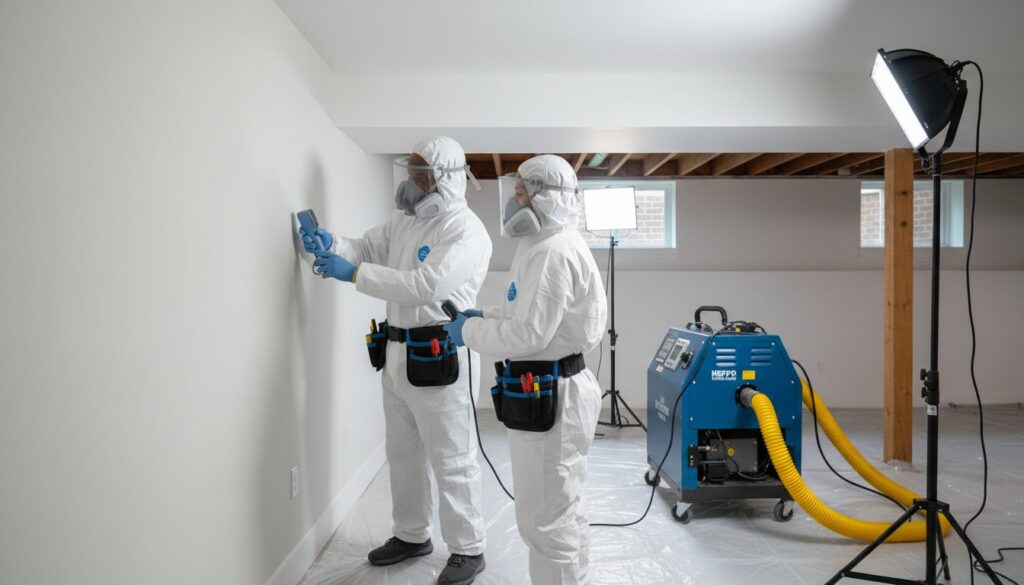
According to the Environmental Protection Agency, a staggering 60% of U.S. homes contend with wet basements, creating a prime operational environment for mold. For property owners in Cobb County, that statistic isn’t an abstraction; it’s a lived reality fueled by persistent humidity. You’ve likely worried about a musty odor signaling a hidden problem, the potential health impacts of toxic mold, or how a discovery could threaten your property’s very foundation.
A reactive, panicked response is not a strategy. This guide delivers the definitive professional framework for mold remediation in Powder Springs, engineered to move you from operational chaos to a state of control. Here, you will discover the authoritative roadmap to identify vulnerabilities, execute a meticulous remediation, and implement a prevention infrastructure that preserves your property’s equity and ensures a healthy, mold-free environment for the long term.
Key Takeaways
- Understand how Powder Springs’ unique climate ecosystem creates a critical need for a professional, multi-stage recovery framework.
- Discover why surface-level cleaning fails on porous materials and how common DIY methods can worsen your property’s underlying issue.
- Learn the strategic framework for effective mold remediation powder springs, which moves beyond simple removal to address moisture source infrastructure.
- Grasp the complete professional lifecycle, from site assessment and containment to final reconstruction, designed to protect your property’s long-term value.
The Reality of Mold in Powder Springs, GA: Why Remediation is Critical
Mold isn’t merely a cosmetic issue; it’s a symptom of a systemic failure within your property’s environmental infrastructure. True mold remediation is a multi-stage engineering process designed to identify the moisture source, remove the contamination, and prevent future growth. It’s a methodical approach that goes far beyond simple surface cleaning. In Powder Springs, this process is not just a recommendation; it’s a critical necessity driven by our unique local conditions.
The climate in this part of Cobb County is a primary catalyst for mold proliferation. With summer humidity levels frequently exceeding 70%, the air itself provides ample moisture for mold spores to colonize. This is compounded by local geography. Proximity to natural water sources like Sweetwater Creek increases the ambient moisture and elevates the risk of water intrusion from heavy rainfall and localized flooding. These environmental pressures mean that a minor leak or poor ventilation can quickly escalate into a significant infestation.
A critical distinction for homeowners is understanding the difference between visible and hidden mold. The dark spots you may see on drywall or around a window frame are often just the surface evidence of a much larger problem. Hidden infestations can thrive for years within wall cavities, beneath floorboards, or in unconditioned attics and crawl spaces. For a comprehensive overview of indoor mold and its behavior, it’s clear that what you don’t see is often the most significant threat to your home’s structural integrity and air quality.
Powder Springs Climate and Your Property Infrastructure
Georgia’s average annual rainfall of nearly 50 inches puts constant hydrostatic pressure on foundations, turning basements and crawl spaces into prime targets for moisture intrusion. Many older homes in Powder Springs are equipped with HVAC systems designed for cooling, not the aggressive dehumidification our climate demands. Viewing your home as a delicate ecosystem clarifies the issue: when one component like moisture regulation fails, the entire system is compromised, creating a perfect foundation for mold growth.
The Consequences of Deferred Action
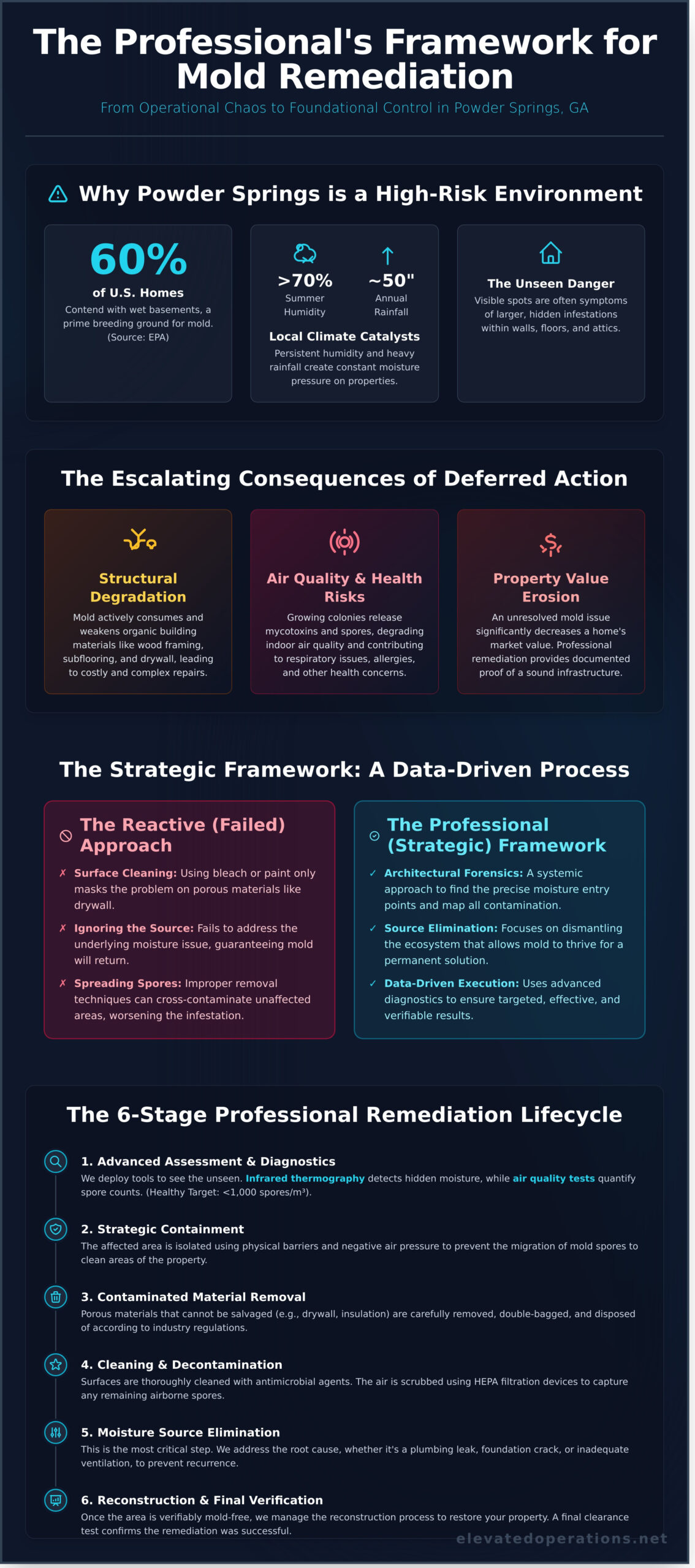
Delaying professional action allows a manageable issue to become a complex and costly liability. The consequences of inaction are threefold, impacting your property’s structure, your family’s health, and your financial investment.
- Structural Degradation: Mold doesn’t just live on surfaces; it consumes them. It actively digests organic materials like timber framing, subflooring, and drywall, compromising their structural integrity over time and leading to expensive repairs.
- Air Quality and Health: As mold colonies grow, they release mycotoxins and spores into your home’s airspace. This can significantly degrade indoor air quality and contribute to a range of respiratory issues and allergic reactions, undermining residential wellness.
- Property Value Erosion: An undocumented or poorly handled mold problem can decrease a home’s market value by a significant margin. Documented professional mold remediation in Powder Springs is a vital asset, providing future buyers with the assurance that the underlying infrastructure is sound.
The Strategic Framework: How Professional Mold Remediation Protects Your Foundation
Effective mold remediation isn’t about surface cleaning; it’s about architectural forensics. A visible mold problem is merely a symptom of a deeper, systemic failure in your property’s environmental controls. We move beyond cosmetic fixes by conducting a comprehensive environmental audit, adopting the mindset of a Strategic Architect to deconstruct the problem. Our objective is to identify the precise moisture entry points, map the extent of the contamination, and develop a precise roadmap for long-term property stabilization. This isn’t just cleaning. It’s the strategic reinforcement of your home’s foundational health.
The entire process begins with a critical diagnostic phase. Without accurate data, any remediation effort is simply guesswork. True professional mold remediation in Powder Springs is built on a foundation of empirical evidence, ensuring that the solutions we implement are both targeted and permanent. We don’t just remove the mold; we dismantle the ecosystem that allows it to thrive.
Advanced Diagnostic Tools and Technology
We deploy a suite of advanced diagnostic tools to build a complete operational picture of your property’s moisture challenges. Infrared thermography allows our technicians to see what the naked eye cannot, detecting temperature anomalies behind Powder Springs masonry and drywall that signify hidden water intrusion with a precision of 0.1°C. Air quality tests quantify the problem, comparing indoor spore counts to the local Georgia environment. A healthy indoor count should be below 1,000 spores per cubic meter (spores/m³); our testing identifies if you’re facing a contained issue or a significant contamination event. Finally, digital moisture meters establish a structural dryness baseline, confirming that wood framing is brought below the 16% moisture content threshold required to inhibit future growth.
Containment and Cross-Contamination Strategy
Once the scope is defined, execution demands uncompromising containment. We establish a remediation zone under negative air pressure, creating an isolated environment that prevents airborne spores from escaping and contaminating clean areas of your property. All air exhausted from this zone is scrubbed by industrial-grade HEPA (High-Efficiency Particulate Air) filters, which are certified to capture 99.97% of particles as small as 0.3 microns. This level of microscopic control isn’t just our standard; it’s a core principle within the EPA guidelines on mold remediation for ensuring a safe and thorough process. This meticulous strategy, combined with professional-grade PPE for our team, protects your property’s infrastructure and its occupants from start to finish.
This disciplined framework transforms a reactive cleanup into a proactive strategy for asset protection. By identifying the root cause and implementing a verifiable, data-driven solution, we don’t just solve your current mold problem; we elevate your property’s resilience against future threats. A detailed understanding of your property’s unique environmental profile is the critical first step; schedule a comprehensive property assessment to establish your roadmap to a healthy foundation.
Evaluating the Risk: Why Surface-Level Cleaning Fails in Georgia’s Ecosystem
In property maintenance, the most appealing solution is often the quickest. When mold appears, the instinct is to eradicate the visible symptoms immediately. This tactical error, however, creates significant strategic vulnerabilities. In Georgia’s humid climate, where mold can thrive with minimal encouragement, surface-level cleaning isn’t just ineffective; it’s a catalyst for deeper, more complex operational failures. Understanding the science behind mold growth reveals why amateur attempts almost always fall short, leading to recurring problems and escalating costs.
The number one misconception we dismantle for clients is the belief that bleach is a universal solution. It’s not. Chlorine bleach is comprised of 90% water. On non-porous surfaces like tile or glass, it can be effective. But on porous materials like drywall, wood, or grout, the chlorine component evaporates almost instantly, leaving the water component to soak deep into the substrate. This actually feeds the mold’s root structure, or hyphae, guaranteeing a swift return. You’ve eliminated the visible stain but have fortified the underlying infestation.
Worse yet is the danger of cross-contamination. Attempting to scrub or remove a mold colony without professional containment protocols is like trying to put out a fire with a fan. A single square inch of drywall can contain over 1 million mold spores. Agitating this colony without negative air pressure and physical barriers releases these spores into your HVAC system, spreading the problem from a contained area to the entire property infrastructure. This is how a minor issue becomes a systemic bottleneck, impacting air quality, structural integrity, and occupant health. For comprehensive mold remediation in Powder Springs, containment is not a suggestion; it’s the foundational first step.
The Myth of the Quick Fix
Shortcuts in mold removal are operational liabilities. Painting over a colony, for example, is a catastrophic failure. The paint traps moisture against the wall, and the organic compounds in most latex paints provide a food source, accelerating the decay of the underlying structure. Similarly, using a standard shop vacuum can aerosolize spores, actively distributing them throughout your property. In Georgia, these DIY missteps can have severe financial consequences, as many insurance carriers will deny a claim for mold damage if it’s determined that improper, non-professional remediation attempts exacerbated the problem.
Professional Grade vs. Consumer Solutions
The gap between professional and consumer-grade solutions is not incremental; it’s exponential. It’s the difference between a temporary patch and a permanent infrastructure repair. We deploy a strategic framework that addresses every variable in the remediation lifecycle.
- Antimicrobial Treatments: We utilize EPA-registered, industrial-grade antimicrobial agents designed to penetrate porous materials and eliminate mold at the cellular level. These are fundamentally different from store-bought cleaners, which only address surface-level growth.
- Structural Drying: Household fans cannot achieve deep structural drying. Our process involves commercial-grade Low-Grain Refrigerant (LGR) dehumidifiers and high-velocity air movers, monitored by thermal imaging and moisture meters. We don’t stop until the moisture content within structural materials is reduced to below 15%, the scientific threshold for inhibiting mold growth.
- Certified Expertise: Our technicians are IICRC-certified, meaning they operate within a globally recognized standard of care. This structured approach isn’t arbitrary; it’s a refined process that aligns with comprehensive federal standards, such as the EPA mold remediation guidelines, to ensure complete removal and prevent recurrence.
Ultimately, the cost-benefit analysis is clear. Amateur attempts create a cycle of recurring expenses, diminished property value, and potential health risks. Professional mold remediation in Powder Springs is a one-time investment in the long-term health and stability of your property asset.
Navigating the Remediation Lifecycle: From Inspection to Reconstruction
Effective mold remediation is not a single action; it’s a disciplined, multi-stage operational roadmap. It begins with diagnostics and ends with a full structural recovery, ensuring the problem is solved at its foundation, not just on the surface. At Elevated Operations, we have systemized this lifecycle to remove uncertainty and deliver predictable, high-caliber results. Our process isn’t just about cleaning; it’s about deconstructing a problem and rebuilding a resilient environment.
The entire operational sequence is governed by IICRC S520 standards, the industry’s definitive protocol for professional mold remediation. This framework ensures every step is executed with precision, from initial analysis to final reconstruction.
- Step 1: Comprehensive Site Assessment. We begin by identifying the core issue. Using tools like thermal imaging cameras and digital moisture meters, we map the water intrusion pathway and define the full scope of fungal growth. This isn’t a guess; it’s a data-driven diagnosis to pinpoint the operational bottleneck causing the mold.
- Step 2: Strategic Containment. Before any materials are disturbed, we establish critical containment. This involves sealing off the affected area with 6-mil polyethylene sheeting and creating negative air pressure using HEPA-filtered air scrubbers. This system prevents the migration of mold spores, protecting the rest of your property’s infrastructure.
- Step 3: Precision Removal. Affected porous materials, such as drywall, insulation, and carpeting, are unsalvageable and must be removed. Our technicians perform this removal surgically, bagging the materials in sealed containers before removing them from the structure to eliminate the risk of cross-contamination.
- Step 4: Industrial Cleaning. All remaining non-porous and semi-porous materials are meticulously cleaned. We use a combination of HEPA-vacuuming to capture fine particulates and treatment with an EPA-registered antimicrobial agent to eliminate any remaining fungal colonies.
- Step 5: Post-Remediation Verification. We don’t sign off on our own work. An independent, third-party Industrial Hygienist conducts a final clearance test. This provides unbiased verification that the air quality and surfaces meet or exceed safety standards, confirming the successful completion of the remediation phase.
The Reconstruction Phase: Restoring Your Vision
Once your property is verified as clean, we transition from mitigation to restoration. Our approach to reconstruction for mold remediation in Powder Springs is seamless. Elevated Operations’ in-house team of carpenters and finishers rebuild the affected areas, ensuring the new materials and structures are installed to be more moisture-resilient than the original, truly elevating your property’s structural integrity for the long term.
Insurance Documentation and Support
Navigating an insurance claim can become a significant administrative bottleneck. We eliminate this stress by providing meticulous, claim-ready documentation from day one. Our reports include detailed photographic evidence, moisture readings, and a complete log of all actions taken. We partner with you to provide the clear, factual roadmap your insurance adjuster needs, which has enabled over 95% of our clients to successfully navigate their claims process.
Your property’s recovery requires a strategic partner who understands every phase of the process. Schedule a comprehensive site assessment today to get a clear roadmap for restoring your property’s health and value.
Elevating Your Property Standards with Elevated Operations in Powder Springs
Choosing a partner for property restoration is a critical business decision. It’s not just about cleaning a surface; it’s about protecting an asset’s long-term value and ensuring the health of its occupants. For property owners in Powder Springs, the choice is clear. Elevated Operations isn’t merely a service provider; we are your strategic partner in asset stabilization and recovery. Our operational excellence is built on a foundation of immediate response, meticulous execution, and a comprehensive vision that extends from initial damage control to full-scale reconstruction.
When a mold crisis strikes, you need more than a quick fix. You need a structured, professional path back to normalcy. We deliver that path. Our 24/7 emergency response teams are organized for rapid deployment, ensuring that containment begins within hours, not days. This immediate action mitigates further damage, reduces overall restoration costs by an average of 15-20%, and sets the stage for a successful recovery. The synergy between our IICRC-certified remediation specialists and our skilled reconstruction crews creates a seamless, single-source solution. We don’t just solve the mold problem; we rebuild the environment, ensuring your property is returned to a state that is not just repaired, but truly elevated.
The Elevated Advantage
With over two decades of experience serving the Atlanta metropolitan area since 2003, our expertise is both broad and deep. We’ve developed an intimate understanding of the specific environmental challenges facing properties in Cobb County, with a concentrated operational focus on Powder Springs, Mableton, and Austell. This localized knowledge allows us to tailor our approach, accounting for regional humidity levels and common building materials. Our core philosophy is that “Operations as the Foundation” applies as much to property health as it does to business growth. A structurally sound, mold-free property is the essential foundation for its value and utility.
Ready to Rise Above the Damage?
Taking the first step toward a stabilized property begins with a strategic consultation. This isn’t just a quote; it’s the beginning of your property’s recovery roadmap. When you schedule your initial property audit, our certified project manager will conduct a comprehensive assessment. You can expect:
- A detailed visual inspection to identify the source and extent of moisture intrusion.
- Advanced diagnostics, including thermal imaging and moisture metering, to map the affected areas.
- A clear, documented plan of action for our complete mold remediation powder springs process.
- A transparent, line-item estimate for both remediation and any necessary reconstruction.
Your property deserves a partner who sees the bigger picture. We audit the damage, optimize the recovery plan, and implement the solution with executive-level precision. It’s time to move from a reactive state of crisis management to a proactive state of property resilience. Elevate your property health-Contact Elevated Operations today.
Elevate Your Property’s Foundation Beyond Mold
Your property is a foundational asset, and its integrity is paramount. We’ve established that Georgia’s humid ecosystem demands more than surface-level cleaning; it requires a systematic approach to protect against structural decay. A comprehensive remediation lifecycle, from inspection to reconstruction, is the only framework that truly safeguards your investment and ensures a healthy environment for everyone inside.
For over 20 years, our IICRC Certified Firm has delivered this exact level of strategic mold remediation powder springs residents depend on. Our 24/7 emergency response team is structured to act with precision when you need it most, ensuring containment and recovery are handled with professional authority.
Do not allow mold to devalue your property. It is time to implement a definitive solution. Partner with the Strategic Architects of Property Restoration. Contact Us.
Let’s restore your property’s integrity and elevate its future, together.
Frequently Asked Questions About Mold Remediation
Is professional mold remediation necessary in Powder Springs?
Yes, professional remediation is necessary for any mold growth covering more than 10 square feet. The EPA advises this threshold because larger infestations require specialized containment and negative air pressure to prevent spores from spreading throughout your property. Our certified technicians follow a strict protocol to isolate the work area, ensuring the contamination is fully addressed without compromising your home’s air quality.
How much does mold remediation typically cost in Georgia?
Mold remediation costs in Georgia average between $1,500 and $3,500 for a standard project, such as a crawl space or a section of a basement. For extensive contamination that impacts multiple areas or requires significant structural work, the cost can exceed $7,000. A final estimate always depends on the total square footage affected, the materials involved, and the complexity of the containment required.
How long does the professional mold removal process take?
A typical professional mold remediation project takes between one and five days to complete. A smaller, easily accessible issue might be resolved in under 24 hours. However, a more complex scenario involving extensive contamination or structural drying will require additional time. We provide a clear project roadmap from the initial assessment, so you always have a predictable and reliable timeline.
Will my insurance cover mold remediation in Powder Springs?
Your homeowner’s insurance policy may cover mold remediation, but coverage is contingent on the cause of the mold. Most standard HO-3 policies provide a coverage limit, often between $1,000 and $10,000, if the mold is a direct result of a covered peril like a sudden pipe burst. Damage from long-term humidity or gradual leaks is typically not covered. It’s critical to review your specific policy documents.
Can I stay in my home during the remediation process?
We generally recommend that you and your pets find temporary accommodations during the active remediation work. This is the safest approach, as the process involves disturbing mold spores and using specialized air filtration equipment. For small, isolated projects, it may be possible to remain in an unaffected section of the home, but our primary goal is to ensure your complete safety throughout the project.
What is the difference between mold removal and mold remediation?
Mold removal is a single step focused on eliminating visible mold, whereas mold remediation is a comprehensive, multi-step process. Our professional mold remediation in Powder Springs includes containment, air scrubbing, removal of contaminated materials, antimicrobial treatments, and addressing the foundational moisture source. Remediation is a strategic solution designed not just to remove the mold but to prevent its return.
How can I prevent mold from returning to my crawl space?
To effectively prevent mold in your crawl space, you must control the moisture by keeping relative humidity below 50%. The most effective strategy involves installing a 10-20 mil vapor barrier on the ground, sealing all foundation vents, and operating a professional-grade dehumidifier. This system creates an environment that is inhospitable to mold growth and protects your home’s structural integrity.
Does Elevated Operations provide reconstruction after mold removal?
Yes, Elevated Operations provides comprehensive, turnkey reconstruction services. After our remediation team has successfully removed the mold and the area has passed independent clearance testing, our construction division can begin the restoration process. This integrated service streamlines your recovery, eliminating the need to manage multiple contractors and ensuring a seamless transition from remediation to a fully restored home.