

A sewage backup is more than a mess; it is a critical breach of your home’s foundational safety and your family’s health. The immediate aftermath is a landscape of chaos, defined by overwhelming concerns: exposure to hazardous pathogens, confusion over city versus homeowner responsibility, and the looming threat of lingering odors and permanent structural damage. Navigating this crisis requires more than just a hasty cleanup; it demands a strategic, professional response to ensure a complete and lasting recovery.
This is where a clear plan becomes your most valuable asset. For homeowners in need of professional sewage backup cleanup in Powder Springs, this guide serves as an authoritative roadmap. We will detail the critical steps for complete property decontamination, provide clarity for navigating complex insurance claims, and establish a framework for preventing the long-term consequences of water damage and mold growth. Our mission is to help you move from crisis to control, ensuring your property is restored to a safe, secure, and healthy environment.
Key Takeaways
- Recognize the immediate biohazard risks of “black water” and understand the common triggers for sewer system failures in Powder Springs.
- Determine financial responsibility by learning the “Lateral Line” rule that defines where the city’s maintenance obligation ends and yours begins.
- Map out your recovery with a strategic, two-phase approach to professional sewage backup cleanup powder springs, from emergency containment to debris removal.
- Navigate your insurance claim effectively by understanding the critical difference between flood insurance and a sewer backup endorsement.
- Learn why a “Strategic Architect” approach to restoration delivers a more comprehensive and secure recovery than a standard cleanup crew.
Understanding the Crisis: Sewage Backups in Powder Springs
A sewage backup is not merely a plumbing inconvenience; it is a significant property and health crisis. When raw sewage breaches your home or commercial facility, it introduces what the IICRC (Institute of Inspection, Cleaning and Restoration Certification) classifies as Category 3 water, or “black water.” This contamination represents an immediate biohazard emergency, compromising structural materials, personal belongings, and the safety of all occupants. The psychological impact of this intrusion-the feeling of violation and overwhelming stress-is profound for both homeowners and facility managers. In this environment, immediate, professional intervention is the only viable path to mitigating damage, salvaging property value, and restoring a safe, functional space. Delay only compounds the structural and financial costs.
The Anatomy of a Sewer Backup
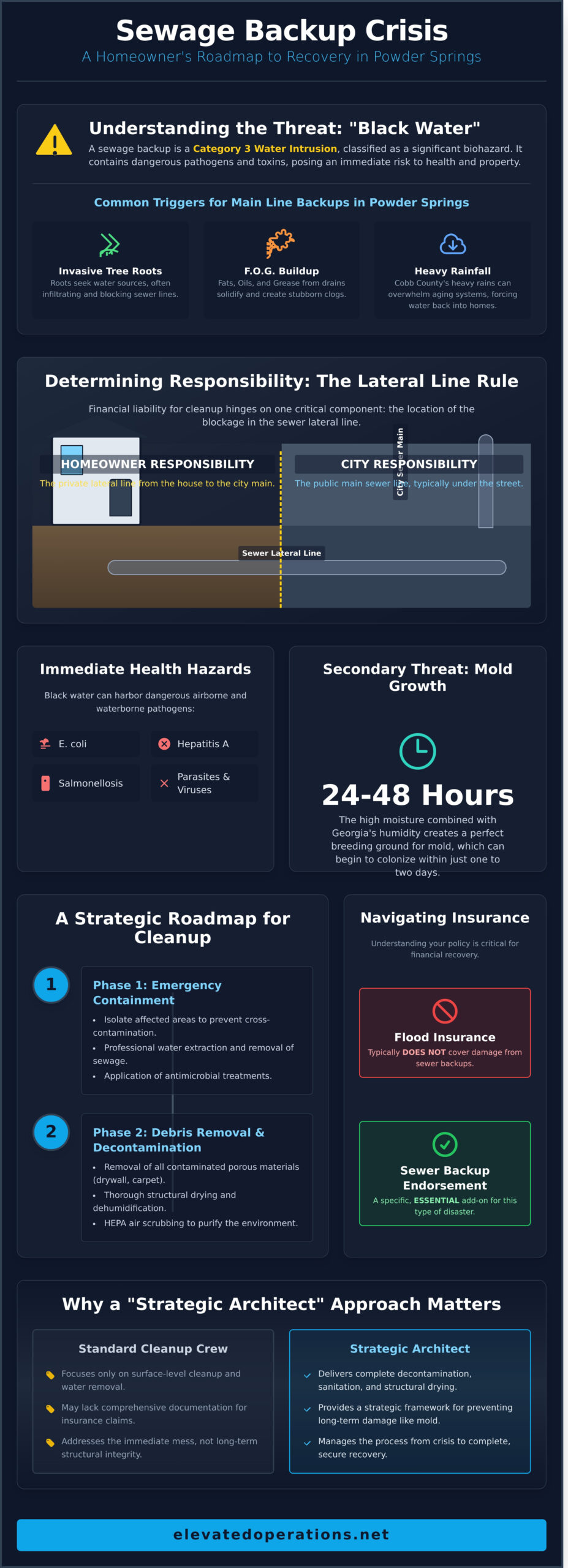
It is critical to distinguish between a simple drain clog affecting a single fixture and a main sewer line failure, which impacts the entire property. In Powder Springs, common triggers for main line backups include invasive tree roots and the buildup of FOG (Fats, Oils, and Grease) within the municipal infrastructure. These existing vulnerabilities are often exacerbated by Cobb County’s heavy rainfall, which can overwhelm aging sewer systems and force contaminated water back into properties. Category 3 water is defined as a liquid containing significant pathogens and toxins harmful to humans.
Health Hazards and Biohazard Risks
The health risks associated with a raw sewage overflow are severe and non-negotiable. A thorough approach to sewage backup cleanup in Powder Springs must address these threats directly. The water and saturated materials can harbor dangerous pathogens, including:
- E. coli
- Hepatitis A
- Salmonellosis
- Parasites and other viruses
A deeper dive into understanding sewage contamination reveals a complex mixture of biological and chemical waste. Beyond direct contact, harmful bacteria and viruses can become airborne, necessitating professional-grade air scrubbers and HEPA filtration to purify the environment. Furthermore, the high moisture content from a backup, combined with Georgia’s inherent humidity, creates the perfect breeding ground for rapid-onset mold growth, which can begin in as little as 24-48 hours and introduce a secondary health threat.
Determining Responsibility: The Powder Springs Lateral Line Rule
When you’re facing a sewage backup, the first critical question is not “how,” but “who.” The answer determines financial liability and the immediate course of action. In Powder Springs, responsibility hinges on a single piece of infrastructure: the sewer lateral line. This is the pipeline connecting your home’s plumbing to the city’s main sewer line. Understanding this division is the foundational step toward an efficient and correctly managed cleanup.
The city’s responsibility begins at the main sewer line, typically located under the street. Your responsibility covers the entire lateral line, from where it exits your home to the point it connects with that city main. Before initiating a comprehensive sewage backup cleanup in Powder Springs, it’s vital to diagnose the blockage’s location. A few key indicators can help:
- Isolated vs. Widespread Issues: If only one drain is backing up, the problem is likely isolated to your home’s internal plumbing. If all drains are affected, the blockage is probably in your main lateral line or the city’s sewer.
- Neighboring Problems: If your neighbors are experiencing similar issues, the bottleneck is almost certainly in the city’s main sewer line.
Documenting these initial observations with photos or videos provides a clear record of the event’s origin, which is invaluable for both insurance claims and coordinating with municipal authorities.
Homeowner Maintenance Requirements
Powder Springs ordinances require homeowners to maintain their private lateral lines, ensuring they remain free of obstructions like grease, debris, and invasive tree roots. Your property’s cleanout-a capped pipe providing direct access to the lateral line-is the primary access point for a plumber to diagnose and clear these blockages. It is crucial to distinguish between service providers: a plumber addresses the cause of the clog, while a restoration specialist handles the aftermath, providing the expert sanitation and structural drying required for a safe recovery.
While they are based in the UK, the comprehensive services offered by specialists like Plumbing & Boilers London serve as a good example of the expertise required to diagnose and resolve the underlying plumbing failures that cause backups.
Working with Powder Springs Public Works
If you suspect the issue originates in the city’s infrastructure, contact the Powder Springs Water/Sewer Supervisor, located on Springs Industrial Drive. The city is responsible for maintaining its 73-mile sewer system and will dispatch a crew to inspect the main line. Obtaining a report from their inspection is a critical piece of documentation. This official assessment helps establish the source of the backup, which is essential when navigating water damage insurance claims and proving liability. A clear paper trail simplifies the entire process, ensuring your claim is processed smoothly and effectively.
A Strategic Roadmap for Sewage Backup Cleanup
A successful sewage remediation is not a chaotic scramble; it is a meticulously executed strategic plan. Our process for sewage backup cleanup in Powder Springs is designed to move from emergency containment to full restoration with precision and control. This roadmap ensures every health risk is neutralized and the structural integrity of your property is preserved, establishing a solid foundation for recovery.
We organize our response into five distinct, critical phases:
- Phase 1: Emergency Stabilization and Biohazard Containment. Our first priority is to stop the source of the backup, assess the extent of the contamination, and establish a containment zone to prevent cross-contamination.
- Phase 2: Specialized Water Extraction and Debris Removal. We use powerful, truck-mounted extraction systems to remove all standing blackwater and contaminated solids from the affected area.
- Phase 3: Deep Sanitization and Industrial-Grade Deodorization. Once the area is clear, we begin a multi-step cleaning and sanitization process to eliminate dangerous pathogens and odors.
- Phase 4: Structural Drying and Moisture Monitoring. We deploy advanced drying equipment to remove residual moisture from the air, flooring, and wall cavities.
- Phase 5: Final Clearance Testing and Restoration Planning. Before any reconstruction begins, we verify that the area is completely sanitized, dry, and safe for reoccupation.
Advanced Mitigation Techniques
To achieve complete remediation, we utilize industry-leading technology and methods. Our professional sanitization involves EPA-registered, hospital-grade disinfectants specifically designed to eliminate Category 3 waterborne pathogens. We implement the “Flood Cut” method-removing drywall at least 12 inches above the visible water line-to address hidden contamination. Simultaneously, industrial-grade dehumidifiers and HEPA air scrubbers work to capture airborne particulates and neutralize persistent odors at their source.
Structural Drying and Integrity
Hidden moisture is the primary threat to your home’s long-term health. Sewage can travel upward through porous materials like drywall and wood studs in a process called “wicking.” We use calibrated moisture meters to meticulously test subfloors, wall cavities, and framing, ensuring all materials are brought below a 15% moisture content. This scientific approach prevents future mold growth and prepares the clean “canvas” of your home for the final reconstruction phase.
Insurance and Documentation: Navigating the Financial Recovery
The aftermath of a sewage backup extends beyond the physical cleanup; it initiates a complex financial recovery process. A critical distinction many property owners overlook is that standard flood insurance rarely covers this type of event. Coverage typically requires a specific “Sewer Backup Endorsement” on your homeowner’s policy. Navigating this landscape requires an operational partner who can translate on-site realities into the precise language of insurance claims.
At Elevated Operations, we serve as your strategic advocate, ensuring the documentation foundation is built for a full and fair payout. We meticulously differentiate between salvageable and non-salvageable contents, creating a detailed inventory that leaves no room for ambiguity. This process culminates in a comprehensive “Scope of Work” that outlines every necessary step, from biohazard remediation to final reconstruction, providing the carrier with an undeniable roadmap for your claim.
The Claims Process for Biohazards
A successful sewage claim is built on irrefutable evidence. We establish this with exhaustive digital photo and video documentation, capturing the extent of contamination before any work begins. This data supports the “Proof of Loss” statement we help you prepare, ensuring it is submitted with executive-level precision. Crucially, we communicate directly with adjusters to justify the use of specialized biohazard rates, a necessary expense often underestimated by standard adjusters but vital for a safe and complete sewage backup cleanup in Powder Springs.
Maximizing Your Restoration Budget
We apply a Fractional COO approach to your property’s recovery, balancing immediate mitigation costs with long-term reconstruction needs to optimize your timeline and budget. This strategic oversight helps you avoid the “Sunk Cost Fallacy”-the mistake of investing money to clean heavily contaminated porous materials like drywall or carpeting when replacement is the safer and more cost-effective solution. Our goal is to elevate your entire recovery operation, ensuring every dollar is allocated for maximum impact and a swift return to normalcy.
Elevating Your Recovery with Elevated Operations
A property disaster is more than a mess; it’s a critical breakdown in your home’s operational infrastructure. Where a standard crew sees a job site, we see a complex ecosystem requiring a Strategic Architect. Our approach transcends mere cleanup, focusing instead on a comprehensive roadmap to recovery. We don’t just remove the problem; we rebuild the foundation, ensuring your property is not only restored but fortified for the future. This is the pivotal difference between a temporary fix and a permanent, elevated solution.
The Elevated Difference in Powder Springs
With over 20 years of experience fixing the “plumbing” of property disasters, we bring a level of calm authority to operational chaos. Our local presence on Riverview Rd SE ensures we can deploy rapidly to Powder Springs, Austell, and Mableton, providing the decisive leadership your family or business needs. We assess the damage, we structure the response, and we execute with precision, transforming a moment of crisis into a clear path forward.
Our comprehensive process for sewage backup cleanup in Powder springs is designed to manage the entire project lifecycle. We seamlessly transition from emergency mitigation-the immediate containment and sanitation-to high-quality property reconstruction. This integrated system ensures every phase of your restoration is managed with strategic oversight, eliminating the bottlenecks and communication gaps that often plague multi-contractor projects. Your recovery becomes a single, streamlined operation.
Your Next Steps to Restoration
While our emergency response team is en route, your safety is the immediate priority. We advise you to take the following precautions to protect your family and property:
- Avoid Contact: Keep children and pets away from the affected area to prevent exposure to harmful contaminants.
- Stop the Source: If you can safely do so, shut off the main water supply to your property.
- Electrical Safety: Do not use any electrical appliances or outlets in or near the contaminated area. If there is standing water, turn off the power at the breaker box if it is in a dry location.
The first step toward a complete recovery is a professional assessment. Contact us immediately to initiate a thorough inspection of the damage. We will define the scope of work and provide a clear, actionable plan to restore your home’s ecosystem. Elevate your recovery process with our expert sewage cleanup team and partner with a team that builds back better.
Your Strategic Path to a Full Recovery
A sewage backup is a significant disruption, but a structured recovery is entirely achievable. This guide has provided a strategic roadmap, from understanding the complexities of biohazard contamination to navigating local rules and insurance claims. Executing a successful sewage backup cleanup powder springs residents can trust requires more than just equipment-it demands precision, expertise, and a clear plan for restoration.
The IICRC Certified Biohazard Specialists at Elevated Operations are your strategic partners in this process. We provide 24/7 emergency response for Powder Springs and Austell, expert insurance documentation support, and a commitment to restoring your property’s foundation of safety and stability. Let us manage the complexities so you can focus on moving forward with confidence.
Partner with the Strategic Architects of Restoration-Contact Elevated Operations Now
Frequently Asked Questions
Is a sewage backup covered by standard homeowners insurance in Georgia?
Standard Georgia homeowners insurance policies typically exclude damage from sewer or drain backups. This coverage usually requires a specific endorsement or rider added to your policy. We advise reviewing your policy documents or contacting your agent to confirm your coverage. Our team is experienced in documenting damage for insurance claims and can provide the necessary reports to support your filing, ensuring a clear and structured process.
How long does the professional sewage cleanup process typically take?
The timeline depends on the extent of contamination and the materials affected. A contained incident might take 1-3 days, while a significant event involving multiple rooms or structural saturation could take 5-7 days or longer. Our process is systematic: we assess, extract, sanitize, and dry. This structured approach ensures every phase is completed thoroughly, establishing a solid foundation for full restoration and your peace of mind.
Can I stay in my home while the sewage cleanup is being performed?
For your safety, we strongly recommend against staying in the home during active cleanup and sanitation. Raw sewage contains dangerous pathogens, bacteria, and viruses that can become airborne. Our technicians use specialized Personal Protective Equipment (PPE) to operate safely. Relocating temporarily ensures your family is not exposed to these health hazards while we work to restore a safe and clean living environment for your return.
What is the “lateral line” and why is it important for Powder Springs residents?
The sewer lateral line is the underground pipe connecting your home’s plumbing to the municipal sewer main. In Powder Springs, as in most cities, the homeowner is responsible for the maintenance and repair of this line. Clogs from tree roots, grease, or pipe degradation in your lateral line are a primary cause of sewage backups. Understanding this responsibility is crucial for preventative maintenance and addressing the root cause of a backup.
What should I do if sewage backs up into my bathtub or shower?
First, cease all water usage in your home to prevent more sewage from entering. Avoid contact with the contaminated water and keep children and pets away from the area. Do not use consumer-grade chemical cleaners, as this can be ineffective and hazardous. Your immediate next step should be to call a professional for emergency sewage backup cleanup in Powder Springs to safely address the contamination and diagnose the plumbing issue.
How do you ensure the smell of sewage is permanently removed?
Permanent odor removal is a core component of our restoration roadmap. It is not about masking the smell; it is about eliminating the source. This involves removing all contaminated materials, deep cleaning structural elements with antimicrobial agents, and thoroughly drying the area. We then deploy advanced equipment like hydroxyl generators to neutralize any lingering odor-causing particles in the air and within porous surfaces, ensuring your home’s air quality is fully restored.
Do I need to throw away everything that touched the sewage water?
A professional assessment is critical. Porous materials like carpet, drywall, and upholstered furniture that absorb contaminated water are typically unsalvageable and must be discarded for health reasons. However, non-porous items such as glass, metal, and hard plastics can often be professionally cleaned, sanitized, and restored. We conduct a detailed evaluation to determine what can be safely salvaged, optimizing the restoration process and minimizing your losses.
What is the difference between sewage cleanup and standard water damage restoration?
The critical difference is the contamination level. Standard water damage often involves “clean water” from a supply line. Sewage cleanup addresses “black water,” which is grossly contaminated with pathogens and toxins. This distinction demands a far more rigorous protocol. We don’t just dry; we decontaminate, we sanitize, and we verify. The process requires specialized PPE, antimicrobial treatments, and strict disposal procedures to ensure the property is biologically safe.