
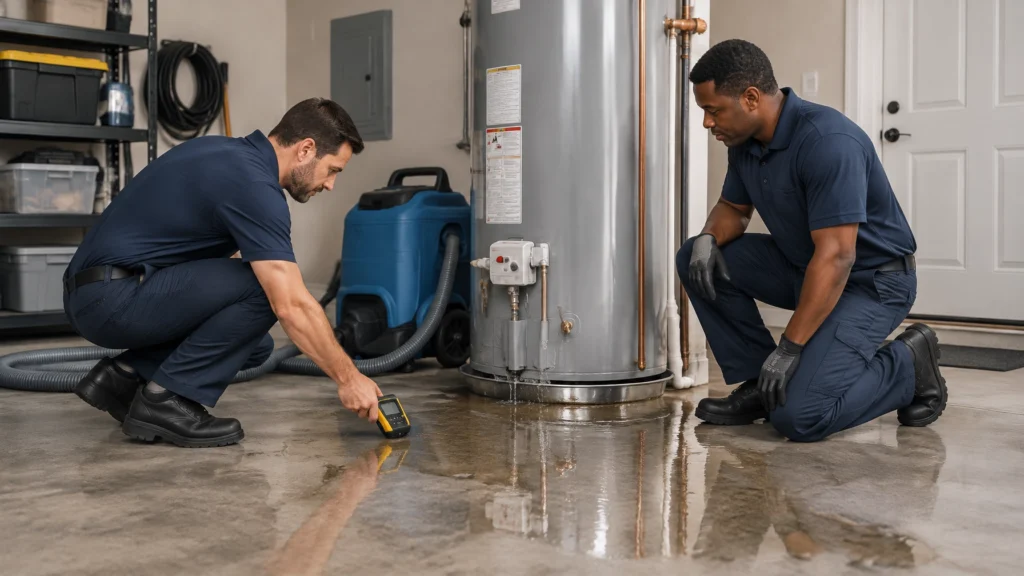
A water heater leak needs quick action: shut off the cold-water supply and the heater’s power or gas, then contain the water if it is safe to do so. A fitting or valve repair may cost about $150–$400, while a full tank replacement can run $1,500–$3,500. In Metro Atlanta, water damage can become the larger expense if wet materials are not dried within 24–48 hours.
Written by Chris Kwangwari · Owner, Elevated Operations · IICRC-Certified Restoration Contractor
Related Questions People Ask Next
Is a water heater leak an emergency?
A small drip contained in a pan may allow time to schedule a plumber, but shut off the source and dry the area now. A steady stream, a leaking tank bottom, or water reaching a room below needs an immediate response.
Does a leak at the bottom mean I need a new water heater?
Often, yes. Water coming from a corroded tank body or seam usually means the steel tank has failed and cannot be reliably patched. First rule out water running down from a top fitting or leaking drain valve.
Will homeowners insurance cover water damage from a water heater?
A sudden, accidental failure may be covered, subject to your policy and deductible. Damage from a slow leak or long-term corrosion is often treated as a maintenance issue. The water heater itself may not be covered.
What to Do in the First 10 Minutes
- Turn off power or gas safely. For an electric heater, switch off its breaker before touching the heater or standing water. For a gas heater, turn the control to OFF or PILOT if it is safe to approach. If you smell gas, leave the home and call the gas company from outside.
- Close the cold-water inlet valve on the pipe entering the top of the tank. If there is no accessible valve, or it will not turn, shut off the home’s main water supply. Do not force a corroded valve.
- Contain the water with towels and a bucket if the water is not hot and the area is safe. Do not touch electrical equipment or wiring near water.
- Move belongings out of the wet area, including stored items, rugs, and boxes. Avoid walking through water if there may be an electrical hazard.
- Take photos and video of the leak, water, affected rooms, tank label, and any visible damage before cleanup. Note when you discovered it.
- Call for help. Contact a licensed plumber to diagnose and repair or replace the heater. If water has spread into flooring, walls, ceilings, or another room, call a restoration company promptly and notify your insurer.
Is This a Water Heater Emergency?
| What you see | What to do |
|---|---|
| Small drip from a fitting, contained near the heater | Schedule a plumber today; shut off the source and dry the area now. |
| Steady stream or water coming from the tank bottom | Emergency. Shut off water and power/gas safely, then call for help now. |
| Water spreading beyond the pan or into a room below | Emergency. Call a restoration company immediately to assess and dry affected materials. |

Find Where the Water Is Coming From
Water from a fitting near the top can run down the outside of the tank and collect underneath. So a water heater leaking from bottom does not automatically mean the tank itself has failed. Dry the exterior only if safe, then watch for where new water appears. If you cannot identify the source, leave it to a plumber.
| Where the water appears | Likely cause | Repair or replace? | Typical repair estimate* |
|---|---|---|---|
| Top fittings or connections | Loose or corroded supply fitting, connector, or nipple | Often repairable | $150–$400 |
| T&P relief valve or its discharge pipe | Faulty valve, excessive pressure, or overheating | Diagnose promptly; valve may be replaceable | $150–$400 |
| Drain valve near the bottom | Loose, worn, or damaged valve | Often repairable; a plumber should assess it | $150–$400 |
| Bottom seam or tank body | Corrosion or failure of the steel tank | Usually replace the tank; do not patch rust-through | $1,500–$3,500 |
| Flue or venting area | Condensation or a venting issue, especially during operation | Needs inspection to distinguish condensation from a leak | Varies |
| Drain pan | Water from a leak above, a clogged drain, or a damaged pan | Find the source; a pan does not repair a leaking heater | Varies |
*Typical planning ranges, not a quote. Actual cost varies with heater type, parts, access, labor, and local conditions. If the T&P valve is discharging, do not cap or block its outlet: it may be releasing excess temperature or pressure, which needs professional attention.
A leak from the top is often a relatively inexpensive repair. Supply fittings, nipples, and some T&P valve problems can be fixed without replacing the tank. By contrast, water coming through the tank body or a rusted bottom seam usually means the tank has failed. Do not let anyone sell you a patch for a rusted-out tank as a lasting repair.
Safety Comes First
Tank water may be 140°F or hotter, so a puddle can cause a serious burn. An electric water heater and water create a shock risk: turn off the breaker before touching the heater, nearby equipment, or water. For gas, leave the house if you smell gas; call the gas company from a safe location. A T&P valve releasing water is a warning of a possible temperature or pressure problem, not a reason to plug the valve.
Why the Water Damage Can Cost More Than the Heater
A leak can travel beneath flooring and into subfloor, drywall, baseboards, insulation, and wall cavities. In Metro Atlanta, many homes have a water heater in an attic, garage, or second-floor closet. A leak in one of those locations may go unnoticed until water stains a ceiling or reaches a room below.
Mold can begin growing within 24–48 hours when moisture and conditions allow. That is why a prompt response matters: a small, clean-water loss caught early may remain a drying job. If water sits and materials stay wet, the scope can grow to include demolition, disposal, and reconstruction.
The IICRC S500 is a professional standard used in water damage restoration. It describes water categories based on contamination: Category 1 is clean water from a sanitary source, Category 2 is significantly contaminated, and Category 3 is grossly contaminated. Category can change as water contacts materials or remains in place. A typical water heater supply leak may start as Category 1, but the source and conditions matter; a qualified restorer assesses the loss rather than assuming it stays clean.
For more on professional water damage restoration and emergency water removal, see Elevated Operations’ service pages.

Water spreading beyond the heater? Call Elevated Operations at (770) 404-6895. Our IICRC-certified restoration team responds 24/7 and typically arrives within 60 minutes across Metro Atlanta. A plumber repairs the heater; our team handles water extraction, structural drying, and restoration.
Water Heater Leak Repair Cost and Restoration Costs
A water heater leak repair cost depends on whether the problem is a replaceable fitting or valve, or a failed tank. For planning, a fitting or valve repair may run about $150–$400. A full tank replacement may range from $1,500–$3,500, depending on the unit and installation. These are estimates, not a quote, and a plumber must confirm the cause and scope.
Water damage restoration is a separate cost. National industry estimates put a typical water-damage loss at roughly $1,300–$5,600. A contained leak may cost less; water affecting multiple rooms, subfloor, ceilings, or wall cavities can cost more. The figures are not local quotes: the final scope depends on affected materials, moisture readings, water category, equipment and drying time. See our Georgia water damage restoration cost guide for more context.
On a covered claim, the homeowner typically pays the policy deductible, subject to coverage limits and exclusions. Elevated Operations bills insurance carriers directly and assists with qualifying deductibles up to $1,000. We document the damage and help navigate the claim; coverage decisions remain with your insurer.
Will Insurance Cover a Water Heater Leak?
Homeowners insurance often covers resulting damage from a sudden, accidental water heater failure, depending on the policy. A slow leak tied to long-term corrosion, deterioration, or lack of maintenance is commonly denied as a maintenance issue. The appliance replacement itself may also be excluded, even when resulting water damage is covered. Review your policy and contact your insurer promptly.
To help document a claim:
- Record the discovery date and, if known, when the leak began.
- Photograph the heater, leak source, standing water, and affected rooms before cleanup.
- Keep receipts and note the steps you took to limit further damage.
- Do not throw out the failed fitting, valve, or tank before checking with your insurer or plumber.
Elevated Operations can document the affected building materials and coordinate directly with the carrier for restoration work.
How to Reduce the Risk of Another Leak
- Flush the tank annually, following the manufacturer’s instructions or a plumber’s advice.
- Ask a plumber to check the anode rod every 2–3 years. Georgia’s hard water can contribute to faster mineral and rod degradation.
- Set the thermostat to 120°F to help reduce scald risk.
- Have worn supply hoses and a faulty T&P valve replaced by a qualified plumber.
- Install a drain pan and a leak sensor, especially under heaters in closets or attics.
- Find and test your home’s main water shutoff before an emergency.
Frequently Asked Questions
How do I know if my water heater is leaking from the top or bottom?
Dry the outside only if it is safe, then observe where new water appears. Water starting at a top connection may run down and collect beneath the tank. Water emerging through the tank seam or body suggests tank failure. A plumber can confirm the source.
Can I keep using the water heater if it is leaking?
Turn it off and stop the water supply while the leak is assessed. Do not operate a heater that may be empty, damaged, or leaking near electrical or gas components. Ask a plumber when it is safe to restart.
How quickly should water damage be dried?
As soon as possible. Water can spread into concealed building materials, and mold may begin growing within 24–48 hours when conditions are favorable. Prompt extraction and professional drying can help limit the scope.
Who should I call first: a plumber or a restoration company?
Call a plumber to repair or replace the water heater. Call a restoration company as well if water has spread beyond the immediate area, soaked building materials, or reached another floor. If there is a gas smell, leave and call the gas company first.
How fast can Elevated Operations respond in Metro Atlanta?
Our team responds 24/7 and typically arrives within 60 minutes across Metro Atlanta. Call (770) 404-6895. Our restoration work is performed by IICRC-certified technicians and is backed by a 12-month warranty.
Call for Water Damage Help in Metro Atlanta
If a heater leak has soaked flooring, walls, ceilings, or belongings, Elevated Operations can help with emergency extraction, structural drying, insurance coordination, and reconstruction through one team. We serve Cobb, Fulton, DeKalb, Douglas, Clayton, Henry, and Paulding counties, including Mableton, Sandy Springs, Marietta, Smyrna, Powder Springs, Austell, and Kennesaw.
Call (770) 404-6895 for 24/7 emergency response, typically within 60 minutes. Our IICRC-certified technicians provide direct insurance billing for restoration work and a 12-month warranty.
Sources
- ANSI/IICRC S500 Standard for Professional Water Damage Restoration
- U.S. Environmental Protection Agency: Mold
- Angi: Water damage restoration cost estimates
- Angi: Water heater repair cost estimates
- Angi: Water heater replacement cost estimates
About the Author
Chris Kwangwari is the owner of Elevated Operations, a Metro Atlanta property damage restoration company. The company’s IICRC-certified technicians respond to water emergencies and coordinate mitigation, drying, and reconstruction for residential and commercial properties.
Content reviewed and updated November 2026.