
The initial mitigation team left two weeks ago, but now your property sits in limbo. Your contractor has become unreachable, the insurance adjuster is questioning every line item, and a permitting delay in Fulton County has brought all progress to a complete halt. It’s a frustratingly common scenario where the recovery phase becomes a bigger disaster than the initial event itself.
This operational bottleneck is where many well-intentioned rebuilds fail, costing owners time, capital, and peace of mind. This guide provides a strategic roadmap to navigate the journey from a stabilized site to a fully restored asset. We will show you how premier reconstruction services atlanta can transform a chaotic process into a streamlined operation that elevates your property’s final value and reduces your stress. We’ll break down the critical phases of a successful rebuild, from mastering insurance negotiations to implementing a communication framework that provides total transparency until you’re ready for move-in.
Key Takeaways
- Learn why the transition from emergency mitigation to full reconstruction is a critical strategic phase that prevents costly operational bottlenecks in your recovery.
- Discover how to navigate the complex ecosystem of local permits and building codes in Atlanta to ensure your project’s foundation is compliant and secure.
- Understand the significant advantages of choosing integrated reconstruction services atlanta, which streamlines communication and ensures consistent quality from mitigation to final rebuild.
- See how a customized reconstruction roadmap is developed based on the specific “DNA” of your property’s damage, whether from fire, water, or severe storms.
The Strategic Transition: From Emergency Mitigation to Atlanta Reconstruction
The immediate aftermath of a disaster is about control. It’s a phase defined by emergency mitigation, where the primary objective is to stop the bleeding: tarping the roof, extracting water, and stabilizing the environment. This is the critical first response. A strategic error occurs, however, when this defensive posture extends beyond its purpose. The transition from temporary stabilization to permanent rebuilding represents the most pivotal moment in your property’s recovery, a moment where the entire trajectory of your asset’s value is determined.
For many Mableton homeowners, a ‘wait and see’ approach after mitigation creates significant operational bottlenecks. The project stalls, momentum is lost, and the property languishes in a state of suspended damage. This pause isn’t just a delay; it’s a strategic retreat. It’s here that a crucial psychological shift must occur. The mindset must evolve from merely ‘stopping the damage’ to proactively ‘elevating the asset.’ This is the precise point where reconstruction begins, transforming a reactive crisis into a proactive opportunity to rebuild with greater strength, efficiency, and value than before.
Restoration vs. Reconstruction: Knowing the Difference
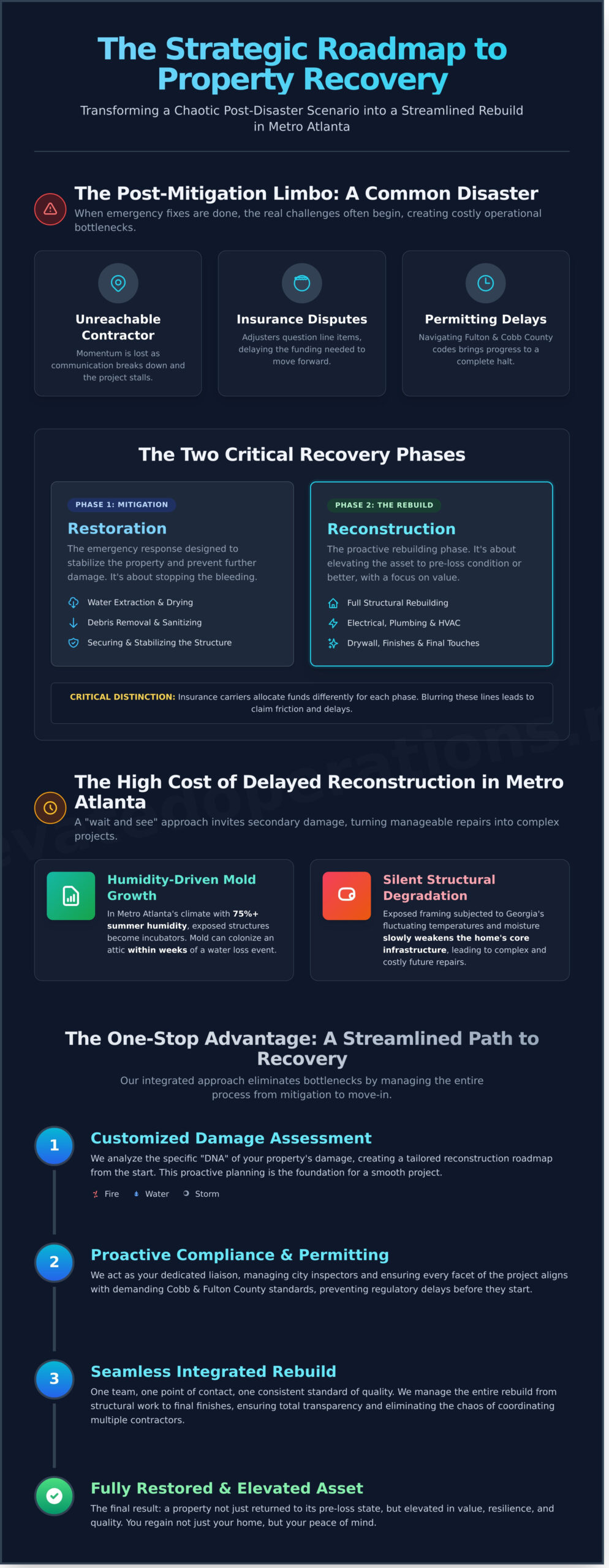
Understanding the distinction between these two phases is fundamental to a successful recovery. They are not interchangeable, and confusing them often leads to significant insurance claim friction in Georgia. Think of it this way:
- Restoration (Mitigation): This is the emergency response. It involves cleaning, sanitizing, drying affected areas, and removing debris. Its goal is to stabilize the property and prevent further damage.
- Reconstruction: This is the rebuilding phase. It encompasses carpentry, electrical work, plumbing, drywall, and the complete structural rebuilding of damaged sections of your home.
The initial cleaning and sanitizing phase is foundational to a successful recovery. While this guide focuses on reconstruction in Atlanta, it’s helpful to see how specialists approach this first step. For example, professional cleaning companies like Master Services showcase the meticulous processes involved in disinfection and site preparation, which are crucial before any rebuilding can begin.
Insurance carriers allocate funds and processes differently for each phase. When a claim blurs these lines, it can trigger reviews, require additional documentation, and ultimately delay the funding needed to move your project forward.
The Risk of Delayed Reconstruction in Metro Atlanta
Delaying the start of reconstruction is an invitation for secondary damage. In the Metro Atlanta climate, where summer humidity levels consistently climb above 75%, an exposed and unconditioned structure is a prime incubator for new problems. We’ve seen humidity-driven mold growth colonize Marietta attics within weeks of a water loss event, turning a manageable repair into a complex remediation project. Beyond mold, structural degradation is a silent threat. Exposed framing, subjected to Georgia’s fluctuating temperatures and moisture, slowly weakens the home’s core infrastructure, creating complex issues that must be addressed according to strict local building codes to ensure future safety. Reconstruction is the systematic replacement of unsalvageable structural elements to pre-loss or better conditions.
Beyond environmental risks, a vacant property undergoing reconstruction is a prime target for theft, vandalism, and other security breaches. Managing this exposure is a critical aspect of protecting your investment during the vulnerable rebuilding phase. For high-value assets or complex situations, specialized firms providing executive protection services georgia can secure the site, mitigate risks, and ensure your property remains safe throughout the project.
This is where Elevated Operations steps in, not as a mere contractor, but as the Strategic Architect of your home’s new foundation. We manage the seamless transition from mitigation to rebuilding, eliminating the costly bottlenecks that plague typical recovery efforts. Our approach to reconstruction services atlanta is built on a forward-looking roadmap. We don’t just replace what was lost; we analyze the infrastructure, identify opportunities for improvement, and implement a plan that elevates your property’s resilience and long-term value.
Navigating the Atlanta Reconstruction Ecosystem: Permits, Codes, and Compliance
A successful rebuild is defined by more than its visible structure; its true foundation lies in the unseen framework of regulatory compliance. For any significant property restoration, navigating the complex administrative ecosystem of Cobb and Fulton Counties is the critical first step. This is where many projects stall, caught in a web of permits, zoning ordinances, and code inspections. We see compliance not as a bureaucratic task, but as the non-negotiable plumbing of a successful project. Without it, even the most ambitious vision will fail to hold water.
Our role as your Strategic Architect extends far beyond the physical build. We are your dedicated liaison, managing city inspectors and ensuring every facet of the project aligns with demanding regional standards. Elevated Operations is engineered to keep your project on its intended trajectory by preempting the regulatory hurdles that create costly delays. We don’t just react to problems; we build a strategic roadmap that anticipates them. This proactive oversight ensures that the complex world of providing reconstruction services atlanta is managed with precision from day one.
Permitting Nuances in Mableton, Austell, and Powder Springs
The permitting process in Metro Atlanta is not one-size-fits-all. Structural repairs in unincorporated Cobb County areas like Mableton are governed by a different set of protocols than those within Marietta city limits, where historic preservation overlays add another layer of complexity. For homes in Marietta’s historic districts, understanding “grandfathered” codes and their limitations is essential. We audit your property’s complete permit history and zoning status to build a seamless approval strategy from the outset.
Georgia Building Codes and Insurance Standards
Georgia’s adoption of the 2026 International Building Codes (IBC) will introduce new requirements for structural integrity and energy efficiency. This often creates a significant bottleneck in insurance-funded reconstruction. Why? Insurers are obligated to restore your property to its previous condition, but the county requires you to build to the current code. We leverage our 20+ years of experience to bridge this gap, expertly documenting and justifying these necessary code upgrades to insurance adjusters, ensuring your project is funded correctly and built to last.
Anticipating these challenges is the core of our operational strategy. We meticulously manage every detail, from initial plat surveys in Fulton County to final inspections in Cobb, eliminating the friction points that derail timelines and inflate budgets. This deep institutional knowledge is what separates a reactive builder from a strategic partner. If your project demands a higher level of oversight, explore the framework our team uses to guarantee compliance and protect your investment.
The One-Stop Advantage: Why Integrated Mitigation and Reconstruction Wins
Property damage creates immediate chaos. The conventional response, hiring one company for mitigation and another for rebuilding, only compounds the problem. This fractured approach introduces operational friction, communication bottlenecks, and conflicting timelines. It’s a recipe for delays and costly rework. A truly strategic recovery requires a unified project ecosystem where mitigation and reconstruction are two phases of one seamless operation, managed under a single, accountable leadership structure.
Operations as the Foundation: The Unified Model
The critical failure point in a multi-vendor project is the information gap. The water mitigation team may achieve perfect drying standards, but their data on structural moisture content often fails to reach the master carpenter. This disconnect leads to materials being installed over inadequately prepared substrates, causing future failures. Our model eliminates this risk. A single project manager oversees the entire trajectory, ensuring the drying plan directly informs the reconstruction roadmap. This reduces property downtime by design, not by chance.
Comparing Single-Source vs. Multi-Vendor Models
Choosing a partner for reconstruction services atlanta is a critical business decision. The operational model you select directly impacts your timeline, budget, and peace of mind. The contrast between a single-source provider and a collection of independent vendors is stark.
- Accountability: With multiple vendors, warranty issues become a maze of finger-pointing. The drywall contractor blames the plumber; the plumber blames the mitigation crew. In our single-source model, we own the entire outcome. Our warranty covers the project from initial water extraction to the final coat of paint, providing you with a single point of accountability.
- Communication: Juggling five different contractors is a full-time job. We provide a “Fractional COO” approach to project management. Your dedicated project manager serves as your sole point of contact, delivering consolidated, executive-level updates on a pre-set schedule. You get total transparency without the administrative burden.
- Cost-Efficiency: A multi-vendor strategy means you pay multiple mobilization fees, administrative markups, and project management overheads. Our integrated model leverages a single, streamlined operational infrastructure. This consolidation reduces redundant costs, often lowering the total project expense by 5-10% compared to managing separate contractors.
This streamlined process also transforms the insurance claims experience. Instead of collating paperwork from multiple sources, your adjuster receives one comprehensive, professionally documented file. It’s a faster, cleaner, and more efficient path to getting your claim approved and your property restored with elevated precision.
Specialized Reconstruction for Fire, Water, and Storm Damage in Metro Atlanta
Property damage is never uniform. A fire in Marietta leaves a different structural signature than a flooded basement in Mableton. Effective reconstruction begins with a precise diagnosis of this unique damage profile, allowing us to develop a strategic roadmap that doesn’t just repair, but fundamentally elevates the property’s infrastructure for long-term resilience. We analyze the core damage, we define the optimal material and engineering solutions, and we execute with architectural precision.
Fire and Smoke Damage Reconstruction
A simple coat of paint will not solve a fire damage problem; it merely hides it. Soot particles, often smaller than 2.5 micrometers, penetrate deep into porous materials like wood framing and drywall, leading to persistent odors and potential health risks. Our process involves deep thermal cleaning and, where necessary, the complete replacement of smoke-charred structural components. This is also a critical opportunity to modernize. During a fire rebuild, we can upgrade your property’s entire electrical infrastructure to meet the latest 2023 National Electrical Code (NEC) standards, integrating AFCI protection to prevent future electrical fires. For the common concern of lingering smoke odor in wood, our solution is definitive: after a meticulous cleaning, we seal all affected framing with a shellac-based primer that permanently encapsulates any residual odor molecules, guaranteeing a clean and neutral environment.
Water and Storm-Related Structural Repair
Atlanta’s severe weather seasons demand more than a standard fix. Water and storm damage compromise a building from its foundation to its roof, and our approach to reconstruction services atlanta is built to counteract these specific threats. We don’t just replace what was lost; we optimize for future performance.
- Optimizing for Georgia Humidity: For basements and lower levels, we replace saturated materials with superior, moisture-resistant alternatives. This includes installing mold-resistant drywall and applying closed-cell spray foam insulation, which provides an R-value of up to R-7 per inch and acts as a certified vapor barrier.
- Strategic Drainage Infrastructure: To prevent a repeat flood event, reconstruction must include water management. We engineer and install integrated drainage systems, such as exterior French drains and interior perimeter drains connected to a high-capacity sump pump with a battery backup, ensuring functionality during storm-induced power outages.
- Securing and Replacing Damaged Doors: Storms and water intrusion frequently compromise entry points. Water can cause wood doors to swell and warp, while high winds can damage frames and hardware. For professional door repair and replacement in the Atlanta area, specialists like Liberty Door Repair can restore security and ensure new installations meet modern weather-resistance standards.
- Rebuilding for Wind and Impact: When load-bearing walls are compromised by wind or tree impact, we rebuild them to exceed current structural standards. This often involves replacing traditional lumber with engineered LVL (Laminated Veneer Lumber) beams and reinforcing roof-to-wall connections with hurricane ties rated for wind speeds over 140 mph.
Your property’s recovery is an opportunity to build back stronger, safer, and more resilient than before. By addressing the root cause of the damage with advanced materials and strategic engineering, we ensure the finished structure is prepared for the next 50 years, not just the next storm. To begin a detailed analysis of your property’s needs, schedule a comprehensive structural assessment to define your reconstruction roadmap.
Elevating Your Property: The Roadmap to Full Recovery with Elevated Operations
Recovering from property damage is an exercise in operational management. It’s a complex project with moving parts, critical deadlines, and significant financial stakes—a principle that applies across industries, from residential rebuilding to the offshore engineering projects managed by consultancies like Poseidon Offshore Energy. We approach it as such, applying a ‘Fractional COO’ philosophy to your home or business rebuild. Instead of leaving you to manage the chaos, we step in as your dedicated strategic partner, overseeing the entire recovery ecosystem so you don’t have to. We believe you shouldn’t have to become a general contractor overnight to reclaim your space.
Our role is to fix the ‘plumbing’ of your property’s operational recovery. We handle the complex logistics, vendor coordination, and quality assurance that cause bottlenecks and budget overruns. This frees you to focus on what matters most: running your business or living your life. With a 98% on-time project completion rate since 2018, our process is designed for precision, predictability, and peace of mind.
The Elevated Operations Process
Our methodology is transparent and structured, moving your project from crisis to completion with executive-level clarity. We audit, we create the roadmap, and we execute with unwavering attention to detail.
- Step 1: The Strategic Audit. This goes beyond a simple damage estimate. We conduct a comprehensive assessment to define the gap between your property’s current state and its optimal pre-loss condition. Our audits identify an average of 15% more efficiencies in resource allocation and material sourcing compared to standard industry assessments, laying the groundwork for a smarter rebuild.
- Step 2: The Roadmap. We deliver a transparent, actionable plan. This detailed roadmap outlines every phase of the reconstruction, complete with clear milestones, budget checkpoints, and communication protocols. You gain 24/7 access to our client portal to track progress, view photos, and communicate directly with your project lead. There are no surprises, only scheduled progress.
- Step 3: Execution. This is where vision becomes reality. Our approach to reconstruction services atlanta pairs high-quality craftsmanship with the seasoned executive oversight you’d expect in a corporate boardroom. From foundation work to the final walkthrough in your Powder Springs home, every detail is managed to an elevated standard of excellence.
Ready to Rise Above the Daily Grind of Property Damage?
Choosing a partner for your recovery is a critical decision. As a Mableton-based firm, our accountability is local and our reputation is built right here in the communities we serve. When your reconstruction partner is also your neighbor in Cobb County, you receive a level of commitment and accessibility that larger, impersonal firms simply can’t match. We don’t just rebuild structures; we restore stability for our fellow Atlanta residents.
This is a professional invitation to restore your property with strategic precision. Let us build the operational foundation for your recovery, allowing you to move forward with confidence. We manage the project so you can manage your future, ensuring the final result is not just a repair, but a true elevation of your space. Elevate your property recovery—contact Elevated Operations today.
Your Roadmap to a Fully Restored Atlanta Property
Property recovery in Atlanta isn’t just about rebuilding; it’s about re-establishing your foundation with strategic precision. A seamless transition from emergency mitigation to full-scale reconstruction, paired with expert navigation of local building codes, defines the path to a complete restoration. This integrated, one-stop approach ensures every detail is managed, from the initial 24/7 emergency call to the final walkthrough.
For property owners in Cobb and Fulton counties, this is where a true partner makes the difference. With over 20 years of dedicated Metro Atlanta experience, our Mableton-based team delivers comprehensive reconstruction services atlanta residents trust. We don’t just repair the damage; we architect a recovery plan that elevates your property’s integrity for the future.
Don’t settle for a simple repair. Partner with the Strategic Architects of Atlanta Reconstruction—Schedule Your Audit. Your property’s next chapter starts now. Let’s build it together, with strength and strategy.
Frequently Asked Questions About Reconstruction in Atlanta
How much do reconstruction services cost in Atlanta?
The cost for reconstruction services in Atlanta is determined by the project’s scale and complexity. A single-room restoration after water damage might cost between $5,000 and $15,000, whereas a complete structural rebuild can range from $175 to $250 per square foot. Factors like high-end material selections, intricate architectural details, and specific code compliance requirements influence the final investment. We provide a comprehensive, line-item estimate to ensure complete financial clarity for your project’s roadmap.
Does insurance cover the full cost of reconstruction after a fire or flood?
Insurance coverage is dictated by your policy’s specific terms, not a universal rule. A Replacement Cost Value (RCV) policy is designed to cover the full rebuild cost, minus your deductible. In contrast, an Actual Cash Value (ACV) policy only pays for the depreciated value of the damaged property, which often leaves a significant financial gap. We partner with you and your insurance adjuster, providing detailed documentation to help maximize your claim and streamline the financial recovery process.
How long does the reconstruction process typically take in Mableton?
A reconstruction project in Mableton typically follows a 3 to 9-month timeline. Smaller-scale restorations, like a kitchen rebuild, often conclude within 3 months. A full-scale structural reconstruction can extend to 9 months or more, contingent upon Cobb County permitting timelines, material supply chain logistics, and required inspection schedules. Our strategic project management establishes a clear roadmap from the start, optimizing every phase to ensure a predictable and efficient trajectory for your property’s restoration.
Do I need a separate architect for my reconstruction project in Marietta?
You likely won’t need a separate architect for a direct, “like-for-like” restoration in Marietta. However, if your vision includes altering the floor plan, making structural modifications, or adding square footage, stamped architectural plans are required by city and state building codes. Our integrated team includes design-build capabilities, allowing us to manage this process internally. This streamlines communication and ensures the architectural vision aligns perfectly with the reconstruction execution from day one.
Can I make upgrades to my home during the reconstruction phase?
Yes, the reconstruction phase presents a strategic opportunity to make significant upgrades. While your insurance policy generally covers restoring the property to its previous state, you can invest in elevating your space with features like enhanced insulation, modern fixtures, or an optimized floor plan. The cost of these upgrades is typically handled as a separate, out-of-pocket expense. We help you integrate these improvements seamlessly into the project scope, enhancing your property’s long-term value and functionality.
What is the difference between a general contractor and a reconstruction specialist?
A reconstruction specialist offers a highly focused skill set tailored to disaster recovery. While a general contractor excels at new construction, a specialist understands the intricate challenges of properties damaged by fire, water, or storms. This includes expertise in structural drying, smoke remediation, and navigating the complexities of insurance claims documentation. Our specialization ensures every decision is made to restore not just the structure, but its safety, integrity, and foundational value with precision.
How do I get a permit for reconstruction in Cobb County?
Obtaining a reconstruction permit in Cobb County requires submitting a formal application, structural plans, and a site plan to the Cobb County Community Development Agency’s permitting division. The review and approval process typically takes between 4 and 6 weeks, depending on project complexity. As your strategic partner, Elevated Operations manages this entire administrative process. We handle all documentation and municipal communication, removing this operational bottleneck so you can focus on the vision for your restored property.
Is Elevated Operations a licensed and insured reconstruction company in Georgia?
Yes, Elevated Operations is a fully licensed and insured reconstruction company operating in Georgia. We hold a State of Georgia Residential-Light Commercial Contractor License and carry comprehensive insurance policies that exceed state requirements, including a $2 million general liability policy and full workers’ compensation coverage. This foundational commitment to compliance and protection provides our clients with complete peace of mind and underscores our dedication to professional excellence on every project we undertake.