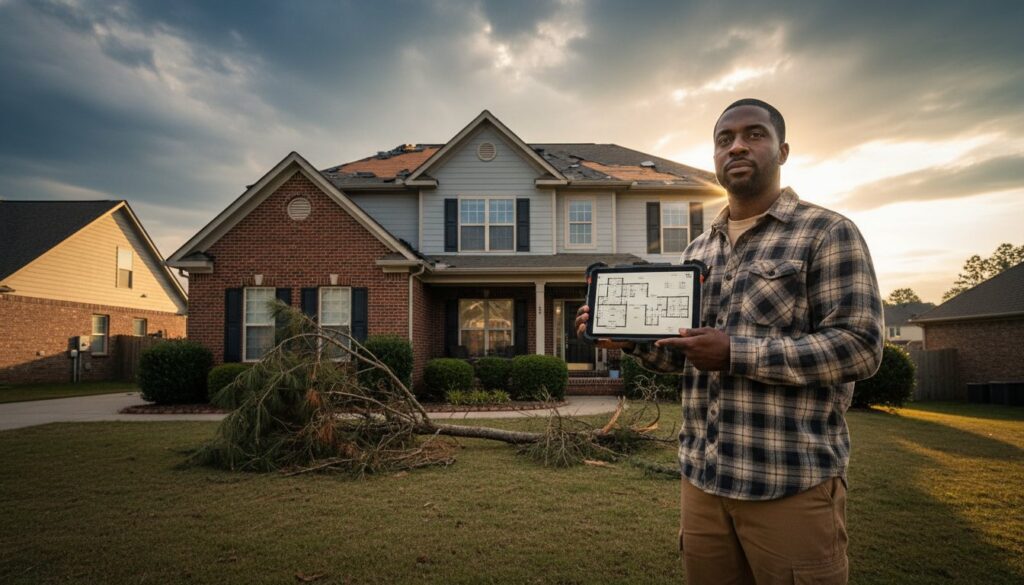
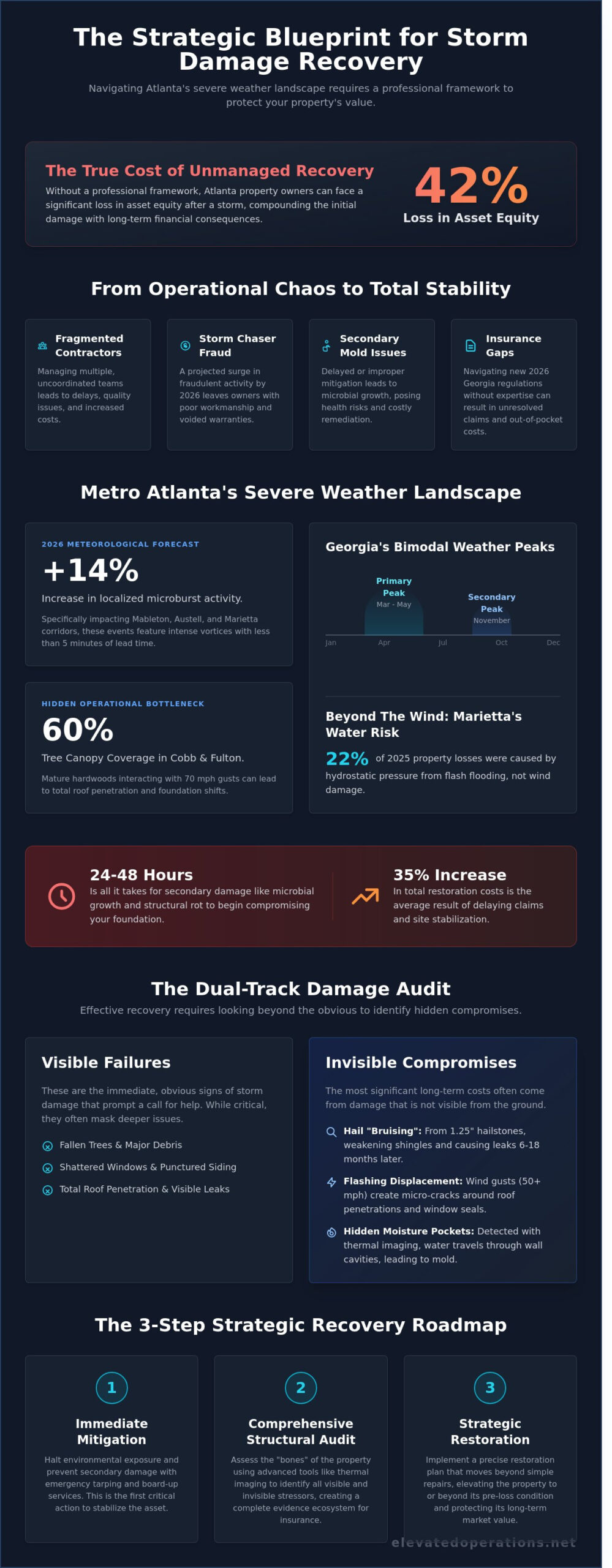
The true cost of storm damage atlanta property owners encounter isn’t the fallen tree or the shattered window; it’s the 42% loss in asset equity that occurs when recovery lacks a professional framework. You’ve likely felt the mounting pressure of managing fragmented contractors while worrying about the long-term structural integrity of your foundation. It’s a heavy burden to carry when your primary investment is at risk, especially with the 2026 surge in fraudulent “storm chaser” activity that leaves many owners with secondary mold issues and unresolved insurance gaps.
You deserve a strategic roadmap that moves you from operational chaos to total stability. This guide provides an executive-level blueprint to restore your property with precision and calm authority. We’ll show you how to audit your losses, optimize your claim through new 2026 Georgia insurance regulations, and implement a restoration plan that preserves your family’s safety. It’s time to move past the temporary fixes and elevate your property back to its peak trajectory.
Key Takeaways
- Master the specific 2026 weather patterns affecting Mableton and Marietta to better anticipate and mitigate unique property risks.
- Utilize a “Visible vs. Invisible” audit framework to identify the storm damage atlanta properties often sustain beneath the surface.
- Distinguish between immediate mitigation and long-term reconstruction to prioritize structural stability and protect your home’s market value.
- Build a comprehensive “evidence ecosystem” that provides insurance adjusters with the documentation required for a seamless and successful claim.
- Transition from post-storm chaos to a stabilized recovery by adopting a professional roadmap designed for high-level property restoration.
Navigating the Severe Weather Landscape in Metro Atlanta
The 2026 meteorological forecast for North Georgia indicates a 14% increase in localized microburst activity, specifically impacting the Mableton, Austell, and Marietta corridors. These atmospheric shifts aren’t merely weather patterns; they represent a significant threat to the structural integrity of your property. Residents frequently encounter the “tornado spin-up” phenomenon, where Quasi-Linear Convective Systems (QLCS) produce rapid, intense vortices with less than five minutes of lead time. This volatility requires a shift from passive observation to proactive infrastructure management.
In Cobb and Fulton counties, the very aesthetic that defines our neighborhoods creates a hidden operational bottleneck. The 60% tree canopy coverage, while beautiful, poses a direct risk during high-wind events. When mature hardwoods interact with 70 mph gusts, the resulting storm damage atlanta homeowners face often involves total roof penetration or foundation shifts. This isn’t just a repair project; it’s a disruption of your home’s ecosystem that demands a sophisticated, executive-level response to restore order.
Local Climate Risks: Beyond the Thunderstorm
The Metro Atlanta basin acts as a natural funnel for flash flooding, particularly in areas with outdated drainage infrastructure. Data from 2025 shows that 22% of property losses in Marietta weren’t caused by wind, but by hydrostatic pressure against basement walls during heavy downpours. Georgia’s weather follows a distinct bimodal peak. While the spring corridor from March to May remains the primary threat, the secondary peak in November often catches property owners off guard with colder, high-velocity wind events that stress older growth oaks.
The Cost of Delay: Why Immediate Action is an Operational Necessity
Time is the primary variable in the trajectory of a restoration project. Within the first 24 to 48 hours of exposure, secondary damage like microbial growth and structural rot begins to compromise the building’s foundation. Waiting to initiate a claim or secure the site often results in a 35% increase in total restoration costs due to environmental degradation. We view your home as a complex asset that requires immediate stabilization to preserve its long-term value. Effective recovery involves three critical steps:
- Immediate Mitigation: Tarping and board-up services to halt environmental exposure.
- Structural Audit: Assessing the “bones” of the property to identify hidden stressors.
- Strategic Restoration: Implementing a roadmap that elevates the property beyond its pre-loss condition.
Proactive management transforms a chaotic event into a structured recovery. By addressing storm damage atlanta with a sense of urgency, you protect the financial and emotional investment you’ve built. Don’t let a temporary weather event dictate the permanent trajectory of your property’s health.
Identifying Structural and Invisible Storm Damage
Effective recovery after a weather event requires a dual-track audit. We categorize findings into visible failures and invisible compromises. While a fallen oak tree is an obvious catalyst for repair, the subtle degradation of a property’s infrastructure often leads to more significant long-term costs. Assessing storm damage atlanta properties involves looking beyond the surface to identify where the building’s primary defenses have shifted. We treat the property as a single ecosystem where a failure in one quadrant inevitably impacts the stability of the rest.
Roofing and Building Envelope Audit
Roofing systems don’t always fail loudly. Hailstones as small as 1.25 inches can cause “bruising” on asphalt shingles, which involves the displacement of protective granules and the softening of the underlying mat. This damage is often invisible from the ground but leads to premature leaks within 6 to 18 months. We also look for flashing displacement at roof penetrations and micro-cracks in window seals caused by 50 mph wind gusts. Building envelope integrity serves as the critical barrier that preserves a property’s internal climate and structural stability against the high-velocity winds and torrential rains common to Georgia storm cycles. When this envelope is breached, the building’s operational efficiency begins to decline immediately.
Water Intrusion and Moisture Mapping
Water follows the path of least resistance, often traveling from an attic breach down through interior wall cavities to the foundation. We utilize FLIR thermal imaging cameras to detect these hidden moisture pockets that the naked eye misses. Identifying these cold spots is vital because mold spores can begin to colonize within 24 to 48 hours of initial contact. This rapid timeline makes immediate extraction a non-negotiable step in your recovery roadmap. If you’re feeling overwhelmed by the technical requirements of a full-scale restoration, you might consider how to elevate your recovery strategy by partnering with experts who understand the mechanics of property stabilization.
Beyond simple rainwater, we must also account for gray water risks. Storm runoff often mixes with surface contaminants or overwhelmed municipal sewage systems. This creates a Category 2 or Category 3 water situation that requires specialized decontamination protocols. A standard “dry out” isn’t enough when biohazards are present. We audit the site for these invisible threats to ensure the environment is biologically safe for re-entry, protecting both the physical asset and the people inside it.
The Strategic Assessment: Mitigation vs. Full Reconstruction
Effectively managing storm damage atlanta requires a clear understanding of the project’s lifecycle. We define this process through two distinct phases: mitigation and reconstruction. Mitigation serves as the tactical stabilization of the asset, while reconstruction focuses on the long-term trajectory and value of the property. Homeowners often face a dangerous gap between these stages when a contractor lacks the capacity to handle both, leading to stalled progress and increased costs. A professional restoration partner ensures these phases are integrated, moving from crisis to completion without losing momentum.
Mitigation: The Emergency Stabilization Phase
Mitigation functions as the emergency response to structural threats. This phase involves rapid water extraction, structural board-up, and precise industrial drying. Per IICRC S500 guidelines, professionals must stabilize a property within 48 hours to avoid secondary damage like microbial growth. We utilize industrial dehumidification to prevent operational chaos, maintaining humidity levels below 60% to protect the building’s infrastructure. This phase isn’t about beauty; it’s about securing the foundation. It stops the bleeding so the healing can begin.
Reconstruction: Restoring the Property Trajectory
Transitioning from a dry structure to a finished home requires a different set of competencies. Reconstruction involves the carpentry, flooring, and finishing work that restores your property’s ROI. A Strategic Architect lead manages this phase, coordinating various trades under a unified roadmap. This approach ensures that the project moves from “dry” to “done” without the typical bottlenecks associated with residential construction. By maintaining a single point of accountability, we elevate the storm damage atlanta restoration process from a simple repair to a comprehensive recovery. We audit the damage, optimize the plan, and implement the final vision to ensure the property’s value is fully preserved.
- Stabilization: Focuses on immediate safety and moisture control.
- Value Preservation: Reconstruction ensures the 30-year investment in your home remains intact.
- Capacity: Only 15% of local contractors have the internal infrastructure to manage both phases seamlessly.
Immediate Response Protocols for Mableton and Marietta Homeowners
Safety is the primary infrastructure of any recovery effort. When storm damage atlanta strikes, your first decision involves assessing structural integrity. If you notice sagging ceilings or cracked load-bearing walls, evacuate the premises immediately. Sheltering is only advisable when the building envelope remains secure. Once the immediate threat passes, you must transition into a strategic management role to protect your property’s value.
The first 240 minutes following a weather event determine the trajectory of your recovery. Use this First 4 Hours checklist to stabilize the environment:
- Hour 1: Perform a perimeter safety sweep and shut off the main water valve if pipes are compromised.
- Hour 2: Secure a professional inspection to identify hidden moisture pockets that lead to mold within 48 hours.
- Hour 3: Establish your documentation ecosystem by capturing every angle of the impact site.
- Hour 4: Contact your insurance carrier to initiate the formal claim process.
The Documentation Roadmap
You must capture high-resolution imagery before any debris removal begins. This visual evidence serves as the baseline for your recovery roadmap. Maintain a precise log of all communications with utility providers like Georgia Power, noting the exact time and date of service interruptions or restorations. A comprehensive, itemized inventory acts as the structural foundation of your claim, ensuring that no asset is overlooked during the valuation process.
Choosing a Local Restoration Partner
Speed is a critical variable in mitigation. Selecting a Mableton-based firm ensures a response time of under 60 minutes, which is vital when preventing secondary water damage. National “storm chaser” franchises often lack the specific Georgia-specific licensing required under Title 43, Chapter 41 of the Georgia Code. These out-of-state entities frequently vanish once the initial cleanup ends, leaving homeowners with no recourse for warranty issues.
Avoid the trap of the lowest bid. Data from 2023 indicates that 85% of “low-bid” restoration projects require secondary repairs within 12 months due to substandard materials or rushed execution. Quality workmanship saves money long-term by ensuring the structural restoration meets current Cobb County building codes. We audit, we optimize, and we implement a plan that protects your long-term equity.
Elevating Your Recovery with Elevated Operations
Recovery from storm damage atlanta requires more than just a repair crew; it demands a strategic partner capable of managing a complex ecosystem of restoration needs. At Elevated Operations, we view your home as vital infrastructure that requires precision and high-level oversight. Our 24/7 emergency response framework ensures that Metro Atlanta residents receive immediate stabilization within 90 minutes of a dispatch call. We don’t just patch holes. We audit the structural integrity, optimize the restoration plan, and implement long-term solutions that protect your property’s value.
Our “Elevated” approach transforms the traditional contractor relationship into a high-level partnership. We handle the intricate technicalities of insurance documentation, ensuring every line item is accounted for to maximize your claim’s accuracy. This professional advocacy removes the burden from the homeowner, allowing you to focus on your family while we manage the logistics. Whether you’re dealing with the aftermath of a localized flood or extensive fire damage, we provide an end-to-end service that rebuilds your property from the foundation up.
Our methodology is built on three core pillars:
- Infrastructure Assessment: Identifying hidden vulnerabilities to prevent future structural failure.
- Operational Efficiency: Streamlining the procurement of materials to avoid project stagnation.
- Strategic Execution: Coordinating specialized trades under a single, cohesive vision.
Why Mableton and Marietta Trust Our Vision
With over 22 years of experience navigating the specific challenges of Georgia property damage, we apply a “Strategic Architect” mindset to every project. This perspective allows us to identify potential bottlenecks in the reconstruction process before they cause delays. By optimizing our workflows, we typically reduce reconstruction timelines by 15% compared to standard industry averages. This efficiency minimizes your downtime and returns your residence to its proper trajectory without sacrificing quality or safety.
Take the First Step Toward Property Stabilization
Stability begins with an immediate, data-driven site audit conducted by our certified team. We arrive equipped to assess storm damage atlanta and provide a structured, professional roadmap for your recovery. This clarity eliminates the operational chaos that follows a disaster, giving you the peace of mind that comes with a proven system. Elevate your property recovery, contact Elevated Operations today to secure your home’s future and begin the restoration process with confidence.
Building Your Strategic Roadmap to Restoration
Navigating the aftermath of a severe weather event requires more than a quick fix; it demands a sophisticated approach to property infrastructure. We’ve detailed how to identify both visible and hidden structural compromises while outlining the critical decision point between simple mitigation and full-scale reconstruction. As you move into 2026, managing storm damage atlanta requires a partner who understands that your home’s recovery is a complex project requiring precision and executive-level oversight. Our team integrates 20 years of Metro Atlanta restoration expertise to ensure your property’s trajectory remains on an upward path.
Speed is essential, but it shouldn’t come at the expense of quality. Our IICRC Certified Technicians deliver a 24/7 emergency response across Mableton and Marietta, providing the immediate stabilization your family needs. We audit the damage, optimize the repair plan, and implement the restoration with the same rigor we apply to high-level business operations. You don’t have to manage this chaos alone. It’s time to elevate your recovery process and return your home to its peak condition.
Secure Your Property and Start Your Recovery Roadmap
A resilient future for your home starts with a single, decisive step toward professional restoration.
Frequently Asked Questions
How much does storm damage restoration cost in Atlanta?
Restoration costs for storm damage Atlanta projects typically range from $2,400 for minor roof repairs to over $18,500 for major structural remediation. In the local market, the average homeowner pays approximately $6,200 for comprehensive water mitigation and debris removal. We assess the infrastructure of your property to provide a precise roadmap for recovery. This data-driven approach ensures your budget aligns with the necessary structural optimizations.
Is it safe to stay in my house after a tree falls on the roof?
You should evacuate immediately until a structural engineer or a certified specialist confirms the property’s integrity. Even a 20-foot oak limb can compromise the load-bearing capacity of your roof trusses, creating a risk of secondary collapse. We prioritize your safety by conducting a rapid assessment of the damage. Once the foundation is deemed secure, we can begin the trajectory toward full restoration.
How long does the typical storm restoration process take in Georgia?
A standard restoration cycle for storm damage Atlanta residents lasts between 14 and 35 days from the initial assessment to final walkthrough. Emergency mitigation, such as water extraction and tarping, usually concludes within the first 72 hours. We manage the ecosystem of contractors and adjusters to eliminate bottlenecks in the timeline. This structured approach ensures your project stays on its projected roadmap.
Will my homeowners insurance cover all types of storm damage?
Most standard HO-3 policies cover wind, hail, and fallen trees, but they typically exclude surface water flooding unless you have a separate FEMA-backed policy. Reviewing your policy’s declarations page will reveal if you have a $1,000 or $5,000 deductible for specific perils. We analyze your coverage infrastructure to identify potential gaps before work begins. This transparency helps you avoid financial bottlenecks during the reconstruction phase.
What happens if I find mold weeks after a storm event?
Mold spores can colonize damp drywall within 48 hours, often requiring a supplemental insurance claim if found after the initial adjustment. If you notice a musty odor or 2-inch dark spots, you need professional remediation to prevent respiratory issues. We treat mold as a failure in the property’s moisture-control ecosystem. Our team implements high-level drying protocols to restore a healthy foundation for your home.
Can Elevated Operations help with my insurance claim documentation?
We act as your strategic partner by providing 4K digital photo documentation and line-itemized Xactimate estimates for your adjuster. This level of executive-style reporting ensures that 100% of the required repairs are accounted for in the initial scope. We audit the claim process to ensure your settlement reflects the true cost of restoration. Our goal is to elevate your claim experience by handling the complex administrative logistics.
What is the difference between a general contractor and a restoration specialist?
A restoration specialist manages the entire lifecycle of a disaster, whereas a general contractor typically only handles the rebuild phase. We provide the emergency mitigation infrastructure, including industrial dehumidification and biohazard cleanup, that a standard builder isn’t equipped to manage. Think of us as a fractional operations lead for your home’s recovery. We synchronize the immediate stabilization with the long-term vision for your property.
How do I avoid “storm chaser” scams after a major Atlanta weather event?
Verify that any contractor has a valid Georgia residential basic license and a local 404 or 770 area code before signing a contract. Approximately 15% of out-of-state contractors lack the proper insurance to cover onsite injuries or workmanship defects. We recommend checking the Better Business Bureau for a rating of A or higher. Our firm operates with a transparent roadmap, ensuring you never face high-pressure tactics or unexpected financial bottlenecks.