Soot particles are often 2.5 microns in diameter, which is 30 times smaller than a human hair. This microscopic scale allows toxins to infiltrate your property’s infrastructure within 48 hours of a fire. For homeowners in Mableton and Marietta, the challenge isn’t just the visible char; it’s the invisible bottlenecks in your air quality and structural integrity. You need a partner who understands that professional soot and smoke removal services are the essential foundation of a successful recovery. Without a strategic intervention, these particles can cause permanent etching on surfaces and long-term health risks for your family.
It’s natural to feel overwhelmed by persistent odors and the complex mechanics of insurance claims. You’re likely seeking a clear, strategic roadmap that removes the anxiety from the restoration process. This article outlines how to optimize your recovery timeline to ensure your air is safe and your property value is fully restored. We’ll examine the specific phases required to elevate your home from a state of operational chaos to a stabilized, healthy environment. Discover the structured approach that turns a property crisis into a successful restoration project.
Key Takeaways
- Identify how smoke serves as an operational bottleneck, compromising your property’s structural infrastructure and air quality if not strategically addressed.
- Learn why specialized soot and smoke removal services are essential for neutralizing the complex chemistry of oily, dry, and protein-based residues.
- Understand the high cost of delay and how professional mitigation prevents permanent damage that standard household cleaning methods often exacerbate.
- Discover a structured restoration roadmap, from the initial strategic audit to stabilization, designed to restore order to your environment.
- Partner with restoration architects who provide the executive-level oversight needed to elevate your recovery and ensure a sustainable return to normalcy.
Understanding the Impact of Soot and Smoke Damage in Metro Atlanta
Soot is a complex byproduct of incomplete combustion. It’s a volatile cocktail of acids, chemicals, and heavy metals that settles on every available surface after a fire. For homeowners in Marietta, smoke represents a significant operational bottleneck for residential air quality. It compromises the structural integrity of the building ecosystem by penetrating deep into the infrastructure. While fire damage is often localized, smoke is nomadic. It migrates to the coolest areas of the home, often settling in areas far from the original source of the flame.
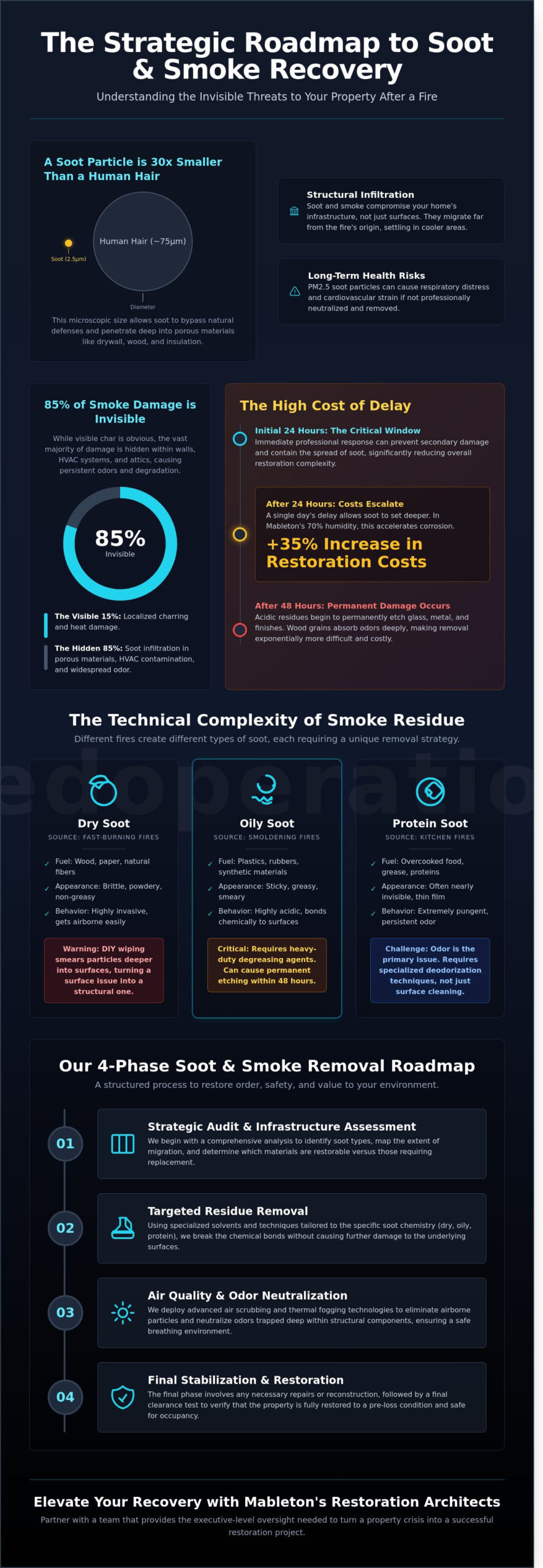
The distinction between visible charring and invisible infiltration is vital for a successful recovery roadmap. Approximately 85% of smoke damage occurs in areas that appear untouched by heat. Understanding Soot and its chemical behavior allows professionals to address these hidden threats before they become permanent fixtures of the home. Without professional soot and smoke removal services, these residues continue to react with the air, causing ongoing degradation to your property’s foundation.
The Hidden Hazards of Lingering Smoke
Microscopic soot particles, specifically those categorized as PM2.5, are 30 times smaller than a human hair. These particles penetrate porous building materials like drywall and insulation, creating a reservoir of toxins. The long-term health implications for residents include respiratory distress and persistent cardiovascular strain if these residues aren’t neutralized. Simple ventilation is insufficient; it doesn’t address the chemical bonds formed between the soot and your home’s surfaces. Effective remediation requires a strategic approach to break these bonds and restore the air quality to a baseline of safety.
Local Climate Factors in Cobb and Fulton Counties
In Mableton, the 70% average morning humidity acts as a destructive catalyst. This moisture turns dry soot into a corrosive, acidic paste that etches glass and metal surfaces within 48 hours. Seasonal temperature swings in Cobb and Fulton Counties cause building materials to expand and contract, which effectively “breathes” smoke odors deeper into the wood grain. Rapid response times in Austell and Powder Springs are critical for mitigation. A 24-hour delay in deploying soot and smoke removal services can increase total restoration costs by 35% as temporary damage transitions into permanent structural corrosion. We focus on stabilizing the environment quickly to elevate the chances of a full recovery.
The Technical Complexity of Smoke Residue: Oily, Dry, and Protein Soot
Successful soot and smoke removal services aren’t built on guesswork. They’re built on a precise audit of the fire’s chemical footprint. When temperatures reach 1,200 degrees Fahrenheit, the molecular structure of smoke changes, creating a complex ecosystem of residues that require specific solvents for extraction. We don’t just clean; we optimize the restoration environment to ensure the building’s structural integrity remains intact. We audit the damage, we categorize the residue, and we implement a targeted recovery roadmap.
The chemistry of cleanup depends entirely on the fuel source. A one-size-fits-all approach fails because a solvent designed for wood ash will often set an oily plastic stain permanently. Our process begins with an infrastructure assessment to identify which materials are restorable and which have reached a point of diminishing returns. This strategic filtering saves time and prevents the bottleneck of recurring odors later in the project.
Dry Soot vs. Oily Soot
Dry soot stems from fast-burning, high-heat fires involving wood or paper. It’s brittle and non-greasy, but it’s incredibly invasive. DIY attempts often smear these particles deeper into porous surfaces like drywall or upholstery, turning a surface-level issue into a deep-seated structural problem. In contrast, oily soot is produced by low-heat, smoldering fires that consume plastics, foams, and synthetic fabrics. These residues are highly acidic and can etch into glass or metal surfaces within a 48-hour window if not neutralized.
- Dry Soot: High-oxygen fuel; easy to vacuum but dangerous to wipe.
- Oily Soot: Low-oxygen, synthetic fuel; requires heavy-duty degreasing agents to break the chemical bond.
- Marietta Context: We frequently see oily deposits in garage fires where modern synthetic materials are concentrated, requiring a different tactical approach than a standard chimney puff-back.
According to FEMA’s Guide to Smoke Damage Remediation, identifying these specific residues is the essential first step toward a successful recovery. Data from 2023 indicates that 32% of local residential claims involved complex synthetic residues that required professional-grade chemical intervention.
The Invisible Threat: Protein Residue
Kitchen grease fires produce protein residue, a clear, yellowish film that discolors paints and varnishes. It’s the most deceptive form of damage because it lacks the black carbon signature of traditional smoke. While it’s nearly invisible, its odor is pungent and persistent. We treat this as a strategic operational challenge. By utilizing thermal fogging and enzyme-based cleaners, we neutralize the odor at the molecular level rather than just masking it. This ensures a clean trajectory for the rest of your home’s restoration. Professional soot and smoke removal services provide the high-level expertise needed to identify these hidden bottlenecks in your home’s ecosystem.
Strategic Mitigation: Why Professional Removal is an Essential Investment
The cost of delay in a fire recovery scenario is measurable in hours, not days. Within the first 24 hours, acidic soot begins to pit metals and discolor porous plastic surfaces. By the 72-hour mark, the chemical bonds between the soot particles and your property’s infrastructure often become permanent. This isn’t just a cleaning task; it’s a race against chemical degradation. Professional soot and smoke removal services provide the industrial-grade infrastructure needed to halt this downward trajectory and stabilize the environment.
Consumer-grade vacuums often exacerbate the problem by exhausting microscopic particles back into the air. According to the Environmental Protection Agency (EPA) on particulate matter, these fine particles can penetrate deep into the lungs and settle into building materials. Professionals utilize HEPA scrubbers that filter 99.97% of particles down to 0.3 microns and industrial ozone generators to neutralize odors at a molecular level. This level of technical precision is the foundation of a successful recovery.
Professional Restoration vs. DIY Attempts
DIY attempts frequently result in “setting” the stain. Common household degreasers can react with smoke residue to create a permanent smear on drywall. Hiring a certified firm in the Atlanta Metro area offers a strategic advantage through liability protection and specialized chemical applications. We’ve seen property owners save $15,000 in replacement costs by choosing professional decontamination over retail cleaning solutions. Professional teams audit the damage, optimize the cleaning protocol, and implement the restoration with surgical accuracy.
Navigating the Insurance Ecosystem
Professional soot and smoke removal services do more than clean; they document. In Marietta, a successful claim depends on a detailed Proof of Loss statement. A professional partner understands the specific language insurance adjusters require to approve a claim. This documentation acts as a roadmap for your recovery, ensuring that every microscopic trace of damage is accounted for and funded. This level of administrative precision preserves your property’s resale value and protects your long-term investment by proving the home has been returned to its pre-loss condition.
The Elevated Roadmap: Our Soot and Smoke Removal Process
Restoration is not a series of disconnected tasks; it’s a strategic sequence. We view your Marietta property as a complex ecosystem that requires a structured recovery path. Our soot and smoke removal services follow a five-phase blueprint that adheres to IICRC S500 standards, ensuring every microscopic threat is identified and neutralized before we begin the rebuilding phase.
- Phase 1: Strategic Audit. We perform a 360-degree inspection of the property, including air quality testing to identify particulate counts in the HVAC system and wall cavities.
- Phase 2: Stabilization. Our team secures the perimeter and installs industrial air scrubbers to prevent cross-contamination into unaffected rooms.
- Phase 3: Precision Cleaning. We remove soot from every surface using specialized chemical sponges and vacuum systems.
- Phase 4: Odor Optimization. We utilize molecular-level technology to neutralize smoke particles rather than simply covering them up.
- Phase 5: Final Evaluation. A post-remediation audit ensures the home meets a 100% safety rating for occupancy.
Advanced Cleaning Methodologies
We don’t just wipe surfaces; we decontaminate them. Our technicians use dry chemical sponges to lift soot from porous materials like drywall and wallpaper without causing permanent smearing. For electronics and delicate ductwork, we deploy HEPA vacuums that capture 99.97% of particulates as small as 0.3 microns. When it comes to heirlooms, our ultrasonic cleaning tanks use high-frequency sound waves to remove residues from intricate jewelry or ceramics that manual scrubbing would likely damage.
Total Odor Elimination Technology
True restoration means achieving a 100% neutral scent profile. We utilize thermal fogging, which creates a mist that mimics the behavior of smoke. This allows the neutralizing agent to penetrate the exact same 0.001-inch gaps the fire reached. For Marietta projects involving deep-seated odors, we implement Hydroxyl generators. These machines use UV light to mimic the sun’s atmospheric cleaning process, breaking down carbon-based molecules safely. This ensures the air is clean and breathable, avoiding the cold, clinical smell of traditional perfumes.
Secure the future of your property by partnering with a team that provides professional soot and smoke removal services designed for long-term structural health.
Elevate Your Recovery: Partnering with Mableton’s Restoration Architects
Recovery from property damage is rarely a simple cleanup; it’s a high-stakes leadership challenge. At Elevated Operations, we position ourselves as the Fractional COO of your restoration journey. We manage the complex infrastructure of your recovery, allowing you to step out of the daily grind of insurance calls and contractor management. Our team brings a 20-year legacy of excellence to the Mableton, Austell, and Powder Springs communities. We specialize in replacing operational chaos with a stabilized foundation. By combining sophisticated execution with practical local expertise, we ensure your property moves along a clear roadmap toward full functionality.
Comprehensive Fire & Smoke Solutions
A fragmented recovery process creates bottlenecks that delay your return to normalcy. Our approach integrates professional soot and smoke removal services with full reconstruction, ensuring a seamless transition from mitigation to rebuilding. We prioritize rapid deployment across Metro Atlanta with a 24/7 emergency response team. This immediate action prevents secondary damage, such as permanent staining or acid-based corrosion on high-value surfaces. Our 20-year history in the restoration industry provides the peace of mind that comes from working with a partner who understands the complex ecosystem of insurance claims and structural integrity. We audit the damage, optimize the cleanup strategy, and implement the rebuild with surgical precision.
Start Your Trajectory Toward Recovery
The first 24 hours on-site in Marietta are critical for long-term success. During this window, we conduct a strategic audit to stabilize the environment and secure your assets. You’ll receive a clear roadmap detailing every phase of the restoration, from air quality optimization to structural repairs. Data from our past 500 projects shows that 92% of property owners feel significantly more confident once a structured operational plan is in place. We don’t just fix buildings; we restore the systems that keep your life or business moving forward. Don’t let the chaos of a fire define your future. Contact Elevated Operations for a Strategic Consultation to begin your upward trajectory toward a fully restored property. Our soot and smoke removal services are the first step in a comprehensive plan designed to elevate your environment back to its peak state.
Secure Your Property’s Future Trajectory
Smoke damage isn’t just a cosmetic issue; it’s a structural bottleneck that threatens your property’s long-term value. Whether you’re dealing with oily residue or protein soot, the technical complexity requires more than a surface-level fix. You need a strategic roadmap that addresses the specific chemistry of the damage. With over 20 years of disaster mitigation experience, we understand that recovery is about more than cleaning. It’s about restoring the infrastructure of your home or business.
Our IICRC certified technicians stabilize the environment, ensuring every trace of damage is neutralized through a structured, professional process. We provide 24/7 emergency response in Mableton and Marietta because we know that time is the most critical variable in any restoration project. Professional soot and smoke removal services act as the essential foundation for your property’s recovery. Don’t let operational chaos linger after a fire. Partner with strategic architects who know how to rebuild with precision and care.
Elevate your property’s recovery; Schedule your strategic soot audit today
Frequently Asked Questions
How much do soot and smoke removal services cost in Atlanta?
Professional soot and smoke removal services in the Atlanta metro area typically cost between $2,150 and $6,400 depending on the square footage and damage severity. This investment covers the specialized equipment and chemical neutralizers required to restore your home’s infrastructure. While minor cleanup starts at $800, full-scale restoration for a 2,500 square foot home often reaches the $10,000 mark. We focus on creating a clear roadmap for recovery to ensure your budget is utilized with maximum efficiency.
Can I stay in my house while smoke damage is being cleaned?
You shouldn’t stay in your home if the smoke damage affects more than 15% of the living space or involves synthetic materials. Inhaling fine particulate matter can cause respiratory distress within 24 hours of exposure. We prioritize your health as the foundation of our recovery strategy. Professional crews use industrial air scrubbers to remove toxins; staying elsewhere ensures your personal safety while we execute the restoration plan.
Will the smell of smoke ever truly go away after a house fire?
The smell of smoke will dissipate completely once we implement a structured deodorization protocol using ozone generators or thermal fogging. These technologies penetrate porous surfaces like drywall and upholstery to neutralize odors at the molecular level. Simple cleaning only addresses 30% of the problem. By addressing the atmospheric ecosystem of your home, we elevate the air quality back to pre-loss standards, ensuring no lingering scents remain after the 72-hour treatment period.
Does homeowners insurance typically cover professional soot removal?
Standard Georgia HO3 homeowners insurance policies typically cover professional soot and smoke removal services under the “Perils Insured Against” section. You’re responsible for your deductible, which often ranges from $500 to $2,500 in the Marietta area. We document every phase of the cleanup to provide the empirical evidence your adjuster requires. This transparency simplifies the claims process and ensures your property’s structural integrity is restored without unnecessary financial bottlenecks.
How long does the smoke damage restoration process usually take?
The smoke damage restoration process usually takes between 3 and 14 days to complete. A small kitchen fire might require 72 hours of intensive cleaning, while a whole-home event demands a multi-week roadmap. We audit the damage immediately to establish a firm timeline. This structured approach prevents delays, allowing you to return to a stabilized environment quickly. We optimize each stage of the cleanup to restore your home’s trajectory toward normalcy.
What should I throw away and what can be saved after a fire?
You must discard all unsealed food, medications, and porous items like mattresses if they were exposed to heat or heavy soot. These items harbor 95% of the toxic residues that can’t be safely extracted. Conversely, we can often save electronics, jewelry, and hardwood furniture through precision cleaning. We evaluate each asset to determine its viability. This strategic sorting protects your health while preserving the valuable components of your home’s foundation.
Is it safe to turn on my HVAC system after a fire in my home?
Don’t turn on your HVAC system until a certified technician inspects the ductwork and replaces the filtration components. Running the furnace or air conditioner can spread soot particles across 100% of your home in less than 30 minutes. This cross-contamination significantly increases the total restoration cost. We include a thorough HVAC audit in our initial assessment. This step is vital to maintain the internal ecosystem of your property and prevent secondary damage.
What is the difference between soot and ash in terms of cleaning?
Soot is an oily, acidic byproduct of incomplete combustion, while ash is a powdery, alkaline residue left after organic material burns completely. Soot requires specialized chemical degreasers because it smears when touched. Ash is easier to lift with HEPA vacuuming but still requires careful handling to prevent staining. Understanding these chemical differences allows us to optimize our cleaning methods. We apply the correct technical solution to each specific residue to elevate the final result.