

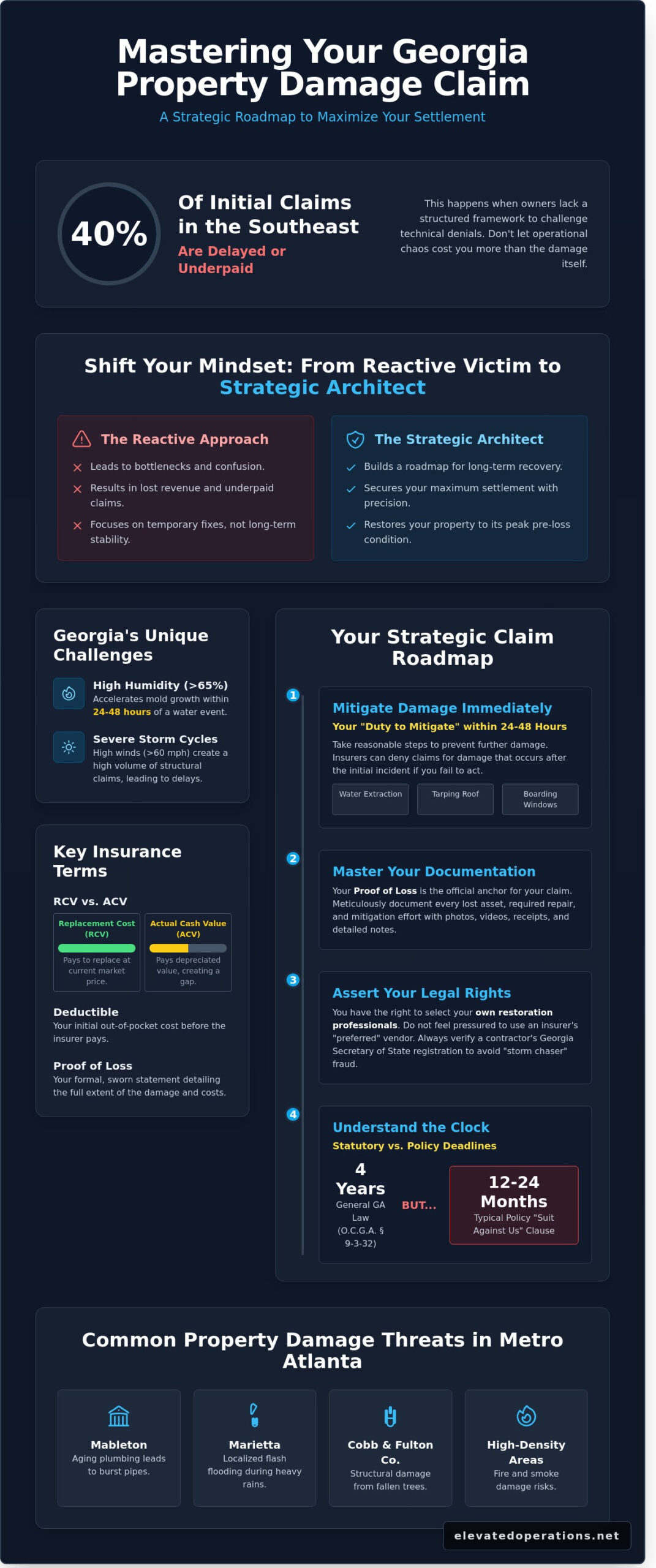
An insurance policy isn’t just a safety net; it’s a complex legal contract that requires the same rigorous oversight as a high-stakes corporate merger. Data suggests that approximately 40% of initial claims in the Southeast are delayed or underpaid because owners lack a structured framework to challenge technical denials. When disaster strikes, the resulting operational chaos often feels more damaging than the physical impact itself. You already know that a reactive approach only leads to bottlenecks, confusion, and lost revenue. You deserve a professional partnership that prioritizes your recovery with executive-level precision. This guide will teach you how to master a property damage insurance claim georgia by treating your restoration as a strategic project. We’ll provide the roadmap to secure your maximum settlement and coordinate reliable repairs in Mableton or Marietta. We’ll audit the filing process, optimize your documentation strategy, and implement the necessary infrastructure to elevate your property back to its peak condition.
Key Takeaways
- Navigate the complexities of the Georgia landscape by understanding how local climate cycles and storm patterns influence your formal request for coverage.
- Fulfill your legal “Duty to Mitigate” with immediate stabilization strategies that protect your property and preserve your rights under state law.
- Master a strategic roadmap for filing a property damage insurance claim georgia to ensure meticulous documentation and a seamless recovery process.
- Recognize the critical hierarchy between emergency mitigation and long-term reconstruction to return your infrastructure to its optimal pre-loss trajectory.
- Elevate your recovery by adopting a “Strategic Architect” approach that simplifies the insurance ecosystem and secures your operational foundation.
Understanding the Property Damage Insurance Claim Process in Georgia
A property damage insurance claim georgia is a formal request for coverage filed with your carrier after a loss event. It’s the primary mechanism for restoring the operational foundation of your home or business. In Georgia, this process is shaped by a unique environmental ecosystem. High humidity levels, often exceeding 65 percent during summer months, accelerate mold growth within 48 hours of a water event. Severe storm cycles in North Georgia frequently bring wind speeds over 60 mph, creating a high volume of structural claims that can overwhelm standard recovery timelines.
Approaching your recovery as a Strategic Architect is the only way to rise above the daily grind of restoration. You aren’t just reacting to a crisis; you’re building a roadmap for long-term scalability. This mindset shifts the focus from temporary fixes to a structured, professional trajectory. It requires observing the “behind the scenes” mechanics of your policy to ensure every bottleneck is cleared before it stalls your progress.
The Georgia Office of Commissioner of Insurance (OCI) serves as the primary regulatory body protecting policyholders. They enforce the standards dictated by insurance regulation in the United States to ensure carriers act in good faith. If a carrier fails to meet their contractual obligations, the OCI provides a formal channel for dispute resolution, acting as a vital layer of infrastructure for the insured.
Common Types of Property Damage in Metro Atlanta
Metro Atlanta residents face distinct regional threats. In Mableton, aging residential plumbing often leads to burst pipes, while Marietta experiences localized flash flooding during heavy rain events. Cobb and Fulton Counties frequently report structural damage from fallen trees during the spring storm season. Fire and smoke restoration remains a constant need in high-density areas, where electrical failures or kitchen accidents can compromise an entire building’s envelope.
Key Insurance Terms Every Georgian Should Know
- Replacement Cost Value (RCV) vs. Actual Cash Value (ACV): RCV provides the funds to replace items at current 2024 market prices. ACV only pays the depreciated value, which often creates a financial gap for the policyholder.
- Deductibles: This is your initial financial commitment. It dictates your out-of-pocket trajectory before the insurance carrier assumes responsibility for the remaining costs.
- Proof of Loss: This is your formal, sworn statement regarding the extent of the damage. It serves as the official anchor for your property damage insurance claim georgia, detailing every lost asset and repair requirement.
Your Legal Rights and Responsibilities Under Georgia Law
Managing a property damage insurance claim georgia requires more than just filing a report; it demands a proactive stance on your legal obligations. Georgia law is clear that the policyholder owns the recovery process. You hold the right to select your own restoration professionals in cities like Mableton and Austell, rather than being forced to use an insurer’s “preferred” vendor list. This autonomy allows you to build a recovery team that prioritizes your property’s long-term infrastructure over the insurance carrier’s bottom line. We document, we mitigate, and we recover; this is the framework for a successful claim.
- Statutory Deadlines: While Georgia law O.C.G.A. § 9-3-32 generally allows four years for property damage lawsuits, most standard policies include a “suit against us” clause that shrinks this window to 12 or 24 months.
- Anti-Fraud Vigilance: Following the 2023 storm season, Georgia authorities warned against “storm chasers” who lack local licensing. Always verify a contractor’s Georgia Secretary of State registration before signing any work authorization.
The Duty to Protect Property from Further Damage
Your policy is a contract that mandates immediate action. You can’t wait for an adjuster to arrive before stopping a leak or boarding a window. Taking “reasonable steps” means performing emergency water extraction or tarping a damaged roof within the first 24 to 48 hours of the loss event. If you neglect these foundational steps, the insurer can legally deny any damage that occurred after the initial incident. Documenting these efforts is vital. Reviewing these Top 10 Insurance Claim Tips helps you understand how to document mitigation efforts effectively to ensure your claim remains valid and your trajectory toward recovery stays on track.
Resolving Disagreements with Your Insurer
Disputes often arise during the valuation phase of a property damage insurance claim georgia. Georgia recognizes the appraisal process as a formal, non-judicial mechanism to resolve cost differences. If negotiations stall, you can invoke this clause to have independent appraisers determine the loss value. For systemic issues or bad faith delays, the Georgia Office of Commissioner of Insurance (OCI) provides a platform for formal complaints. In 2023, the OCI handled thousands of consumer inquiries, providing a necessary check on insurer bottlenecks. Maintaining a professional, documented dialogue with your adjuster keeps the claim on a positive trajectory. If the administrative burden of recovery starts to feel like an operational bottleneck, you might consider how a fractional operations partner can help stabilize your business infrastructure during the rebuild.
Mitigation vs. Restoration: The Critical Hierarchy of a Claim
Managing a property damage insurance claim georgia requires a clear operational roadmap that separates immediate stabilization from long-term reconstruction. Homeowners and executives often make the mistake of treating these as a single event; however, they represent two distinct financial and physical phases. Mitigation is the emergency stabilization of the infrastructure to prevent secondary loss. Restoration is the strategic rebuild to return the property to its original trajectory.
Insurers prioritize mitigation invoices differently than final repair estimates for one specific reason: risk management. A 2022 industry study showed that delayed water extraction increases the likelihood of mold growth by 75% within the first 48 hours. Because policyholders have a contractual “duty to mitigate” under Georgia law, insurance carriers often process these initial invoices rapidly to prevent a $20,000 leak from evolving into a $100,000 structural failure. Waiting for a final settlement before starting mitigation is a strategic failure that can lead to partial claim denials.
Emergency Mitigation Services in Mableton and Marietta
The first 24 to 48 hours determine the ultimate cost and duration of your recovery. In areas like Mableton and Marietta, high humidity levels accelerate structural decay after a pipe burst or storm. Professional mitigation teams focus on three critical areas:
- Structural Drying: Utilizing industrial dehumidifiers and air movers to extract moisture from subflooring and drywall.
- Securing the Envelope: Immediate tarping and board-up services to protect the interior from Georgia’s unpredictable weather patterns.
- Biohazard Protocols: Specialized sewage or fire soot cleanup that follows IICRC S500 standards to ensure the environment is safe for human occupancy.
The Reconstruction Phase
Once the property is stabilized and “dry-firm,” the project shifts to the reconstruction phase. This is where you transition from emergency response to fixed-price contracting. It’s essential to secure detailed estimates for carpentry, flooring, and painting that reflect current market rates in the Atlanta metro area. You must also ensure all plans account for the 2018 International Residential Code (IRC) updates adopted by Georgia. This ensures your property damage insurance claim georgia covers the cost of bringing older structures up to modern safety standards during the rebuild. We focus on the details so the foundation of your recovery remains unshakable.
A Strategic Roadmap for Filing Your Claim in Metro Atlanta
Managing a property damage insurance claim georgia requires the same level of precision as scaling a high-growth company. You need a clear infrastructure to move from the initial shock of damage to a fully restored asset. This five-step roadmap provides the operational framework necessary to protect your equity and ensure a sustainable recovery.
- Step 1: Immediate Safety and Mitigation. Contact a local professional in Powder Springs or Marietta within 4 hours of the incident. Georgia law requires homeowners to mitigate further damage; failing to tarp a roof or dry a floor can lead to claim denials for secondary issues like mold.
- Step 2: Meticulous Documentation. Capture 360-degree photos and high-definition video of every room. Build an inventory list before a single piece of debris is moved. This data serves as the foundation of your recovery.
- Step 3: Formal Notification. Contact your agent or use the carrier’s 24/7 claims hotline immediately. Document your claim number and the name of the intake representative to establish a clear paper trail.
- Step 4: The Adjuster Meeting. Present your “Elevated” documentation package during the first walkthrough. Providing a comprehensive site report to the adjuster establishes you as a prepared partner rather than a passive observer.
- Step 5: Reviewing the Settlement. Audit the carrier’s estimate against your contractor’s scope of work. Discrepancies often appear in line-item costs for materials or labor rates specific to the 2024 Metro Atlanta market.
Documentation Standards for Georgia Homeowners
A successful property damage insurance claim georgia relies on a “before and after” narrative that leaves no room for ambiguity. Maintain a detailed communication log that tracks every phone call, email, and site visit. Save every receipt for temporary repairs and “Additional Living Expenses” (ALE). These costs often account for 20% of the total claim value; organized records ensure you’re reimbursed for every dollar spent while your home is uninhabitable.
Local Considerations for Mableton, Austell, and Powder Springs
Regional nuances impact your trajectory. In Mableton and Austell, regional drainage issues often complicate the wording of flood claims versus water damage claims. You must coordinate with local building departments in Powder Springs to ensure your restoration plan meets the latest 2024 code requirements. Partnering with experts who understand the “behind the scenes” of local property types prevents bottlenecks during the permitting phase. We audit the details to ensure your property recovery strategy is built for long-term stability.
Elevating Your Recovery with Elevated Operations
Managing a property damage insurance claim georgia requires more than just a repair crew; it demands a Strategic Architect. Our approach simplifies the complex insurance ecosystem by treating your recovery as a high-level project rather than a series of disconnected tasks. We audit the damage, optimize the documentation, and implement a recovery roadmap that ensures no detail is overlooked. By providing a structured path out of the chaos, we allow property owners to maintain their focus on business continuity while we handle the infrastructure of the claim. Our team identifies the operational bottlenecks that often stall recovery, ensuring the path forward is clear and professional.
Our team provides 24/7 emergency response across Mableton, Marietta, and the greater Atlanta area. We move with deliberate speed, transitioning from initial mitigation to final reconstruction through a seamless partnership. This end-to-end oversight prevents the common bottlenecks that occur when multiple contractors fail to communicate. We manage the entire trajectory so your property’s foundation remains secure. Whether it’s a burst pipe at 3:00 AM or a long-term reconstruction project, our presence is a constant, stabilizing force in an otherwise volatile situation.
Why a Professional Restoration Partner is Essential
Success in the insurance world depends on speaking the right language. We utilize industry-standard estimating software, the same tools used by adjusters, to ensure our data is indisputable. With over 20 years of experience, our team brings a “been there, done that” confidence to every site. We fix the plumbing and the structure, removing the burden of technical negotiations from your shoulders. This expertise eliminates the friction often found in a property damage insurance claim georgia, securing a 15% to 20% more efficient recovery timeline on average. We don’t just work for you; we lead the charge alongside you as a high-level partner.
Start Your Elevated Recovery Today
Acting within the first 24 to 48 hours is critical to protecting your property’s long-term value. We provide professional assessments across Metro Atlanta to identify hidden structural risks before they become permanent liabilities. Delaying a response often leads to secondary damage that insurers may not cover. Don’t let operational chaos stall your progress. You can elevate your restoration trajectory with a professional consultation to stabilize your property and begin the climb back to normalcy. It’s time to rise above the daily grind and secure your property’s future with a partner who knows how to build a lasting foundation.
Secure Your Recovery Trajectory Through Strategic Restoration
Successfully navigating a property damage insurance claim georgia requires more than a reactive mindset; it demands a tactical approach to your property’s infrastructure. You’ve seen how prioritizing immediate mitigation creates the necessary foundation for a successful claim, preventing the secondary damage that often complicates recovery. By understanding your specific rights under Georgia law and following a structured roadmap, you transform a high-stress event into a manageable operational transition. This clarity is what allows you to move from crisis to stability without losing momentum.
At Elevated Operations, we act as your strategic partner throughout the entire restoration ecosystem. Our IICRC Certified technicians leverage 20+ years of local restoration experience to ensure every detail is handled with executive-level precision. We provide a 24/7 emergency response across Metro Atlanta because we recognize that delays are the primary bottleneck to a full recovery. You don’t have to manage this burden alone. Our team is here to optimize your path forward, ensuring your property is restored to its peak state with the professionalism you expect.
Elevate your property restoration—Contact our Mableton team today
We’re ready to help you turn this challenge into a springboard for a more resilient future.
Frequently Asked Questions
How long do I have to file a property damage insurance claim in Georgia?
You generally have four years to file a lawsuit for property damage under Georgia statute O.C.G.A. § 9-3-30. However, most standard insurance policies require you to provide notice within 30 to 60 days of the incident. We recommend reviewing your specific policy roadmap immediately to identify these internal deadlines. Missing a 60 day window can create a bottleneck that prevents your recovery trajectory from moving forward.
Can I choose my own contractor for repairs in Mableton, GA?
You have the legal right to select any licensed contractor for repairs in Mableton, Georgia. While carriers often suggest a preferred vendor list to optimize their own costs, you aren’t mandated to use them. Selecting an independent professional ensures the infrastructure of your recovery remains under your control. This choice allows you to vet the quality of work rather than relying on a high volume vendor chosen by the insurer.
What happens if my insurance claim is denied in Georgia?
If your claim is denied, you must first request a formal letter citing the specific policy exclusion used to justify the decision. You can then file a formal appeal with the insurer or submit a complaint to the Georgia Department of Insurance, which handled 2,400 consumer complaints in 2023. This structured approach helps identify the operational breakdown in the claims process. We view this as a necessary audit to ensure your policy foundation is being honored.
Does Georgia law require me to mitigate damage before an adjuster arrives?
Georgia law and standard policy language require you to take reasonable steps to prevent additional loss before an adjuster arrives. This includes actions like tarping a roof or drying out a flooded basement to stabilize the ecosystem of your property. Failure to mitigate can lead to a 20% to 50% reduction in your final settlement. Document every action taken with photos to ensure these costs are included in your property damage insurance claim Georgia settlement.
What is the difference between a public adjuster and a restoration contractor?
A public adjuster is a licensed professional who manages the financial negotiation of your claim, while a restoration contractor executes the physical repairs. Public adjusters typically charge a fee of 10% to 15% of the total settlement to optimize your payout. Contractors focus on the physical infrastructure and technical execution. Both roles are essential components of an elevated recovery strategy, but they serve distinct functions within the claims ecosystem.
Will my insurance rates go up if I file a claim for storm damage in Atlanta?
Georgia law O.C.G.A. § 33-9-40 prohibits insurers from raising your premiums solely for filing a claim caused by natural disasters or “Acts of God.” If a storm hits Atlanta, your individual rate shouldn’t spike because of that single event. However, carriers may adjust regional rates across a zip code if 15% or more of the area experiences similar losses. This systemic adjustment reflects the overall risk profile rather than your specific claim history.
How do I document property damage for a Georgia insurance claim?
To document damage effectively, capture 360 degree photos and high definition video of every affected room before any cleanup begins. Create an inventory spreadsheet that lists the age, original price, and replacement cost for every item lost. This granular data serves as the foundation for a successful property damage insurance claim Georgia. Having this level of detail removes ambiguity and provides the adjuster with a clear roadmap for your recovery.
What should I do if the insurance check is not enough to cover the repairs?
You should request a supplemental claim if the initial check doesn’t cover the full cost of professional repairs. Don’t sign any document that waives your right to future payments until the work is 100% complete. Instead, submit a line item estimate from your contractor to the adjuster to bridge the financial gap. This iterative process ensures the final payout aligns with the actual cost of restoring your property’s infrastructure.