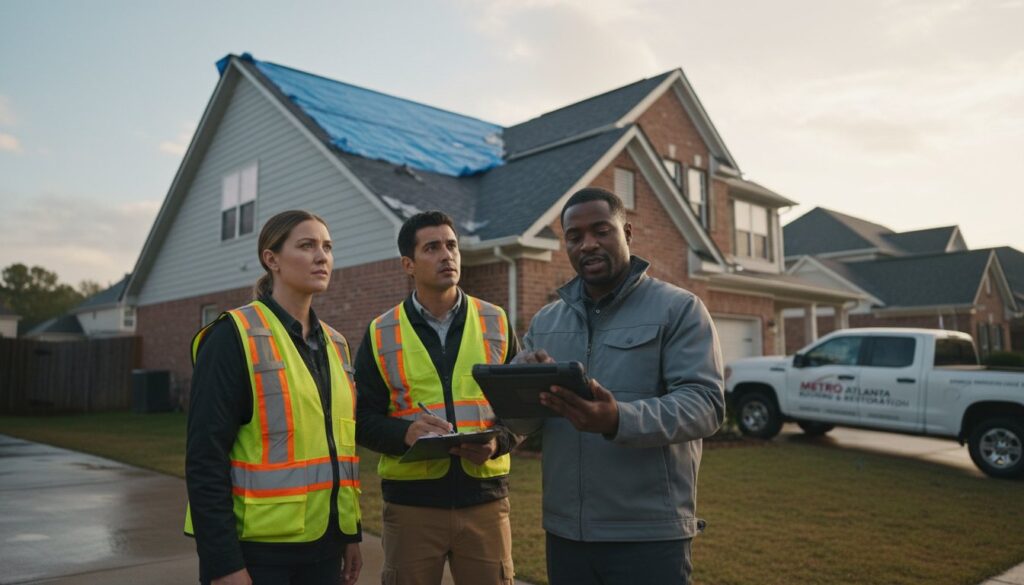
The true cost of a Georgia storm isn’t the initial impact; it’s the 48-hour window of operational paralysis that follows. When severe weather hits Mableton, the immediate debris is often less damaging than the structural uncertainty and insurance friction that linger. You already know that every hour your property remains exposed increases the risk of secondary issues like mold or weakened foundations. Securing professional storm damage services shouldn’t be a reactive scramble. It must be a strategic deployment of resources designed to protect your asset’s long-term trajectory.
We recognize the stress of managing three or four different contractors while negotiating with insurance adjusters. This guide provides a professional roadmap to transition your property from chaos to a stabilized, secure state. You’ll gain a clear framework for auditing structural integrity, maximizing claim recovery through precise documentation, and executing a reconstruction plan that serves as a foundation for future resilience. We’ll outline the exact steps to elevate your recovery process and move from immediate mitigation to a fully restored ecosystem.
Key Takeaways
- Master the three-phase operational roadmap-Assessment, Mitigation, and Reconstruction-to transform property chaos into a structured and professional recovery project.
- Shift your perspective on insurance documentation by treating it as a critical data layer that secures the necessary resources for full structural restoration.
- Implement immediate safety protocols and visual perimeter checks to protect your property’s foundation before professional storm damage services arrive on-site.
- Elevate your property’s trajectory by moving beyond temporary fixes toward a comprehensive reconstruction strategy that optimizes long-term value and resilience.
The Landscape of Storm Damage Services in Metro Atlanta
Professional storm damage services represent more than a reactionary cleanup; they are a multi-phase operational response to environmental volatility. In Mableton and the surrounding Metro Atlanta area, a fallen tree is rarely an isolated incident. It is a catalyst for structural instability that requires a sophisticated, strategic approach to resolve. We view a residential property as a complex ecosystem where the roof, framing, and foundation work in concert. When a storm disrupts this balance, a standard debris removal service often fails because it ignores the underlying structural infrastructure that keeps a home viable. Natural disasters frequently result in significant property damage, and addressing these issues requires a roadmap that prioritizes long-term stability over a quick fix.
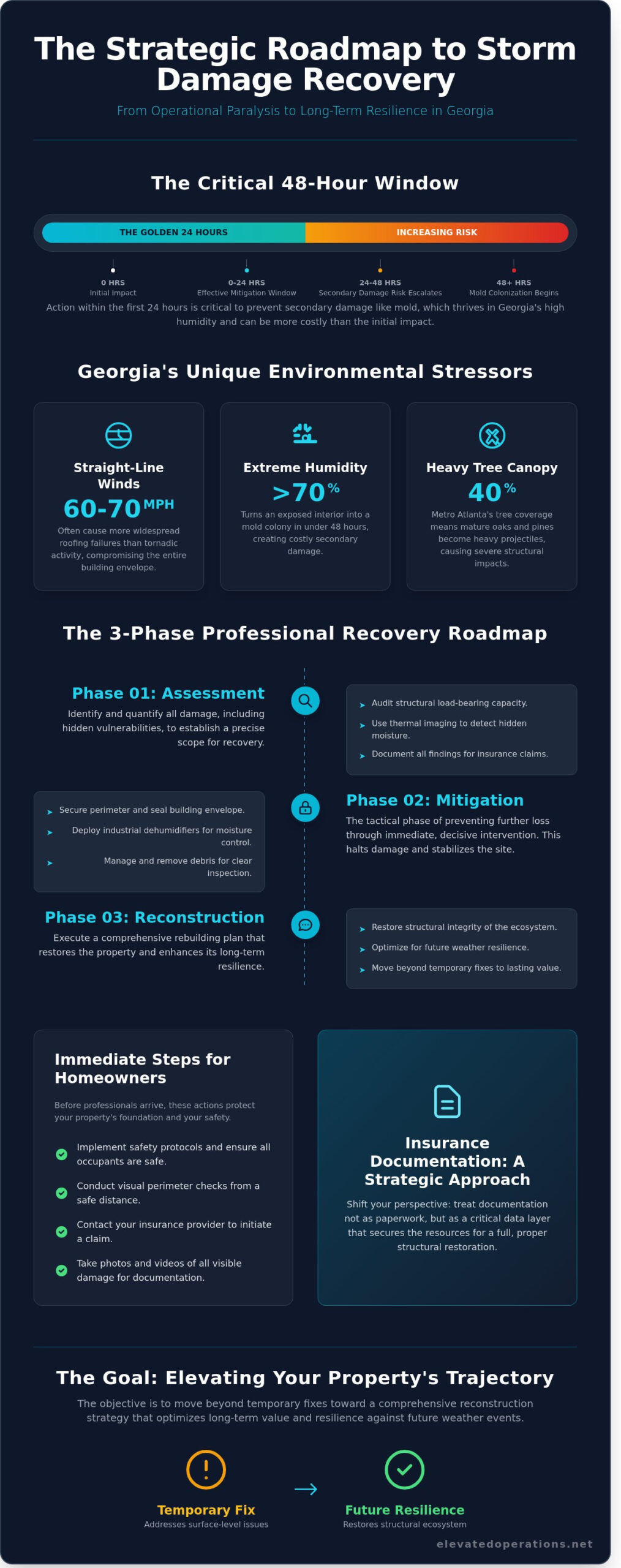
Our approach is designed to elevate the recovery process from chaotic to controlled. We audit the site, we optimize the stabilization efforts, and we implement a recovery plan that accounts for Georgia’s unique environmental stressors. High humidity levels, often exceeding 70 percent during the summer months, mean that an exposed interior can transition from a dry site to a mold colony in less than 48 hours. This creates a secondary damage cycle that can be more costly than the initial impact. To prevent this trajectory, homeowners must transition from shock to tactical execution within hours of the event.
North Georgia Weather Patterns and Property Vulnerability
The meteorology of Cobb County presents specific risks that dictate how we deploy storm damage services. Straight-line winds, which can reach speeds of 60 to 70 miles per hour during summer thunderstorms, often cause more widespread roofing failures than localized tornadic activity. Properties in the Austell and Powder Springs floodplains face a dual threat; while wind compromises the envelope, flash flooding from Sweetwater Creek can undermine foundations. Metro Atlanta’s 40 percent tree canopy coverage, while aesthetically pleasing, creates a unique risk profile where mature oaks and pines become heavy projectiles during high-wind events. This density requires a specialized understanding of how vertical impacts affect horizontal structural loads.
The Critical 24-Hour Window for Mitigation
The “Golden Hours” of storm recovery occur within the first 24 hours after a tree strike. This is the period where structural stabilization is most effective at preventing the collapse of compromised rafters or joists. Rapid intervention is the only way to halt the rapid colonization of mold, which thrives in the stagnant, damp air common in Georgia crawlspaces and attics after a roof breach. Mitigation is the tactical phase of preventing further loss through immediate intervention. We focus on securing the perimeter and sealing the building envelope to ensure that the recovery phase begins from a foundation of safety and predictability. By acting within this window, you shift the trajectory of the project from a total loss toward a sustainable restoration.
- Structural Assessment: Identifying shifts in the home’s load-bearing capacity.
- Moisture Control: Deploying industrial dehumidification to combat 80 percent outdoor humidity.
- Debris Management: Removing biomass to allow for a clear inspection of the building’s exterior.
- Envelope Sealing: Using heavy-duty tarping and board-up techniques to stop water intrusion.
Successful recovery is built on a foundation of operational excellence. It isn’t just about moving wood; it’s about restoring the integrity of your home’s infrastructure. By choosing a partner who understands the strategic mechanics of disaster response, you ensure that your property is not just repaired, but elevated to withstand the next cycle of North Georgia weather.
The Anatomy of Professional Storm Damage Restoration
Recovering from a major tree impact requires more than a cleanup crew; it demands a sophisticated operational foundation. When a 2,000-pound oak breaches your roofline, the resulting chaos disrupts the structural ecosystem of your entire home. Professional storm damage services approach this crisis through a disciplined, three-phase framework: Assessment, Mitigation, and Reconstruction. This methodology ensures that every decision aligns with the long-term integrity of the property rather than offering a temporary, superficial fix.
The initial assessment phase utilizes high-level diagnostic tools to identify hidden vulnerabilities. We don’t rely on visual inspections alone. Technicians employ thermal imaging cameras to detect moisture pockets trapped behind drywall and industrial-grade moisture meters to evaluate the saturation levels of structural headers. This data-driven approach is essential for documenting storm damage accurately for insurance carriers, ensuring that the scope of work reflects the true scale of the loss. By identifying these issues early, we prevent the 15% to 20% increase in costs typically associated with undiscovered secondary damage.
There is a critical distinction between cosmetic repairs and structural restoration. Replacing shingles is a surface-level task. In contrast, structural restoration involves recalibrating the load-bearing capacity of the home’s frame. When a tree falls, the kinetic energy often radiates through the foundation and floor joists. A strategic restoration plan addresses these foundational shifts, ensuring the home remains a stable asset. If you are feeling overwhelmed by the technical complexities of your property loss, optimizing your recovery roadmap with a professional partner can provide the clarity needed to move forward confidently.
Structural Stabilization and Emergency Services
Emergency stabilization is the immediate priority to halt further deterioration. This involves precision roof tarping and the board-up of shattered windows within a 24-hour window of the incident. In Metro Atlanta, the physics of structural drying are complicated by high ambient humidity. We use LGR (Low Grain Refrigerant) dehumidifiers to pull moisture from the air even in saturated conditions, preventing wood rot. Safety protocols are paramount during this phase; crews must maintain a 10-foot clearance from any downed lines until Georgia Power confirms the site is de-energized.
Water Extraction and Biohazard Cleanup
Water intrusion is rarely just “rain.” While clean water from a roof leak is manageable, storm-driven backups often introduce Category 3 “black water” containing pathogens and sewage. Standard janitorial services are insufficient for this level of contamination. Professional storm damage services utilize antimicrobial treatments and HEPA-filtered air scrubbers to sanitize the environment. We treat the home as a controlled site, ensuring that biohazards are neutralized before reconstruction begins. This level of rigor is what separates a basic repair from a professional restoration that protects the health of the occupants.
Insurance Documentation: A Strategic Approach to Recovery
Insurance documentation serves as the vital data layer of your home’s restoration project. It’s the underlying infrastructure that supports every financial and structural decision made throughout the recovery process. When a tree impacts a Mableton residence, the immediate chaos often obscures the need for meticulous record-keeping. However, treating the claim as a structured business operation ensures that no detail is overlooked. Professional storm damage services act as a high-level partner in this phase, moving beyond simple labor to provide the executive oversight necessary for a successful claim. They audit the damage, optimize the documentation strategy, and implement a roadmap for full recovery.
The ultimate goal of any claim is returning the property to its pre-loss condition. This isn’t a vague suggestion; it’s the contractual benchmark for all reconstruction efforts. Following a catastrophic tree strike, homeowners should prioritize guidance from local officials to ensure the site is structurally sound before beginning the data collection phase. Once safety is established, the focus shifts to identifying bottlenecks. Delays usually occur when there’s a gap between the homeowner’s reality and the insurer’s data. We bridge that gap by providing a transparent, evidence-based narrative that leaves no room for ambiguity or under-valuation.
The Importance of Comprehensive Damage Assessment
Precision is the foundation of a successful recovery. Our teams utilize Xactimate, the industry-standard estimating software used by roughly 85% of insurance carriers, to ensure our line items align with adjuster expectations. We don’t guess at costs; we use localized data to reflect the actual market rates in Mableton. This technical accuracy is paired with moisture mapping and high-resolution photo documentation. These tools are non-negotiable for claim approval because they provide empirical proof of hidden damage. By adopting a Fractional COO mindset, we manage these complex logistics so the homeowner can focus on their family’s stability while we handle the operational ecosystem of the restoration.
Navigating the Adjuster Relationship
Successful claims rely on clear, authoritative communication with insurance representatives. It’s essential to understand the distinction between Actual Cash Value (ACV) and Replacement Cost Value (RCV). ACV only covers the depreciated value of your property, while RCV provides the funds necessary to actually rebuild at today’s prices. Most modern policies are RCV-based, but accessing those funds requires a detailed accounting of all storm damage services performed. Elevated Operations assists in this transition by translating technical construction requirements into clear insurance narratives. We provide the roadmap that helps adjusters see the full scope of the loss, ensuring the final settlement reflects the true cost of returning the home to its original state.
Immediate Steps: What to Do After a Damaging Storm
The moment a tree impacts your home, your role shifts from homeowner to strategic project manager. You must move from a state of shock into a phase of disciplined execution to protect both your family and your property’s long-term value. Safety is the non-negotiable foundation of this process. If the tree has pierced the roofline or compromised a load-bearing wall, evacuate the premises immediately. Structural shifts can occur hours after the initial impact, and 14% of secondary collapses happen during the post-storm stabilization period.
Once you’ve confirmed everyone is safe, conduct a visual perimeter check from a distance of at least 20 feet. Look for downed power lines, cracked foundations, or leaning trees that may pose a secondary threat. Do not step onto the roof or attempt to remove debris yourself. Instead, adopt the mindset of a Strategic Architect and document the scene. Take high-resolution photos from 360 degrees, capturing the point of impact, interior leaks, and any broken windows. This evidence serves as the baseline for your recovery roadmap.
Before you touch a hammer or a tarp, contact a professional partner. Engaging expert storm damage services ensures that your recovery is handled with the precision of a corporate scale-up rather than a series of disjointed repairs. These professionals bring the diagnostic tools necessary to identify hidden bottlenecks in your home’s infrastructure, such as hairline fractures in the gas line or internal wall dampness. Specialized storm damage services provide the authoritative oversight needed to navigate insurance requirements without missing critical details.
Emergency Contact and Safety Checklist
Swift communication is the engine of a successful recovery. Keep these Mableton and Cobb County resources ready to stabilize your home’s ecosystem:
- Cobb County Water System (Emergency): 770-419-6200
- Austell Gas System (Mableton Service): 770-948-1841
- Georgia Power (Outages): 888-891-0938
To shut off the main water, locate the meter box near the street and turn the valve clockwise with a curb key or heavy pliers. For gas, use a wrench to turn the valve a quarter-turn until it’s perpendicular to the pipe. Never enter a room with standing water, as submerged outlets create a high-risk environment for lethal electrical surges.
Preventing Secondary Loss
Effective mitigation requires a balance of immediate action and professional restraint. While it’s tempting to blast fans immediately, doing so can actually circulate mold spores or drive moisture deeper into porous insulation. Only utilize high-powered ventilation after a professional has cleared the area of electrical hazards and asbestos risks. DIY drying often fails because standard household dehumidifiers cannot reach the 15% moisture threshold required to prevent fungal growth behind drywall.
Protect your high-value assets by moving electronics, legal documents, and heirlooms to a climate-controlled environment. Data from 2023 shows that 68% of interior property loss after a storm is caused by delayed mitigation rather than the initial impact. By treating your home like a high-growth infrastructure project, you can elevate your recovery strategy and ensure your property returns to its peak operational state. Focus on stabilizing the foundation today so you can scale back to normalcy tomorrow.
Elevating Your Property: The Roadmap to Full Reconstruction
The immediate chaos of a fallen tree often forces homeowners into a reactive posture. You focus on the urgent tasks like tarping roofs and clearing debris to prevent further decay. However, the most successful recoveries happen when you shift your perspective from temporary fixes to long-term property optimization. Viewing this event as a strategic inflection point allows you to rebuild with a vision that exceeds the original state of the home. We don’t just restore what was lost; we refine the entire structural ecosystem of your property.
Fragmented restoration projects often suffer from operational bottlenecks. When you hire separate contractors for tree removal, mitigation, and construction, the lack of a unified roadmap leads to delays and mismatched expectations. Utilizing a single partner for comprehensive storm damage services ensures a seamless transition from the initial crisis to the final walkthrough. This integrated approach eliminates the communication gaps that typically plague large scale residential projects, providing a clear trajectory toward completion without the friction of managing multiple vendors.
We treat every restoration as a high-level project management challenge. By applying a structured framework to the reconstruction process, we ensure that every nail driven and every shingle laid serves a broader purpose. This is your opportunity to upgrade property infrastructure. Whether you choose to implement high-efficiency insulation, impact-resistant roofing materials, or modernized floor plans, the goal is to increase the underlying value of your asset while we have the walls open.
The Elevated Operations Difference
Experience matters when your home’s foundation is at stake. We’ve spent over 20 years serving the greater Atlanta metropolitan area, bringing a sense of calm authority to neighborhoods from Mableton to Buckhead. Our philosophy is rooted in the belief that operations serve as the foundation for every successful outcome. We don’t just provide storm damage services; we act as a professional partner that leads the charge. Our team brings the same strategic rigor to home restoration that a seasoned executive brings to a scaling company, ensuring that every detail is audited, optimized, and implemented with precision.
Next Steps: Starting Your Recovery Roadmap
Recovery begins with a definitive plan of action. Our process is designed to move you from instability to a finished, elevated product through a series of disciplined phases. We start with a comprehensive 360-degree assessment to identify both visible damage and hidden structural vulnerabilities. Once we establish the baseline, we execute a stabilization plan within the first 48 hours to secure the site. From there, we move into the reconstruction phase, providing you with regular updates and a clear timeline that culminates in a meticulous final inspection.
- Phase 1: Professional assessment and damage documentation.
- Phase 2: Immediate stabilization and site security.
- Phase 3: Structural optimization and full reconstruction.
- Phase 4: Final walkthrough and quality assurance.
Don’t let operational chaos dictate the future of your home. You deserve a partner who understands the mechanics of a complex rebuild and possesses the executive presence to see it through. Take the first step toward a more resilient property today. Schedule your 24/7 emergency storm damage assessment with Elevated Operations and begin your journey toward a more secure, optimized home infrastructure.
Securing Your Property’s Future Through Strategic Restoration
Navigating the aftermath of a Metro Atlanta storm requires more than a quick fix. It demands a structured roadmap that addresses immediate mitigation, meticulous insurance documentation, and long-term structural reconstruction. When you choose professional storm damage services, you aren’t just hiring contractors; you’re partnering with strategic architects who understand the complexity of property recovery. Our team brings over 20 years of local restoration experience to every project, ensuring your infrastructure is rebuilt on a solid foundation.
By leveraging IICRC Certified Technicians, we eliminate the bottlenecks of traditional repair cycles. We audit the damage, optimize the claims process, and implement a full-service restoration plan that returns your property to its peak trajectory. This systematic approach transforms a chaotic event into a controlled recovery, protecting your investment and your peace of mind. Our 24/7 emergency team is ready to stabilize your environment and begin the journey toward total property optimization.
Elevate your property’s recovery; contact our 24/7 emergency team today.
Your property’s best days are still ahead, and with the right leadership, the path to full restoration is clear.
Frequently Asked Questions
What qualifies as ‘storm damage’ for insurance purposes in Georgia?
Storm damage in Georgia includes any structural or cosmetic impact caused by wind speeds exceeding 58 miles per hour or hail at least 1 inch in diameter. The Georgia Office of Commissioner of Insurance confirms that standard policies cover these sudden atmospheric events. We evaluate your property’s infrastructure to identify these specific failures. This ensures your claim aligns with the 2023 state insurance guidelines for property recovery.
How long does the storm damage restoration process typically take in Mableton?
A typical restoration project in Mableton requires 3 days for emergency stabilization and up to 28 days for full structural completion. The first 72 hours focus on water extraction and tarping to protect the foundation. After this phase, the trajectory of the project depends on material availability and permit approvals. We optimize this timeline by managing every bottleneck in the reconstruction roadmap.
Should I call my insurance company or a restoration company first?
You should contact a restoration firm first to initiate emergency mitigation and protect the property’s structural integrity. Most Georgia insurance policies require homeowners to take immediate action to prevent secondary loss within 24 hours. Our storm damage services provide the professional documentation needed to support your claim. By securing the site immediately, you establish a clear foundation for a successful insurance settlement.
Can I stay in my home during the storm damage repair process?
Occupancy is permissible if 100% of your home’s essential utilities remain functional and a structural engineer clears the primary living areas. If more than 25% of the roof is compromised, local Mableton building codes often require temporary relocation for safety. We assess the ecosystem of your home to determine if the environment is secure. This professional audit prevents exposure to hidden hazards during the cleanup.
What is the difference between flood insurance and standard homeowners insurance for storm damage?
Standard homeowners insurance covers water that enters from above, such as through a broken window, while flood insurance covers rising ground water. According to FEMA guidelines, a flood involves the inundation of 2 or more acres of land that are normally dry. Understanding this distinction is vital for your financial trajectory. We help you navigate these definitions to ensure your recovery plan remains on track.
How do I know if my home has hidden water damage after a severe storm?
You can identify hidden water damage by using a moisture meter to detect levels exceeding 15% in your drywall. Visible signs include yellow or brown staining covering at least 5% of your ceiling or wall surface. These indicators suggest that the internal infrastructure is compromised. Our team uses thermal imaging to map these bottlenecks and prevent mold growth before it starts.
Does Elevated Operations handle the reconstruction phase as well as the initial cleanup?
Elevated Operations manages the entire lifecycle of your recovery, from the initial 48-hour cleanup to the final reconstruction phase. We don’t just remove debris; we rebuild the infrastructure of your home to ensure long-term scalability and safety. This end-to-end approach removes the stress of managing multiple contractors. We act as your strategic partner, overseeing the roadmap from chaos back to a stabilized home.
What should I do if a tree falls on my house during a storm in Marietta?
You must evacuate all residents immediately and call for professional storm damage services to stabilize the structure. The Marietta Fire Department reports that falling trees often compromise gas lines and electrical systems in 40% of residential strikes. Once the site is safe, we audit the damage to create a comprehensive restoration plan. This ensures your home’s trajectory returns to normal without unnecessary delays.