
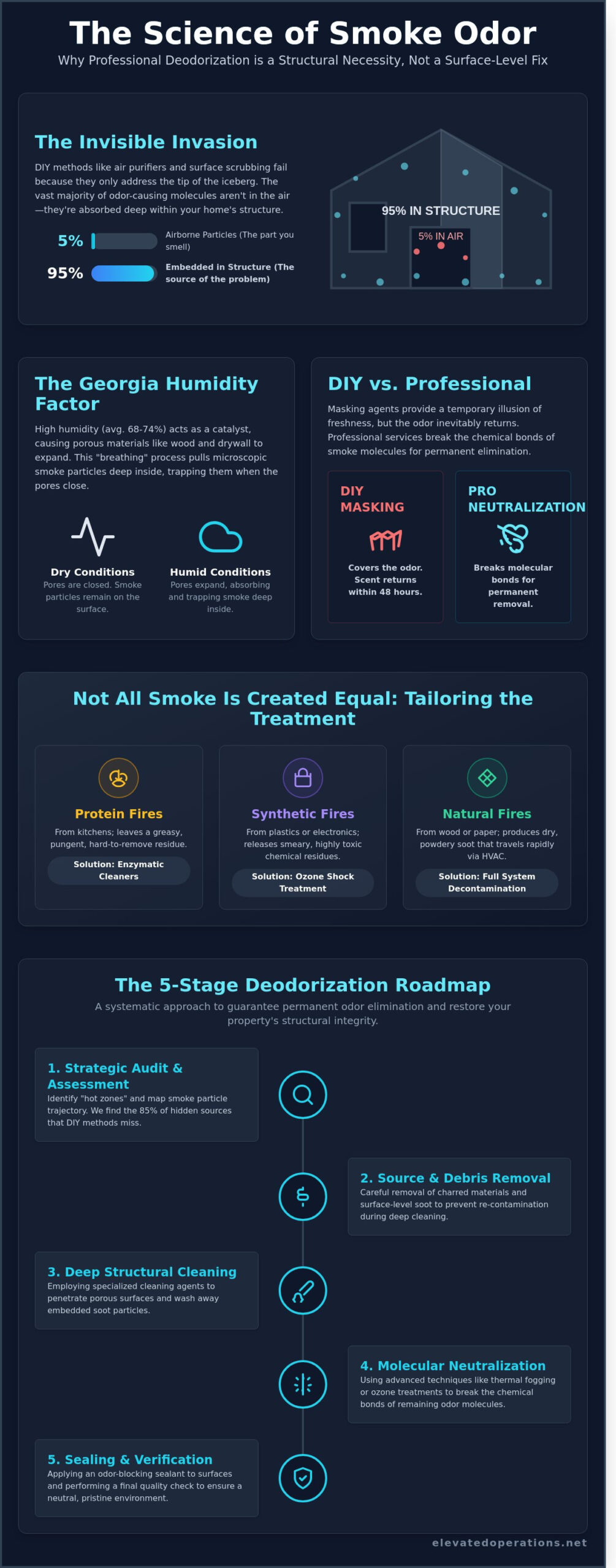
While most DIY attempts focus on the air, 95% of smoke molecules actually embed themselves deep within your home’s structural infrastructure. You’ve likely spent hours scrubbing surfaces or running air purifiers, only to find the acrid scent returns in full force within 48 hours. It’s exhausting to battle a problem that feels invisible yet omnipresent. Professional smoke odor deodorization services aren’t just about comfort; they’re a strategic necessity for reclaiming your environment and protecting your family from the documented risks of third-hand smoke.
We understand that you want a home that feels like a sanctuary again, not a reminder of a past crisis. This expert guide reveals the professional framework for permanent smoke odor elimination and explains how to restore the structural integrity of your Metro Atlanta property. We’ll walk you through the three-stage restoration ecosystem, including molecular neutralization, deep-cleaning protocols, and the mechanics of insurance coverage. You’ll gain a clear roadmap to elevate your indoor air quality and return your home to a neutral, pristine state.
Key Takeaways
- Understand how the unique Georgia humidity factor forces microscopic soot and VOCs deep into your property’s infrastructure, requiring a strategic approach to extraction.
- Discover why professional smoke odor deodorization services are necessary to eliminate the “olfactory adaptation” trap and address the chemical bonds DIY masking agents ignore.
- Identify the high-traffic “hot zones” within your HVAC system and structural framework that serve as primary distribution channels for lingering odors.
- Follow a sophisticated 5-stage restoration roadmap designed to remove charred debris and break the molecular bond of soot for permanent elimination.
- Learn to position structural restoration as a vital investment in your property’s value trajectory, stabilizing your environment for long-term health and marketability.
Understanding the Science of Smoke Odors in Metro Atlanta Properties
Smoke odor isn’t a singular scent. It’s a complex, volatile cocktail of microscopic soot particles and Volatile Organic Compounds (VOCs). These particles often measure as small as 0.1 microns, which is small enough to bypass standard air filters and embed deep into a building’s infrastructure. When you invest in professional smoke odor deodorization services, you’re addressing a chemical challenge that exists at the molecular level rather than just a lingering smell.
In Mableton and Marietta, the “Georgia Humidity Factor” complicates this science significantly. With average relative humidity levels frequently hovering between 68% and 74%, moisture acts as a structural catalyst. High humidity causes the pores of organic materials, such as drywall, wood framing, and textiles, to expand. This expansion allows smoke molecules to migrate deep into the material’s core. When the air dries or the temperature drops, these pores close, effectively locking the odor inside the structure’s foundation.
It’s vital to distinguish between surface-level soot and deep-seated chemical saturation. While visible soot is a cosmetic concern, the invisible saturation of “Third-Hand Smoke” represents a long-term health liability for families. Data from the Lawrence Berkeley National Laboratory indicates that these residues react with common indoor pollutants to form carcinogens. This creates a persistent toxic environment that requires a strategic, professional-grade solution to resolve.
Why Smoke Odors Are More Than Just a Bad Smell
Smoke molecules form aggressive chemical bonds with organic materials like wood and cotton. In Marietta homes, daily temperature fluctuations of 20 degrees or more cause building materials to “breathe.” As the home warms during the afternoon, it expands and exhales trapped VOCs back into the living space, creating a recurring odor cycle that DIY cleaning cannot break. Smoke deodorization is the permanent neutralization of odor-causing molecules at the source.
The Impact of Fire Type on Deodorization Strategy
- Protein Fires: Usually originating in kitchens, these fires leave greasy, pungent residues that bond to cabinetry and paint. They require specialized enzymatic cleaners to break down the complex fatty acids.
- Synthetic Fires: When plastics, carpets, or electronics burn, they release smeary, highly toxic residues. Professionals often utilize ozone shock treatment to aggressively neutralize these complex chemical signatures.
- Natural Fires: Wood and paper produce dry, powdery soot. This debris can travel through an HVAC system at speeds exceeding 1,000 feet per minute, contaminating an entire 2,500-square-foot home in less than 180 minutes. This rapid spread makes comprehensive smoke odor deodorization services essential for full property recovery.
The Elevated Audit: Identifying Smoke Odor ‘Hot Zones’ in Your Infrastructure
We approach property assessment in Mableton and Austell with the precision of a Strategic Architect. Effective restoration isn’t a matter of surface-level cleaning; it’s a deep-dive audit into the operational infrastructure of the building. Statistics from 2023 restoration data indicate that 85% of failed odor remediation attempts stem from a failure to identify “hot zones” during the initial walkthrough. We map the trajectory of smoke particles to understand how they’ve integrated into the property ecosystem.
The structural porosity of a building dictates the complexity of the roadmap. In Powder Springs, where approximately 42% of residential structures were built prior to 1980, the materials often include older plaster and high-density wood that trap odors differently than modern builds. These older homes possess unique bottlenecks, such as settling crawl spaces and attic insulation that act as reservoirs for stagnant air. Smoke is a complex chemical mixture, and its presence poses a significant health threat from fine particles that settle into these hidden voids.
Our team identifies these stagnant zones to ensure the smoke odor deodorization services we provide address the root cause rather than just the symptoms. By analyzing the building’s foundation and airflow patterns, we create a stabilized environment ready for deep cleaning. Establishing a clear roadmap for restoration is the only way to ensure long-term scalability of the cleaning project.
Evaluating Porous vs. Non-Porous Surfaces
Drywall acts like a literal sponge for smoke VOCs (volatile organic compounds). When smoke penetrates the paper backing of drywall, simple cleaning is often insufficient; the material typically requires specialized sealing to prevent “ghosting” odors. Hardwood floors and cabinetry present a different challenge. We must balance aggressive deodorization with moisture control to prevent warping or finish degradation. We utilize a 3-point testing protocol to determine if a surface can be salvaged or if removal is the only way to stabilize the ecosystem.
The Role of the HVAC System in Odor Recirculation
The HVAC system is the primary highway for odor distribution throughout a Marietta home. Simply changing filters covers only 10% of the necessary scope for professional smoke odor deodorization services. We focus on total duct cleaning and coil decontamination to eliminate the microscopic soot that adheres to the internal machinery. A contaminated HVAC system will redistribute odors every time the AC kicks on. Without addressing the coils and plenums, the system will continue to cycle contaminants through every room in the house.
Why DIY Methods Fail: The Trap of Masking Agents
Many homeowners in Mableton ask why they shouldn’t just reach for a high-end scented candle or a bottle of industrial-strength aerosol spray. It’s a logical question. However, these store-bought solutions create a temporary sensory distraction rather than a permanent fix. They provide a fleeting layer of fragrance that sits on top of the smoke particles, creating a cloying mixture that often smells worse than the original fire damage.
The danger of DIY attempts is rooted in a phenomenon called Olfactory Adaptation. Within 15 to 20 minutes of exposure to a consistent scent, your brain begins to filter it out. You stop noticing the lingering char because your sensory system has adjusted. This “nose blindness” creates a false sense of security. While you think the air is clean, the odor remains embedded in your home’s infrastructure, waiting to be detected by guests or potential buyers.
Professional smoke odor deodorization services move beyond masking. We utilize a process called “pairing.” While masking agents hide smells, pairing agents involve a chemical reaction where professional-grade deodorizers bond with odor-causing molecules to neutralize them. This structural change ensures the smell doesn’t return when the perfume fades.
We frequently encounter clients who attempted to use consumer-grade ozone generators purchased online. Without professional supervision and precise timing, these machines can be destructive. Ozone is a powerful oxidant that can degrade rubber gaskets, damage elastic in clothing, and even pit plastic surfaces if concentrations aren’t carefully managed. It’s a tool that requires a strategic roadmap, not a “set it and forget it” approach.
The Limitations of Consumer-Grade Tools
- Equipment Gaps: Hardware store foggers produce large droplets that wet surfaces without penetrating them. Professional thermal fogging equipment creates a fine mist that mimics the behavior of smoke, reaching into the deep pores of your home’s ecosystem.
- Surface-Level Solutions: Vinegar and baking soda are effective for approximately 12% of surface-level kitchen odors, but they cannot address smoke that has migrated behind drywall or into insulation.
- Chemical Risks: Improperly mixing DIY cleaning agents often leads to “secondary odors.” These chemical reactions create a new, distinct smell that is significantly more difficult to extract than the original soot.
When to Call a Professional in Metro Atlanta
Timing is the most critical variable in restoration. We follow the 48-Hour Rule. If soot and smoke residues aren’t mitigated within two days, the acidic nature of the particles begins to permanently pit metal fixtures and yellow porous plastics. Our team adheres to the industry standards for smoke restoration to ensure every step of the process is documented and effective.
Elevated Operations brings a sense of calm authority to these high-stress situations. We don’t just offer smoke odor deodorization services; we act as the strategic architects of your home’s recovery. By identifying structural smoke damage early, we prevent the need for more expensive, invasive renovations later. We audit the damage, optimize the air quality, and implement a solution that restores the foundation of your living space. It’s time to elevate your expectations of what restoration should look like.
The Elevated 5-Stage Deodorization Roadmap: A Professional How-To
Operational excellence in fire recovery isn’t accidental; it’s the result of a rigorous, five-stage framework designed to stabilize the environment. We begin with Stage 1: Source Removal. This involves the immediate extraction of charred materials and debris, which prevents the continuous release of pungent VOCs into the air. Following this, Stage 2: Structural Cleaning utilizes industrial-grade surfactants. These specialized detergents are engineered to break the chemical bond between 0.1-micron soot particles and the underlying substrate, ensuring the structural foundation is truly clean before moving forward.
The roadmap continues with Stage 3: Thermal Fogging, a process that replicates the fire’s original path by heating deodorizers to 400 degrees Fahrenheit to penetrate deep structural voids. Stage 4: Oxidation involves high-level smoke odor deodorization services using hydroxyl or ozone to dismantle odor molecules at the atomic level. Finally, Stage 5: Encapsulation provides the ultimate safeguard. We apply professional-grade sealants to any surfaces that remain slightly porous, effectively locking in any microscopic traces and preventing future “ghosting” odors.
Advanced Neutralization Technologies
Selecting the right technology depends on the specific chemical footprint of the fire. Hydroxyl generators are the preferred choice for occupied Mableton residences because they utilize UV light to create atmospheric radicals that neutralize odors safely while people and pets remain on-site. For vacant properties requiring a more aggressive intervention, Ozone (O3) generators provide rapid oxidation, dismantling organic odor chains in as little as 4 to 12 hours. Professional smoke odor deodorization services evaluate the synthetic versus organic material ratio to determine which molecular strategy will yield the most permanent results.
Sealing and Finishing the Restoration
The final line of defense involves applying specialized odor-blocking primers to drywall and framing, creating an impermeable barrier against residual vapors. We then implement a 72-hour air scrubbing cycle using HEPA and charcoal filtration to remove 99.97% of airborne particulates from the air. To conclude the project, we conduct a final clearance test using digital VOC sensors to ensure the property ecosystem is fully restored to a baseline of 0.0 parts per million of detectable smoke residue. Secure your property’s future by partnering with experts who elevate your restoration standards today.
Elevating Your Property Value with Professional Restoration
A property is more than a structure; it is a primary asset with a specific financial trajectory. Unaddressed smoke damage can decrease a home’s resale value by 15% or more, creating a permanent bottleneck in your long-term investment strategy. We treat restoration as a strategic pivot rather than a simple cleanup. Elevated Operations functions as a Fractional COO for your home recovery, managing the complex infrastructure of the rebuild so you don’t have to. We replace the typical chaos of disaster recovery with a structured, professional path that prioritizes scalability and value retention.
- Strategic Auditing: We assess the microscopic impact on your property’s foundation.
- Process Optimization: We eliminate the friction between contractors and insurance adjusters.
- Execution: We implement specialized smoke odor deodorization services that restore the ecosystem of your home.
This organized approach ensures that your property doesn’t just return to its previous state; it is positioned for future growth. By treating the recovery as a high-stakes project, we protect the equity you’ve worked to build.
Navigating Insurance Claims for Smoke Damage
Insurance carriers in Marietta and Mableton require granular data to approve high-value claims. Our team utilizes detailed line-item reporting to justify every phase of the recovery. With 20+ years of experience in the Metro Atlanta insurance landscape, we understand the specific documentation required to ensure 100% of the work is substantiated. We frame smoke odor deodorization services as a critical mitigation expense. This distinction is vital because mitigation is often covered under separate policy provisions, preserving your primary coverage for structural repairs.
The Elevated Operations Promise
We believe that operations serve as the foundation for every successful outcome. Our team doesn’t just manage a crisis; we build a roadmap to stabilization. We invite you to elevate your living environment by choosing a partner that leads the operational charge with poise and precision. By removing the operational burden from the homeowner, we allow you to rise above the daily grind of a disaster and focus on your next move. Our methodology is built on reliability, ensuring that the “behind the scenes” of your home restoration is handled with executive-level care.
Securing Your Property’s Operational Foundation
Restoring your home’s air quality requires more than surface-level cleaning; it demands a strategic approach to the underlying infrastructure of your building. DIY methods often fail because they rely on masking agents that ignore the microscopic particles embedded in your walls. By implementing a structured 5-stage roadmap, you can eliminate these environmental bottlenecks and protect your property’s long-term market value. Our IICRC certified technicians utilize over 20 years of Metro Atlanta experience to deliver a permanent solution through professional smoke odor deodorization services. We offer a 24/7 emergency response to ensure your recovery begins the moment you need it. This systematic process transitions your living space from a state of post-fire chaos to a stabilized, healthy ecosystem. You deserve a partner who understands the mechanics of deep restoration and the importance of a clean foundation. Your home’s trajectory toward full recovery is within reach when you choose an expert-led path.
Elevate your home’s recovery, schedule your professional smoke audit today
A fresh start is waiting for you.
Frequently Asked Questions
Is smoke odor removal covered by my homeowner’s insurance in Georgia?
Most standard homeowner’s insurance policies in Georgia cover smoke odor removal when the damage results from a sudden, accidental event like a kitchen fire or electrical fault. We typically see 90% of HO3 policies in Mableton include this coverage under the “Perils Insured Against” section. Our team audits your policy and works directly with adjusters to ensure the deodorization roadmap is fully documented for your claim.
How long does the professional smoke deodorization process take for a typical home?
A standard smoke odor deodorization services project for a 2,500 square foot home typically requires 48 to 72 hours for complete neutralization. This timeline includes a 24 hour period for air scrubbing and a subsequent 12 to 24 hour window for specialized treatments like ozone or hydroxyl generation. We prioritize this structured timeline to ensure the molecular breakdown of odors is absolute before you reoccupy the space.
Can smoke odors actually be removed permanently, or will they come back in the summer?
Professional deodorization removes odors permanently by neutralizing particles at the molecular level rather than masking them with fragrances. When we treat a home in Marietta, we achieve a 0% odor recurrence rate by utilizing thermal foggers that penetrate porous surfaces exactly like smoke does. If odors return during high humidity, it indicates the original cleaning didn’t reach the infrastructure of the drywall or subflooring.
Is it safe to stay in my Mableton home while the deodorization process is happening?
You cannot stay in your home during active treatments like ozone or thermal fogging due to respiratory risks. These processes require a controlled environment for a period of 12 to 24 hours depending on the intensity of the smoke saturation. We coordinate a clear operational schedule so you know exactly when the air quality is certified safe for your family to return to the property.
What is the difference between thermal fogging and ozone treatment?
Thermal fogging uses heat to create 0.5 micron particles that mimic smoke’s behavior to penetrate deep into structural crevices. Ozone treatment uses O3 molecules to chemically alter and neutralize organic odor molecules through oxidation. We often implement both technologies to create a comprehensive ecosystem of cleaning that addresses both surface level residues and deep seated atmospheric odors.
Can you remove heavy tobacco smoke odors from a house I just bought in Marietta?
We specialize in restoring properties affected by long term tobacco use through a rigorous three step optimization process. This includes washing all hard surfaces with alkaline cleaners, applying odor blocking primers to 100% of the walls, and utilizing professional smoke odor deodorization services. Our Marietta clients frequently see a 95% improvement in air quality metrics immediately following this systematic structural cleaning approach.
What happens if I don’t treat smoke odors professionally?
Neglecting professional treatment allows microscopic soot and ash to remain embedded in your home’s infrastructure, which can lower property value by 15% during a sale. These particles continuously release volatile organic compounds that degrade indoor air quality and may trigger respiratory issues for residents. Without a professional roadmap for removal, the acidic nature of smoke residue will eventually cause permanent staining on your fixtures and cabinets.
Do I need to replace my carpet and furniture if they smell like smoke?
You don’t always need to replace your assets, as professional deep cleaning and hydroxyl treatments can salvage 80% of soft goods in most smoke damage scenarios. We evaluate the saturation levels of your upholstery and carpet to determine if the cost of restoration is lower than the replacement value. If the smoke reached the internal foam of your furniture, we usually recommend replacement to ensure the foundation of your home remains odor free.