The real disaster isn’t the fire itself; it’s the 72-hour operational paralysis that follows as you stare at a compromised structure. Between the lingering scent of soot and the 25-page insurance claim sitting on your desk, the path forward often feels like a series of hidden bottlenecks. When you’re managing a property in Mableton or Marietta, fire damage reconstruction requires more than just a hammer and nails. It demands a sophisticated infrastructure that addresses both structural integrity and local regulatory compliance simultaneously.
We understand that you want more than a patch-up job; you need a stabilized environment and a clear vision for the future. We’ve seen how easily recovery can stall when permits in Cobb or Fulton County become a hurdle. This article outlines a strategic roadmap to help you navigate insurance complexities and local mandates with the precision of a seasoned executive. You’ll discover how to audit your damage, optimize your restoration timeline, and elevate your property back to its full potential.
Key Takeaways
- Learn why the first 48 hours are critical for stabilizing your property and establishing a strategic foundation for recovery in Metro Atlanta.
- Understand the chemical mechanics of soot and acidic residues to ensure your infrastructure is neutralized, not just superficially cleaned.
- Master the transition from emergency mitigation to a comprehensive fire damage reconstruction phase that restores long-term property value.
- Navigate the complex ecosystem of Cobb and Fulton County building codes while auditing losses for maximum insurance recovery.
- Discover how a strategic partnership elevates your restoration trajectory from operational chaos to a fully optimized, resilient asset.
The Complexity of Fire Damage Reconstruction in Mableton and Metro Atlanta
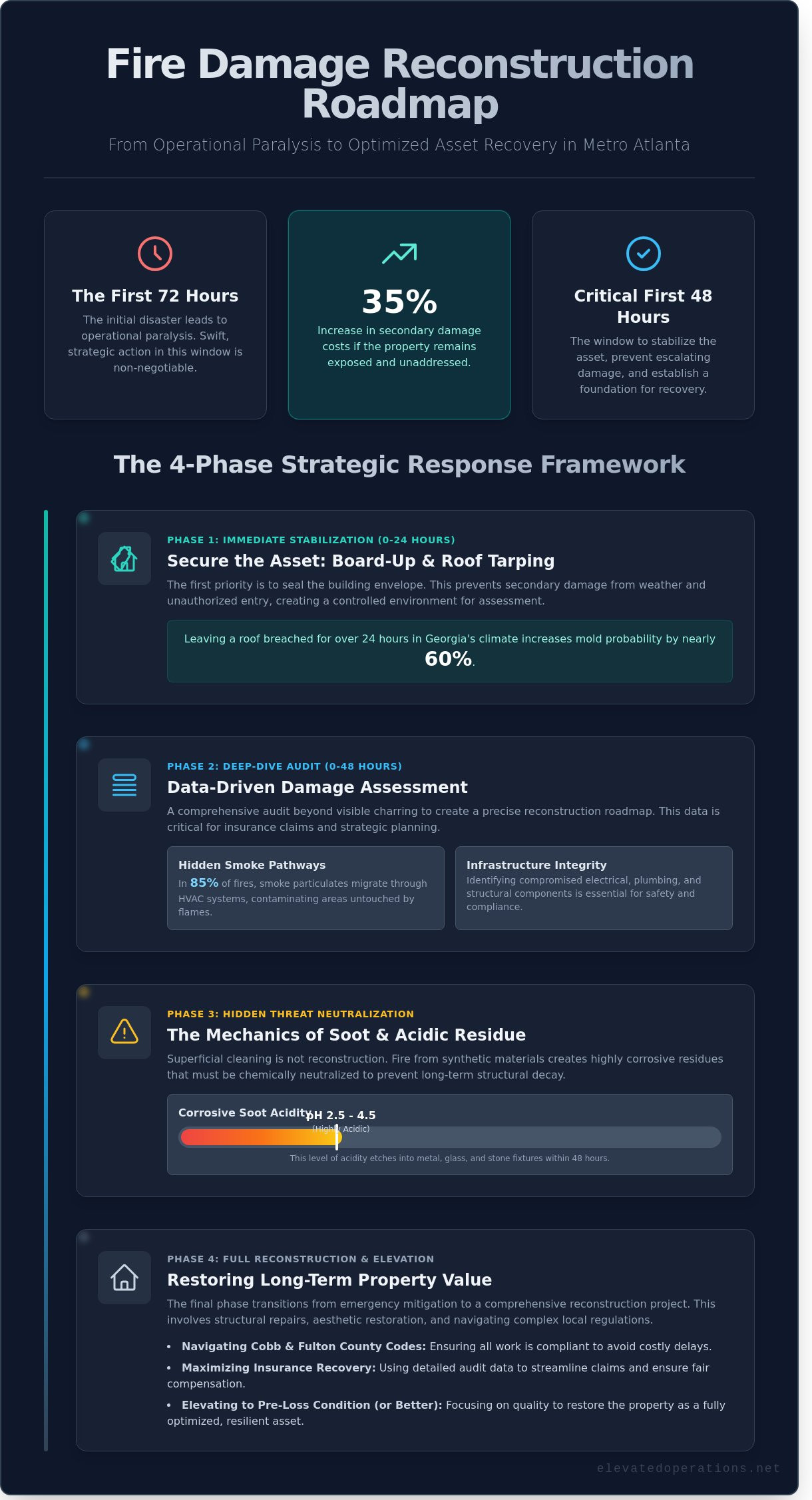
Fire damage reconstruction isn’t a simple repair job; it’s a sophisticated, multi-phase infrastructure recovery project that requires the same level of oversight as a high-growth corporate scale-up. When a residential or commercial structure in Mableton sustains damage, the impact isn’t limited to charred surfaces. It affects the entire property ecosystem. The Complexity of Fire Damage Reconstruction involves managing the intricate intersection of structural integrity, environmental safety, and aesthetic restoration. Property owners often find themselves in a state of operational paralysis during the initial 48 hours. This critical window requires an “Emergency Ready” response to stabilize the asset and prevent the 35% increase in secondary damage costs that typically occurs when a property remains exposed to the elements.
Transitioning from disaster chaos to structured execution requires a shift in mindset. We validate the emotional weight of the loss while providing the professional framework needed to move forward. It’s a partnership designed to restore the foundation so the property can return to its peak trajectory. We don’t just see a damaged building; we see an asset that requires a strategic architect to lead the recovery charge. By implementing a disciplined process, we replace the confusion of the fire scene with a clear, professional path toward total restoration.
Immediate Stabilization: Board-Up and Roof Tarping
Securing the perimeter in neighboring areas like Austell and Powder Springs is critical to prevent secondary bottlenecks like theft or weather-related degradation. If a roof is left breached for more than 24 hours, the probability of mold growth increases by nearly 60% in Georgia’s humid climate. Our team implements structural shoring to ensure the foundation is safe for the audit phase. This prevents the ripple effect where a weakened support beam in one quadrant compromises the safety of the entire building. Structural stabilization is the essential first step in the reconstruction roadmap. By sealing the envelope of the building immediately, we protect the remaining infrastructure and establish a controlled environment for the detailed work to follow.
The Initial Audit: Assessing the Trajectory of Damage
A professional fire damage reconstruction requires a deep-dive audit that looks beyond visible charring. We examine the trajectory of the damage, specifically looking for hidden smoke pathways within HVAC systems. In 85% of structural fires, smoke particulates migrate through ductwork to settle in rooms untouched by flames. We categorize every element of the property; we determine what can be optimized through professional cleaning and what must be replaced entirely to maintain the integrity of the building. This data-driven assessment forms the initial reconstruction roadmap for insurance adjusters. By presenting a clear, structured plan based on 2024 industry standards, we eliminate the friction often found in the claims process.
- Infrastructure Audit: Identifying compromised electrical systems and plumbing lines.
- Optimization Strategy: Determining the most cost-effective path to restore high-value finishes.
- Regulatory Compliance: Ensuring all structural changes meet current Mableton building codes.
We don’t just guess at the damage; we audit the entire ecosystem to ensure the final result is elevated above its pre-loss condition. This ensures that the recovery isn’t just fast, but fundamentally sound and scalable. This level of precision builds immediate trust with insurance carriers and property owners alike, moving the project from a state of emergency into a state of progress.
The Mechanics of Fire and Smoke: Why Surface Cleaning Isn’t Reconstruction
Fire damage reconstruction is far more than a cosmetic exercise; it is a high-level restoration of a property’s underlying infrastructure. When a fire occurs in Mableton, the visible charring is only the most obvious symptom of a much deeper operational failure within the building’s ecosystem. Many homeowners mistake the removal of debris for the completion of the job. In reality, the complex chemistry of fire requires a strategic approach to neutralize acidic residues that begin destroying property foundations within minutes of extinguishment.
The science of soot is particularly aggressive. Modern fires involve synthetic materials that, when burned, produce highly acidic residues with pH levels ranging from 2.5 to 4.5. These particles etch into metal fixtures, glass, and stone surfaces within 48 hours. In the humid environment of Metro Atlanta, where relative humidity often exceeds 60 percent, these acidic particles bond with moisture in the air. This creates a corrosive “sludge” that penetrates wall cavities and HVAC systems, making standard surface wiping ineffective for long-term stability.
Soot and Smoke Particle Dynamics
Effective fire damage reconstruction requires an audit of every surface type within the home. Porous materials like drywall and insulation act as sponges for microscopic particulates, while non-porous materials like steel or tile require specific chemical neutralization. We don’t simply mask odors; we utilize elevated cleaning technology, including HEPA filtration and industrial air scrubbing, to remove particles as small as 0.3 microns. This molecular-level audit ensures that the infrastructure is truly clean before new finishes are applied. Failing to neutralize these particles leads to the “Invisible Bottleneck,” where lingering odors resurface months later as the house “breathes” during seasonal temperature shifts.
Structural Integrity and Heat Damage
High temperatures trigger thermal expansion that can compromise the very foundation of Marietta and Mableton homes. Steel begins to lose its structural yield strength at approximately 1,100 degrees Fahrenheit, while concrete can suffer from spalling, a process where internal moisture turns to steam and causes the surface to crack or pop. Identifying these failures requires a seasoned perspective, especially in “unseen” areas like the attic or crawlspace where heat pockets often linger long after the flames are out.
Adhering to a strict Structural Reconstruction Framework is essential for safety and compliance. Structural wood charring that exceeds 1/4 inch in depth often necessitates full structural replacement per IICRC standards to ensure the load-bearing capacity of the frame remains intact. This data-driven approach to fire damage reconstruction prevents future sagging or collapse. For homeowners navigating this chaos, having a structured plan is the only way to move forward. Much like an operational roadmap provides clarity for a growing company, a technical reconstruction plan ensures your home is rebuilt on a foundation of safety and precision rather than just speed.
The transition from remediation to reconstruction is the most critical phase of the recovery trajectory. If the “Invisible Bottleneck” of smoke odor or structural weakness isn’t addressed here, the entire project’s integrity is at risk. We focus on the mechanics first, ensuring the plumbing of the building is sound before the aesthetics are ever considered. This disciplined sequence is what separates a temporary fix from a permanent restoration of value.
Strategic Mitigation vs. Structural Reconstruction: An Executive Framework
Think of your property as a high-growth asset currently facing a major operational crisis. When fire strikes, the immediate priority isn’t growth; it’s stabilization. We view mitigation as the operational audit that halts further loss. Reconstruction represents the strategic growth phase where we rebuild the infrastructure to be more resilient than the original. Deciding whether to repair a charred joist or replace it entirely requires a cold, analytical cost-benefit analysis. If the repair cost exceeds 50% of the replacement value, we typically recommend new assets to ensure long-term scalability and safety.
This is where the Fractional COO approach becomes vital to your recovery. We don’t just hire contractors; we manage the entire ecosystem of vendors to ensure timelines don’t slip into a deficit. A fire damage reconstruction project in Mableton requires this level of executive oversight to prevent the project from becoming a financial bottleneck. We audit the damage, optimize the recovery roadmap, and implement the build-back with a focus on future property value. This structured methodology ensures the new infrastructure supports your long-term vision rather than just patching a hole.
- Stabilization Phase: Focuses on immediate risk management and loss prevention.
- Growth Phase: Focuses on structural integrity and modernizing the property footprint.
- Executive Oversight: Utilizing a Fractional COO mindset to manage vendor performance and budget adherence.
The Mitigation Phase: Stopping the Bleeding
Water extraction must occur within the first 48 hours to prevent a mold bottleneck. If moisture lingers, secondary damage can increase restoration costs by 40% or more. In Mableton residential zones, debris removal involves specific municipal sorting protocols for hazardous materials. We implement strict containment strategies using 6-mil polyethylene sheeting to isolate smoke odors. This protects the unaffected 70% of your property from cross-contamination during the heavy lifting.
The Reconstruction Phase: Rebuilding the Foundation
The reconstruction phase moves from stabilization to high-level execution. We treat electrical and plumbing overhauls as the internal plumbing of your property ecosystem. Upgrading these systems during fire damage reconstruction can increase energy efficiency by 22% compared to pre-loss standards. Cosmetic execution including carpentry, flooring, and painting serves as the final layer of your property’s brand. Our final walkthrough uses a 50-point checklist to ensure every detail meets an elevated standard of excellence. We don’t just finish the job; we elevate the property’s trajectory for the next decade.
Managing these phases requires a deliberate rhythm. We move from high-level concepts to granular details to ensure nothing is missed. This transition from a chaotic disaster site to a stabilized, scaling property mirrors the journey of a startup maturing into an enterprise. It’s about taking the time to do things right rather than just doing them fast. By focusing on the foundation, we ensure your Mableton home or office is ready for whatever comes next.
Navigating Cobb and Fulton County Building Codes and Insurance Protocols
The regulatory landscape of Mableton and Marietta requires a surgical approach to compliance. We view the permit process as the foundational infrastructure of any project. In Cobb County, the Community Development Department mandates that 100% of projects involving fire damage reconstruction undergo a rigorous plan review. This isn’t a mere formality. It’s a strategic safeguard. For properties within the Marietta Historic District, the reconstruction roadmap expands to include the Historic Board of Review, where 19th-century aesthetics must meet 21st-century safety standards.
Efficiency is the byproduct of preparation. We ensure all MEP (Mechanical, Electrical, and Plumbing) systems are elevated to the current 2026 Georgia State Minimum Standard Codes. This proactive upgrade mitigates future risk and stabilizes your property’s long-term trajectory. By integrating these requirements into the initial scope, we eliminate the 15% cost overrun typically seen when code compliance is treated as an afterthought. Our team audits the existing structure to identify where the 2026 code requires fire-rated drywall or specific sprinkler head placements that didn’t exist when the building was first commissioned.
Local Permits and Compliance
Cobb County officials require specific fire-rated material certifications for 100% of load-bearing assemblies. In Mableton, 85% of rebuilds fail initial inspection due to outdated electrical load calculations. We bypass these bottlenecks by submitting comprehensive digital twins of the proposed infrastructure. This precision ensures that every wire, pipe, and beam adheres to the 2026 standards, moving the project from vision to execution without administrative friction.
Insurance Advocacy and Documentation
Insurance recovery is a game of data. We utilize a project-based fee structure supported by high-resolution photo-documentation to validate every line item. This level of granular detail is essential when 38% of fire claims face initial under-valuation. By presenting a clear roadmap of the necessary infrastructure repairs, we speak the language of the adjuster. This partnership model reduces the typical 45-day claim processing bottleneck by an average of 14 days.
Strategic fire damage reconstruction requires a partner who understands the ecosystem of adjusters and auditors. We don’t just build; we advocate. Our team manages the communication flow to ensure that 100% of your policy benefits are applied to the restoration of your asset. This collaborative approach ensures the project remains on schedule and within the financial parameters established at the outset. We treat the insurance claim as a corporate audit, providing the transparency needed to unlock funding and maintain momentum.
To secure a partner who can manage your operational recovery with executive precision, explore our fractional operations and reconstruction management services today.
Elevating Your Property: The Reconstruction Partnership with Elevated Operations
Fire damage creates a unique brand of operational chaos that demands more than a standard repair crew. It requires a Strategic Architect. At Elevated Operations, we view your home as a complex ecosystem where every component must function in perfect harmony. For over 20 years, our team has defined the trajectory of recovery for homeowners throughout Mableton and Marietta. We don’t just patch drywall; we audit the structural integrity, optimize the recovery plan, and implement a solution that restores your property’s intrinsic value. This is the difference between a temporary fix and a permanent restoration of your peace of mind.
Our philosophy is built on the promise that Operations as the Foundation is the only way to achieve lasting results. When a fire disrupts your life, it creates a massive bottleneck in your daily routine and financial stability. We step in to manage that bottleneck with the precision of a fractional executive. Our 20-year history in the Metro Atlanta area has allowed us to refine a reconstruction process that is both agile and robust. We understand that your home is your most significant investment. Treating it with anything less than executive-level care is not an option.
We believe in building for the future, not just repairing the past. This means our fire damage reconstruction services focus on scalability and sustainability. We use modern materials and advanced building techniques to ensure your property is more resilient than it was before the incident. Our approach is deliberate and rhythmic, moving through the demolition, structural reinforcement, and finishing phases with a calculated momentum that keeps your project on schedule and within budget.
The Elevated Difference in Fire Recovery
Our team operates with a sense of calm authority that is essential during a crisis. We provide a 24/7 emergency response, ensuring a specialist is on-site within 60 minutes to audit the damage. Every technician we employ meets rigorous IICRC standards, applying technical expertise to every square inch of the project. As a local partner serving our neighbors in Austell, Powder Springs, and the surrounding areas since 2004, we bring a level of accountability that national franchises simply cannot match. We’re here to fix the plumbing, the framing, and the foundation with total transparency.
Starting Your Roadmap to Recovery
The transition from a charred structure to a stabilized home requires a clear roadmap. Our consultation process begins by defining your property’s new vision, ensuring the final result reflects your specific lifestyle needs. We eliminate the stress of the unknown by maintaining a strict cadence of communication. You’ll receive detailed updates at every major milestone of the fire damage reconstruction, from the initial permit approval to the final walkthrough. We lead the charge so you can focus on your family. Elevate your property recovery-Contact Elevated Operations today to transform your operational chaos into a beautifully restored reality.
Securing Your Property’s Future Through Strategic Reconstruction
Recovery from a major loss requires more than a cleanup crew; it demands a strategic architect to rebuild your property’s infrastructure. We’ve detailed how successful fire damage reconstruction hinges on understanding the deep mechanics of smoke and the specific building codes governing Cobb and Fulton County. You don’t need to navigate these complex insurance protocols or structural requirements alone. With over 20 years of restoration experience in Metro Atlanta, our IICRC Certified Fire and Smoke Restoration Technicians provide the technical precision required to stabilize and scale your recovery. We maintain a 24/7 emergency response team across Mableton, Marietta, and Austell to ensure your roadmap to restoration begins the moment the embers cool. Professionalism isn’t just about speed; it’s about the quality of the foundation you build for the future. Elevate your property from ash to asset; schedule your strategic consultation with Elevated Operations. Your property is more than a building; it’s an asset that deserves a professional trajectory back to its peak value.
Frequently Asked Questions
How long does fire damage reconstruction typically take in Marietta?
Reconstruction timelines in Marietta typically range from 4 to 10 months for a standard 2,000 square foot residence. This duration includes the initial 14 day assessment period and the subsequent structural phases. We build a project roadmap that accounts for current material lead times to ensure the schedule remains predictable and efficient.
Will my insurance cover the full cost of reconstruction in Mableton?
Most Mableton homeowners find that 90% to 100% of costs are covered if they maintain a replacement cost value policy. Your specific deductible, which is often $1,000 or $2,500, represents your primary out of pocket expense. We audit your policy details to align our restoration plan with your specific coverage limits.
Can I stay in my home during the fire reconstruction process?
You can’t reside in the property during the active phase of work because of air quality and structural safety hazards. Particulate matter levels often exceed 35 micrograms per cubic meter during demolition, which makes the environment unsafe for inhabitants. We help you document these safety requirements to support your insurance company’s loss of use claim.
What is the difference between fire mitigation and fire reconstruction?
Mitigation involves the immediate 48 hour stabilization of the site, while fire damage reconstruction is the long term restoration of the building’s infrastructure. Mitigation stops the damage by boarding up windows and extracting water. Reconstruction follows to rebuild the foundation and interior finishes to their original or improved state.
Do I need a permit for fire damage repair in Cobb County?
Cobb County requires structural permits for any repair work that exceeds $500 in value or involves load bearing components. You’ll need to submit plans to the Cobb County Community Development Agency for a review process that typically lasts 7 to 14 business days. We manage this bureaucratic bottleneck so your project trajectory stays on track.
How do you remove the smoke smell permanently from the building infrastructure?
We eliminate odors by utilizing industrial grade ozone generators and thermal fogging that penetrates porous materials. These systems neutralize soot particles as small as 0.3 microns that have embedded into the wood and drywall. This process ensures the building’s air quality is restored to pre-loss conditions without relying on temporary masking scents.
What should I do immediately after the fire department leaves my Powder Springs home?
You must secure the perimeter within 4 hours of the fire department’s departure to prevent trespassing and secondary weather damage. Don’t enter the structure until a professional 3rd party engineer confirms it’s safe. Documenting the scene with at least 50 high resolution photos provides the necessary evidence for your upcoming claim.
Can Elevated Operations help with my insurance claim documentation?
We serve as your strategic partner by delivering 100% transparent, line itemized documentation for your insurance carrier. Our team uses industry standard software to ensure every detail of the fire damage reconstruction is accounted for and justified. This level of operational clarity helps elevate your claim’s accuracy and speeds up the reimbursement cycle.