In 2024, the average insurance claim for residential water damage in Georgia climbed to $13,280, a figure that fails to capture the long-term cost of structural decay and mold. When water is rising in your Mableton home or Atlanta business, the immediate chaos can feel paralyzing. You’re not just worried about the visible damage; you’re concerned about the hidden threats that Georgia’s humidity can accelerate, from a compromised foundation to pervasive mold growth that can manifest weeks later.
This guide moves beyond the panic, providing the professional framework necessary to protect your property’s long-term value. We will equip you with a clear roadmap for deploying professional emergency water removal services, stabilizing the structure, and ensuring every action is meticulously documented for your insurance claim. From initial extraction protocols to advanced structural drying techniques, we will outline the strategic steps that transform a crisis into a controlled, successful restoration.
Key Takeaways
- Understand the critical 24-48 hour window in Metro Atlanta’s climate to prevent irreversible mold growth and protect your property’s long-term value.
- Discover the strategic framework that defines professional emergency water removal services, moving beyond simple extraction to a comprehensive property stabilization plan.
- Grasp why removing standing water is only the first step and how scientific structural drying is the true foundation of a successful recovery.
- Identify how local challenges, from Mableton’s Georgia clay to flash flood risks, require a specialized roadmap for effective water damage mitigation.
Defining Emergency Water Removal Services in the Metro Atlanta Context
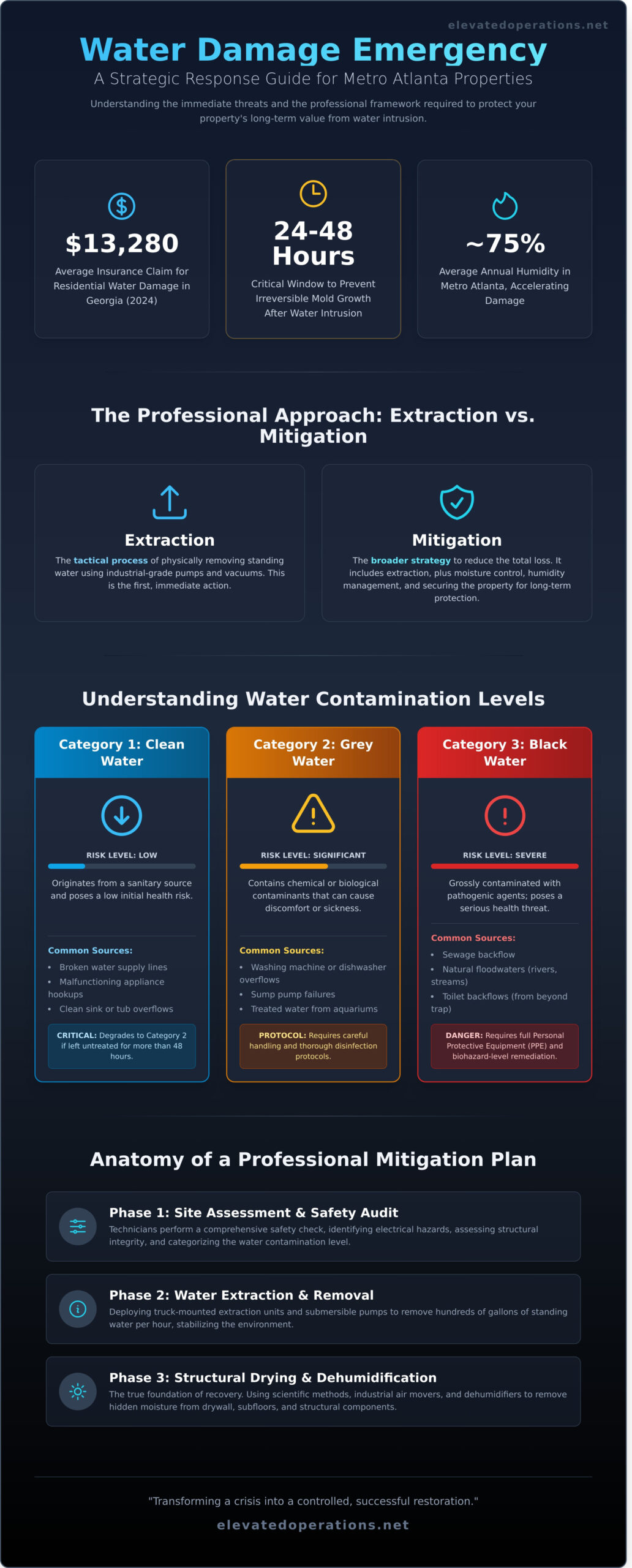
When water intrudes into your Mableton property, the clock starts ticking immediately. Emergency water removal is not merely cleanup; it’s the immediate, mechanical extraction of standing water executed to prevent catastrophic secondary damage. This initial action is the first phase of a larger restoration roadmap, designed to stabilize the environment before irreversible harm occurs. In a high-humidity environment like Metro Atlanta, where average annual humidity hovers around 75%, this response is non-negotiable. Mold and microbial growth can begin to colonize damp drywall, carpet, and wood subfloors in as little as 24 to 48 hours, transforming a simple water issue into a complex environmental hazard.
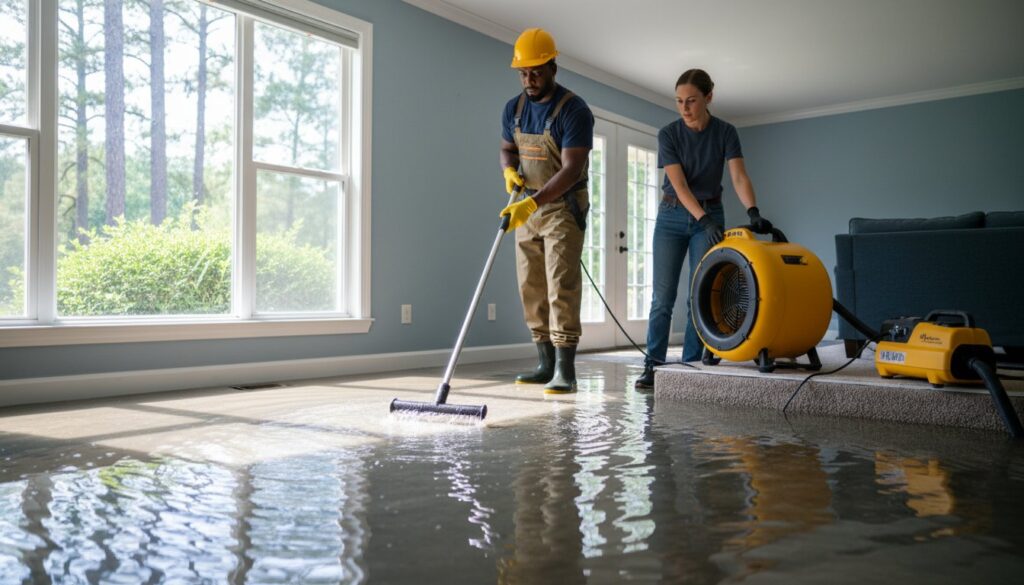
A common misconception is that a standard wet-dry vacuum can manage a water intrusion event. This approach is fundamentally flawed. A consumer-grade vacuum simply lacks the power and capacity to handle a significant water loss. Professional emergency water removal services deploy an entirely different class of infrastructure, including truck-mounted extraction units capable of removing hundreds of gallons per hour. It’s the difference between bailing water with a bucket and deploying industrial-grade pumps. This professional intervention is the critical first step toward stabilization, halting the damage and establishing a controlled foundation for the drying and restoration process that follows.
The Crucial Difference Between Extraction and Mitigation
Understanding the distinction between extraction and mitigation is vital for any property owner. Extraction is the tactical process of physically removing the liquid water. This involves the strategic placement of submersible pumps and the use of high-powered industrial vacuums. Mitigation, however, is the broader strategic effort to reduce the total scope of the loss. It includes extraction but also encompasses moisture control, humidity management, and securing the property. For Mableton property owners, prioritizing both ensures the structural integrity of your foundation and framework is protected from the long-term effects of water saturation.
Categorizing Water Contamination Levels
Not all water damage is created equal. The source of the water dictates the entire operational protocol, from the equipment used to the safety measures required for our technicians. Professionals classify water intrusion into three distinct categories based on contamination levels. Understanding these classifications is a fundamental part of the response, as detailed in sources like Wikipedia’s overview on The Anatomy of a Professional Water Extraction, because the required protocols are drastically different for each.
- Category 1: Clean Water. This originates from a sanitary source, such as a broken water supply line or a malfunctioning appliance hookup. While it poses a low initial health risk, it can quickly degrade into Category 2 if it comes into contact with building materials and is left untreated for more than 48 hours.
- Category 2: Grey Water. This water contains a significant degree of chemical or biological contamination. Common sources include sump pump failures, washing machine overflows, or dishwasher discharges. It can cause discomfort or sickness upon exposure and requires careful handling.
- Category 3: Black Water. This is the most severe classification and is grossly contaminated. Sources include sewage backflow and natural floodwaters, such as overflows from the nearby Chattahoochee River. Black water contains pathogenic agents and requires biohazard-level remediation protocols, including personal protective equipment (PPE) and specialized disinfection techniques.
The Anatomy of a Professional Water Extraction and Mitigation Plan
A water-related disaster demands more than just a mop and bucket; it requires a strategic, multi-phase operational plan. The difference between a rapid recovery and a prolonged, costly battle with secondary damage lies in the structure of the response. Professional emergency water removal services don’t just remove water; they deploy a systematic mitigation plan designed to stabilize the property’s infrastructure, audit the full scope of moisture intrusion, and execute a documented drying roadmap. This process is the foundation for a successful restoration and a streamlined insurance claim.
The entire operation hinges on a precise, three-phase extraction and stabilization process that moves from macro-level problems to microscopic threats.
- Phase 1: Immediate Site Assessment and Safety Audit. Before any equipment is activated, a certified technician performs a comprehensive safety audit. This includes identifying and neutralizing electrical hazards, assessing structural integrity, and categorizing the water source based on IICRC standards (Category 1, 2, or 3) to determine the required level of containment and personal protective equipment.
- Phase 2: High-Volume Water Removal. Once the site is secured, the primary objective is bulk water extraction. We deploy industrial-grade, truck-mounted extraction units capable of removing hundreds of gallons of standing water per hour. This rapid removal is critical to minimizing the time materials are saturated, which directly reduces the risk of permanent damage.
- Phase 3: Targeted Removal of Saturated Materials. With standing water gone, the focus shifts to materials that have absorbed excessive moisture. Saturated carpet padding, compromised drywall, and soaked insulation are often non-salvageable. Their strategic removal is not demolition; it’s a necessary step to accelerate the drying of the core structure and prevent mold amplification.
Advanced Diagnostic Tools: Seeing the Invisible
What appears dry to the touch is often a deceptive metric. Water is a relentless force, seeping into wall cavities, subflooring, and behind baseboards. Our technicians utilize a suite of advanced diagnostic tools to map the full extent of this hidden moisture, ensuring that the drying plan is based on data, not guesswork.
High-resolution thermal imaging cameras are indispensable, especially in Mableton’s older homes, where they can detect temperature variations that indicate water trapped behind historic plaster walls without requiring destructive testing. This technology creates a precise “moisture map” of your property. Complementing this, digital hygrometers and non-invasive moisture meters measure the ambient humidity and the moisture content within materials like wood framing and concrete. These readings establish a baseline and allow us to monitor the building’s “drying trajectory.” A surface may feel dry, but a meter revealing a 20% moisture content in the subfloor indicates a significant problem. Navigating local challenges like persistent humidity requires this level of scientific precision to prevent mold growth, as detailed by the Environmental Protection Agency.
Every reading, photograph, and action is meticulously documented. This creates an unassailable record of loss for the insurance ecosystem, demonstrating that all mitigation efforts were necessary and performed to industry standards. This level of strategic oversight is the core of effective emergency water removal services. To see how this process is structured in detail, you can review our complete mitigation framework and understand the difference a documented plan makes.
Beyond Extraction: Why Structural Drying is the Foundation of Recovery
Removing standing water is a critical first step. It is not, however, the final one. Many Mableton property owners are surprised to learn that physical water extraction accounts for only about 20% of a successful restoration project. The remaining 80% is a meticulous, science-driven process: structural drying. This is where professional emergency water removal services truly define their value, moving beyond the visible problem to address the invisible, and far more destructive, threat of trapped moisture.
The entire process is an exercise in applied psychrometrics, the study of how air, moisture, and temperature interact within a closed environment. We aren’t just cleaning a mess; we are re-engineering your property’s internal ecosystem for recovery. The goal is to create an atmospheric imbalance where the air becomes so dry that wet materials like drywall, wood studs, and subflooring have no choice but to release their trapped moisture into it. That moisture is then captured and removed from the property permanently.
In a climate like Mableton’s, where average annual humidity hovers around 72%, simply placing a few box fans is a recipe for secondary damage. Fans alone merely circulate that humid air, often pushing moisture deeper into porous materials and accelerating the potential for widespread mold growth. Effective recovery requires a strategic, technology-driven approach.
The Mechanics of Dehumidification and Air Movement
A successful drying strategy is built on two pillars: industrial-grade dehumidification and strategic air movement. We deploy Low-Grain Refrigerant (LGR) dehumidifiers, which are engineered to pull massive amounts of water vapor from the air, creating an exceptionally dry environment. This process lowers the vapor pressure, which in turn coaxes moisture from deep within saturated materials. High-velocity air movers are then placed to create a vortex of airflow across wet surfaces, dramatically accelerating evaporation and feeding that moisture to the dehumidifiers. It’s a balanced drying system designed to prevent moisture from ‘wicking’ into previously unaffected areas of your home.
Managing the Mold Trajectory
In Cobb County’s warm, humid climate, mold spores can begin to germinate on damp surfaces in as little as 24 to 48 hours. Professional structural drying halts this trajectory before it begins. By rapidly reducing indoor humidity and drying materials to a safe level, we eliminate the conditions necessary for mold to thrive. As a proactive safety layer, we often apply an EPA-registered antimicrobial treatment to affected surfaces. We don’t guess when a structure is dry; we measure. By establishing a ‘dry standard’ using moisture readings from an unaffected area of your home, we create a clear, data-backed target to ensure the foundation of your recovery is truly solid.
Navigating Local Challenges: From Georgia Clay to Insurance Claims
Effective water removal in Mableton requires more than industrial fans; it demands a deep understanding of the local terrain and regulatory landscape. The iconic Georgia red clay, specifically the Cecil soil series prevalent in Cobb County, has an exceptionally low permeability rate. During the intense downpours common from May to August, rainwater doesn’t absorb into the ground. Instead, it pools, creating immense hydrostatic pressure that compromises foundations and turns basements into flood zones. This isn’t a generic problem; it’s a geological reality for Mableton homeowners.
This challenge is amplified by Metro Atlanta’s volatile weather. A summer afternoon can shift from sunshine to a deluge where the National Weather Service records over two inches of rain in under an hour. This is flash flooding. It overwhelms municipal drainage systems and can quickly saturate the ground around your property. When this happens, you need more than a simple cleanup crew; you need a strategic partner who understands how to mitigate damage specific to our region’s soil and weather patterns.
Mableton and Marietta: Regional Water Damage Profiles
In established communities from Powder Springs to the neighborhoods near the Silver Comet Trail, water intrusion stems from a combination of factors. Aged plumbing infrastructure in homes built before 1980 often fails under pressure, while intense storm surges overwhelm modern sump pumps. The urgency dictated by these local weather patterns means that a standard 24-hour response is inadequate. A 60-minute arrival time is the new benchmark for effective emergency water removal services, preventing water from saturating subfloors and framing.
Strategic Insurance Partnership
Your insurance policy is a contract, and a successful claim is built on irrefutable evidence. We create an exhaustive ‘loss documentation’ package that includes thermal imaging to map hidden moisture, detailed psychrometric readings, and an itemized inventory of all affected materials. A 2023 report from the Insurance Information Institute highlights that nearly 30% of claim disputes stem from inadequate documentation. We eliminate that risk by communicating directly with your adjuster, presenting data in the format they require using industry-standard software like Xactimate. This avoids the common ‘DIY trap,’ where well-intentioned homeowners submit insufficient proof, leading to denied claims for secondary damage like mold growth.
A successful restoration isn’t just about removing water. It’s about rebuilding with precision and foresight. This includes navigating the specific building codes for Marietta and Austell, which govern everything from electrical work in damp environments to the type of drywall required in moisture-prone areas. Choosing a partner without this localized expertise can lead to failed inspections and costly rework, compounding the initial crisis.
Don’t navigate the complexities of restoration and insurance alone. To ensure your property is correctly documented and restored to exceed local codes, partner with our team for a strategic restoration plan.
Elevating Your Property Trajectory with Elevated Operations
A sudden water event presents more than a cleanup challenge; it’s a critical inflection point that will define your property’s future value and structural health. A purely tactical response-simply removing the visible water-is shortsighted and often leads to long-term complications. A strategic response, however, views the crisis as an operational problem requiring executive-level oversight. Elevated Operations is that strategic partner. We serve as the architect of your property’s recovery, transforming a moment of chaos into a structured, predictable return to stability and ensuring every action taken today protects your asset’s trajectory for tomorrow.
We are the missing piece in the property management leadership puzzle during a crisis. Our commitment is built on a ‘Full-Circle’ service framework that provides a single, accountable point of contact from the initial emergency call to the final walkthrough. This integrated system eliminates the friction and costly delays of coordinating multiple vendors. It begins with our 24/7 rapid-response teams, strategically positioned to serve Mableton, Austell, and Marietta. We guarantee a certified technician is dispatched and en route within 90 minutes of your call, 365 days a year. From there, we manage the entire recovery lifecycle: immediate water extraction, advanced structural drying, meticulous mold remediation, contents restoration, and complete reconstruction services. We even interface directly with your insurance carrier, providing the detailed documentation required to streamline your claim and reduce your administrative burden.
Choosing the right partner for emergency water removal services is a decision with significant financial implications. A fragmented or slow response creates a cascade of secondary issues. Within 48 hours, clean water can become contaminated, and mold spores can begin to colonize, turning a manageable situation into a complex environmental hazard. This leads to extended downtime, more expensive repairs, and a permanent reduction in your property’s value. Our operational model is engineered specifically to mitigate these risks, protecting both your physical infrastructure and your financial foundation.
The Elevated Advantage: Sophisticated Execution
With over 20 years of dedicated experience in the Metro Atlanta restoration ecosystem, our execution is both sophisticated and systematic. We apply our ‘Audit, Optimize, Implement’ methodology to every project. We audit the full extent of moisture intrusion using infrared cameras and digital moisture meters, optimize a custom drying plan based on scientific data, and implement it with master-level workmanship that meets or exceeds IICRC S500 standards. Our goal is to restore value, not just function.
Taking the First Step Toward Stabilization
Your first action defines the entire recovery timeline. When you contact our emergency dispatch, our process begins instantly. Within the first 60 minutes of our arrival on-site, you can expect our team to:
- Conduct a thorough safety assessment to identify and neutralize any electrical or structural hazards.
- Begin deploying industrial-grade equipment, including high-velocity air movers and low-grain refrigerant dehumidifiers, to immediately stabilize the environment.
- Provide you with a clear, transparent roadmap outlining the next steps, expected timeline, and projected outcomes.
Don’t let uncertainty dictate your property’s future. Take decisive action. Elevate your property’s recovery-Contact Elevated Operations now.
Elevate Your Property’s Recovery Trajectory
Navigating a water emergency in Metro Atlanta requires more than just a rapid response; it demands a strategic framework. A successful recovery is built upon a meticulous plan that moves from extraction to the non-negotiable foundation of structural drying, ensuring your property’s long-term value is protected. When you need professional emergency water removal services, you aren’t just hiring a crew. You’re engaging a strategic partner dedicated to restoring your operational stability.
Elevated Operations provides that partnership. Our IICRC Certified Technicians deliver 24/7 rapid response across Cobb and Fulton Counties, managing every detail from mitigation to comprehensive insurance claim assistance. Your property’s future doesn’t have to be defined by this event.
Secure Your Property Foundation-Call Our 24/7 Emergency Line and let’s rebuild its trajectory, stronger than before.
Frequently Asked Questions About Water Removal
How quickly should emergency water removal services begin?
Emergency water removal services should begin within 24 to 48 hours of the initial incident. This rapid response is critical because mold and mildew can begin to grow within this exact timeframe, creating secondary damage. The longer water sits, the more it saturates materials like drywall and wood subfloors, increasing the complexity and cost of repairs. A swift, professional response is the key to minimizing long-term structural issues.
Does insurance cover the cost of professional water extraction in Georgia?
Most standard Georgia homeowner’s policies, such as an HO-3 policy, do cover water damage from sudden and accidental internal sources. This typically includes events like a burst pipe, a broken supply line to an appliance, or an overflowing toilet. However, these policies almost never cover damage from external flooding, such as a river overflowing. For that, you need a separate policy from the National Flood Insurance Program (NFIP).
Can I stay in my home during the water removal and drying process?
It’s generally not recommended to stay in your home, especially during the first 48 to 72 hours of the process. The work involves loud, industrial-grade equipment like air movers and dehumidifiers running 24/7. More importantly, depending on the water source (classified as Category 1, 2, or 3), there could be biological contaminants present. For your safety and comfort, it’s often best to arrange a temporary stay elsewhere.
What is the difference between water mitigation and water restoration?
Water mitigation is the immediate emergency response designed to prevent further damage. This phase includes extracting standing water, removing damaged materials, and professionally drying the structure. Water restoration is the second phase; it involves the repair and rebuilding work necessary to return your property to its pre-loss condition. Restoration tasks can include replacing drywall, installing new carpet, and painting.
How do I know if my walls are truly dry after a flood?
You can’t determine if a wall is dry just by touching it. Professionals use specialized instruments like penetrating and non-penetrating moisture meters to get accurate readings from within the drywall and wood studs. They may also use thermal imaging cameras to identify hidden moisture pockets. A structure is considered dry when the materials return to their normal equilibrium moisture content, which is typically below 15% for wood.
Why shouldn’t I use a standard vacuum for water removal?
Using a standard household vacuum or even a typical shop-vac for significant water removal creates a severe risk of electrocution. These appliances aren’t rated for that kind of use and their motors aren’t properly sealed from moisture. Beyond the safety hazard, they lack the power of professional truck-mounted extractors, leaving behind enough residual moisture in carpets and padding to guarantee mold growth within just 24 hours.
What areas around Mableton do you serve for emergency calls?
Our rapid response teams are based in Mableton and provide 24/7 emergency service to all of Cobb County and its surrounding communities. We guarantee a 90-minute or less response time to Mableton and nearby cities, including Smyrna, Austell, Vinings, Lithia Springs, and Powder Springs. If you’re unsure whether you fall within our primary service zone, please call our dispatch line for immediate confirmation.
What should I do while waiting for the emergency water removal team to arrive?
Your first priority is safety. If you can do so safely, shut off the electricity to the affected areas at the breaker panel. Next, if you know the source, turn off the main water valve to your home. You can then begin moving any furniture, documents, or valuable items to a dry, unaffected part of the house. Placing small squares of aluminum foil under the legs of any remaining heavy furniture can prevent rust or wood stains on your flooring.