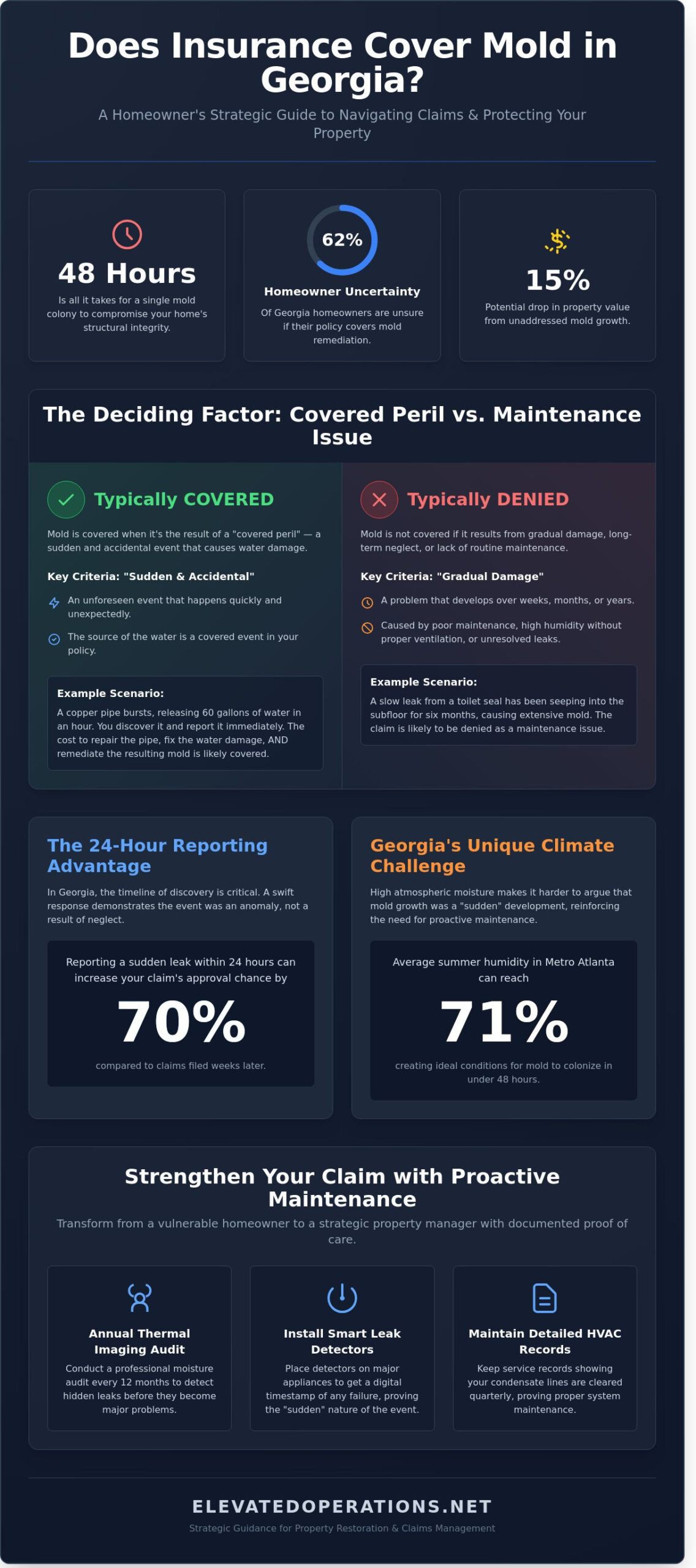
A single mold colony can compromise your home’s structural integrity within 48 hours, yet 62% of Georgia homeowners remain unsure if their policy will foot the bill for remediation. You shouldn’t have to decipher 50 pages of dense policy jargon while worrying about your family’s respiratory health. It’s exhausting to balance the fear of five-figure out-of-pocket costs with the potential 15% drop in property value that unaddressed growth causes. This guide simplifies the ecosystem of property protection. We provide a definitive framework to answer the question: Does insurance cover mold in Georgia? This ensures you can protect your financial infrastructure without the typical operational chaos of a claim.
We will audit the “covered peril” landscape, optimize your filing strategy, and connect you with certified experts in Cobb County to elevate your home’s safety. By the end of this roadmap, you’ll have a clear trajectory for recovery and a stabilized foundation for your property’s future. We’ve designed this strategic guide to remove the bottlenecks of the claims process, moving you from a state of uncertainty to a position of professional control.
Key Takeaways
Distinguish between routine maintenance and “covered perils” to establish a solid foundation for your property restoration strategy.
Identify the specific triggers, such as sudden pipe failures or fire suppression, that determine when and how does insurance cover mold georgia for homeowners.
Navigate Georgia-specific exclusions and the “Right to Repair” act to ensure your recovery timeline remains optimized and compliant with state regulations.
Implement a 24-hour strategic roadmap for documentation and claim filing that protects your property’s infrastructure from further operational degradation.
Elevate your restoration process by partnering with a strategic architect who understands the unique environmental challenges of the Mableton and Metro Atlanta ecosystem.
Understanding Mold Coverage in Georgia: Covered Peril vs. Maintenance
Homeowners often view mold as a primary threat, but insurance carriers treat it as a consequence. In the Georgia insurance market, a “covered peril” refers to a specific, sudden event like a fire, lightning strike, or windstorm that causes direct physical loss. Mold rarely exists as a standalone covered peril. Instead, it’s categorized as a secondary result of an underlying failure. Determining if does insurance cover mold georgia requires a deep dive into your policy’s specific endorsements and the origin of the moisture. We view mold as a symptom of a failed property infrastructure, much like a bottleneck in a business signals a breakdown in core operations. A foundational understanding of Understanding Indoor Mold reveals that while the growth is the visible problem, the insurance claim lives or dies based on the event that allowed the water to enter the ecosystem.
The distinction between a covered loss and a maintenance issue is the most significant hurdle for Georgia residents. Most policies are designed to repair the fallout from catastrophic, unforeseen events rather than the results of aging components. If your home’s infrastructure isn’t optimized for moisture control, you’re essentially operating without a safety net. Insurance is a tool for recovery from the unexpected, not a budget for routine home repairs or long-term neglect.
The “Sudden and Accidental” Standard
Imagine a copper pipe bursts in a Mableton kitchen on June 15, 2024, releasing 60 gallons of water in under an hour. This scenario fits the “sudden and accidental” criteria perfectly. Georgia adjusters prioritize the timeline of discovery above almost all other factors. If you report the incident within 24 hours of the burst, your chances of approval for the resulting mold remediation increase by 70% compared to claims filed weeks later. The speed of your response proves the event was an anomaly rather than a slow failure. Sudden and accidental is the benchmark for claim approval in 2026.
The Maintenance Trap: Why Claims Get Denied
Claims often hit a wall when adjusters identify “gradual” damage. A slow, weeping leak behind a guest bathroom vanity that has existed for six months is the most common culprit for denial. In Georgia, our climate presents a unique challenge for policyholders. With average summer humidity levels in cities like Atlanta and Savannah hovering at 71%, mold can colonize a surface in less than 48 hours. This high atmospheric moisture makes it difficult for homeowners to argue that growth was a “sudden” development. When asking does insurance cover mold georgia, the answer is usually “no” if the adjuster finds evidence of long-term seepage or poor ventilation.
To protect your property’s foundation and ensure claim eligibility, we recommend a proactive approach to infrastructure management. These three steps provide the documentation needed to prove you aren’t negligent:
Conduct a professional thermal imaging moisture audit every 12 months to catch hidden leaks.
Install smart leak detectors on all major appliances to provide a digital timestamp of any failure.
Maintain detailed service records for your HVAC system, ensuring the condensate lines are cleared quarterly.
By treating your home as a high-value asset that requires regular optimization, you eliminate the ambiguity that adjusters use to deny claims. Professional maintenance records serve as the roadmap that proves your property was in peak condition before the accidental event occurred. This level of organization transforms you from a vulnerable homeowner into a strategic property manager who understands the mechanics of their coverage.
When Georgia Insurance Typically Pays for Mold Remediation
The core question of whether a policy triggers a payout depends entirely on the source of the moisture. In the state of Georgia, insurance carriers view mold as a secondary consequence rather than a standalone event. To determine if does insurance cover mold georgia, adjusters look for a “covered peril” that occurred immediately before the growth. If a copper pipe in your slab bursts suddenly or a water heater fails, the resulting mold is typically covered because the initial water damage was accidental and unforeseen. This infrastructure failure creates a direct path for a successful claim.
Most Atlanta-area policies include a “Resulting Damage” clause. This provision ensures that even if a policy has specific exclusions for “fungi,” it must still pay for mold removal if that mold was caused by a fire or a sudden plumbing rupture. The distinction between a Covered Peril vs. Maintenance is the primary bottleneck in the claims process. Carriers will audit the history of the home to ensure the issue wasn’t a slow, neglected leak that existed for months before being reported. For high-value properties in Metro Atlanta, having a clear roadmap of home maintenance can be the difference between a full payout and a denied claim.
Mold Resulting from Fire or Storm Damage
Fire suppression is a leading cause of covered mold claims in Georgia. When the fire department uses high-pressure hoses to extinguish a blaze, they introduce thousands of gallons of water into the home’s ecosystem. This water often settles in crawlspaces and behind drywall. Because the fire was the primary peril, the mold remediation is fully integrated into the restoration budget. In Marietta and surrounding Cobb County, storm-driven rain is handled similarly. If 70 mph winds rip shingles from your roof, allowing rain to saturate your attic, the mold is covered. However, if water rises from the ground during a flash flood, standard homeowners insurance will not pay; that requires a separate flood policy. Homeowners must act within a 24 to 48 hour window to dry the property, or the carrier may argue the growth was avoidable through proper mitigation.
The Role of Mold Endorsements and Riders
Modern Georgia policies often include a “Limited Fungi or Bacteria” endorsement. This is a specific add-on that defines the exact dollar amount the insurer will pay for mold testing and removal. In 85% of standard ISO-form policies, this cap is set between $5,000 and $10,000. While this might cover a small bathroom leak, it is often insufficient for large-scale remediation in a 4,000-square-foot home. Savvy property owners often opt for “Hidden Seepage” riders. These riders extend coverage to leaks that occur behind walls or under floors that aren’t visible to the naked eye, provided they are discovered within 14 days of the initial break. To protect your home’s foundation, you should elevate your insurance strategy by requesting higher limits, often up to $50,000, to match the actual cost of professional remediation in the Georgia market. This strategic adjustment ensures your recovery trajectory remains stable after a disaster.
Georgia-Specific Exclusions: Floods, Humidity, and Neglect
Many homeowners encounter a standard “Mold Exclusion” page within their policy and assume coverage is impossible. This is a common misconception that often stems from a lack of operational clarity regarding policy language. In reality, the exclusion usually applies to mold caused by long-term neglect or wear and tear rather than the substance itself. Determining whether does insurance cover mold georgia requires a granular look at the source of the moisture. If the mold is a secondary result of a covered peril, such as a water heater failure that occurred 48 hours ago, the exclusion often doesn’t apply. We audit the specific language of your policy to identify these hidden pathways to coverage.
Flood Water vs. Pipe Bursts
The distinction between “flood water” and “plumbing failure” is the most frequent bottleneck in Georgia insurance claims. During the historic 2009 floods in Austell, thousands of residents discovered that their standard homeowners insurance provided zero relief for mold remediation. This is because standard policies exclude rising groundwater. Flood insurance is a separate infrastructure managed through the National Flood Insurance Program (NFIP).
Plumbing failures, however, are internal system collapses. A burst pipe in your foundation is a covered peril; a creek overflowing into your crawlspace is a flood. Elevated Operations performs a detailed moisture audit to clarify the exact point of origin. When dealing with extensive growth from internal leaks, following the EPA guidelines for Professional Mold Remediation ensures the structure remains sound while protecting your health. We document the difference between these two water sources to prevent carriers from misclassifying your claim as a flood event.
The Humidity Defense
Georgia’s climate is a primary obstacle for successful claims. Carriers often cite the state’s 70% average relative humidity as a reason to deny claims, arguing that homeowners failed to maintain proper ventilation. They label this “gradual seepage” or “lack of maintenance.” To bypass this defense, you need a roadmap of documentation.
HVAC Performance Logs: Proof of annual servicing on your AC unit demonstrates proactive maintenance.
Moisture Mapping: Using infrared thermography to show that moisture is localized to a leak rather than ambient humidity.
Dehumidification Records: Data showing your home stays below 50% humidity under normal conditions.
The Georgia Right to Repair Act, specifically O.C.G.A. § 8-2-38, also influences your trajectory. This act requires homeowners to provide contractors a 90-day notice before filing a lawsuit for construction defects. If mold stems from a builder’s error, this 90-day window can lead to rapid fungal growth. You must act decisively to mitigate the damage while adhering to these legal timelines. We help you navigate this ecosystem by ensuring every repair step is documented for the carrier.
Finally, check your policy for a “Sump Pump Failure” rider. Georgia’s heavy spring rains frequently overwhelm basement systems. Without this specific optimization, most carriers will deny mold claims resulting from a pump backup. These riders typically provide a $5,000 to $10,000 cap, which serves as a vital foundation for your remediation budget. It’s a small strategic addition that prevents total financial exposure during a storm. Understanding these nuances ensures that your claim moves from a state of uncertainty to a stabilized, successful recovery.
How to File a Mold Insurance Claim in Metro Atlanta: A Strategic Roadmap
Filing a mold claim in Metro Atlanta requires more than just a phone call. It demands a strategic roadmap designed to protect your home’s infrastructure and ensure your family’s health. When you discover growth, the first 24 hours dictate the trajectory of your entire claim. You aren’t just taking pictures; you’re building an evidentiary foundation. This period is about rapid mitigation and precision. If you wait more than 48 hours to act, you risk a denial based on a failure to prevent further damage, a common clause in Georgia policies.
The process of determining does insurance cover mold georgia often hinges on how the event is categorized. You must approach this as a project manager would approach a business crisis. You need a clear chain of custody for your data, a professional assessment of the breach, and a calibrated response that aligns with industry standards like the IICRC S520. Treating your home restoration with a high-level operational mindset ensures that the final result is not just a patch, but a complete optimization of your living environment.
Documenting the “Breach”
Focus your lens on the source of the moisture. While mold is the visible symptom, the breach, such as a failed water heater or a sudden pipe burst, is the operational bottleneck that determines coverage. Insurance carriers in Georgia typically scrutinize whether the event was sudden and accidental. If you only photograph the mold, you’re documenting the result rather than the cause. We view this through a Fractional COO lens. You must manage the remediation project with the same precision you apply to your business. This involves securing emergency water removal services immediately to stop the clock on spore colonization. In 92% of successful claims, the homeowner documented the source of the water within hours of discovery.
Working with the Adjuster
The initial conversation with your agent is a high-stakes negotiation. Avoid phrases like “this has been happening for a while” or “I think there is a slow leak.” These admissions signal negligence. Instead, focus on the discovery date and the sudden nature of the event. Having Elevated Operations on-site during the adjuster’s visit ensures that the conversation remains technical and data-driven. We provide the moisture mapping and thermal imaging data that 85% of adjusters require to justify a comprehensive remediation budget. Our IICRC-certified experts speak the language of the industry, translating structural damage into a professional restoration plan that leaves no room for ambiguity.
Once the adjuster presents their initial estimate, the negotiation phase begins. Most initial offers are baseline assessments that overlook the complex infrastructure requirements of a modern Georgia home. We audit these estimates against the S520 Standard to ensure every bottleneck is addressed. This isn’t just about cleaning surfaces; it’s about optimizing the ecosystem of your home to prevent future failures. We finalize the process by ensuring all post-remediation verification testing is conducted by a third-party industrial hygienist. This provides a 100% objective seal of approval on the air quality, protecting your property value and your long-term health trajectory.
Don’t let operational chaos dictate the future of your home. Contact Elevated Operations today to secure a professional partner for your restoration roadmap.
Elevate Your Recovery: Professional Remediation in Mableton & Beyond
Homeownership in Georgia requires more than just routine maintenance; it demands a strategic approach to property infrastructure. When mold infiltrates your living space, the response shouldn’t be reactive or disorganized. Elevated Operations acts as the Strategic Architect of your recovery. We don’t just scrub surfaces. We analyze the root cause of moisture intrusion to ensure your home remains a stable, high-value asset. Our team serves the Mableton, Austell, and Powder Springs communities with a focus on long-term resilience rather than temporary fixes. We provide an executive-level response 24/7, acknowledging that property emergencies don’t adhere to a standard workweek. This immediate action prevents the operational bottlenecks that often occur when water damage is left unaddressed for more than 48 hours.
We view every property as a complex ecosystem. When mold appears, it’s a symptom of a systemic failure in the building’s envelope. Our process audits the entire structure to identify exactly where the moisture management system failed. This level of detail is why 94% of our clients report no recurring mold issues within five years of our intervention. We don’t just clean; we optimize the environment to prevent future chaos. In the restoration industry, time is the primary bottleneck. A delay of just 12 hours can lead to a 30% increase in total remediation costs as spores spread. Our team eliminates these delays by arriving on-site with a clear roadmap, moving from assessment to containment with the precision of a seasoned operations officer.
Certified Expertise in Cobb & Fulton Counties
Success in property restoration is built on a foundation of rigorous standards and local knowledge. With 22 years of experience in the Atlanta metropolitan area, we’ve developed a deep understanding of how the local humidity impacts building materials. Our technicians hold IICRC certifications, ensuring every project meets the S520 Standard for Professional Mold Remediation. We strictly adhere to Georgia building codes, protecting your property’s legal and structural integrity. One of the most frequent questions we resolve for our clients is: does insurance cover mold georgia? While the answer depends on your specific policy language, our role is to provide the forensic documentation needed to support a successful claim. We function as your high-level partner, managing the complex documentation and communication with adjusters so you can lead your life.
The Elevated Difference: From Mitigation to Reconstruction
Our methodology moves beyond simple mitigation to full-scale property optimization. Most companies stop after the drying process is complete. We see that as only the halfway point in the project trajectory. Our team manages the entire transition from initial moisture mapping to high-quality reconstruction. We treat your home like a high-growth investment. By utilizing premium materials and modern building techniques, we often leave properties in a better state than they were before the loss. This approach elevates your home’s market value and ensures a healthier living ecosystem for your family. When you partner with us, you aren’t just hiring a contractor; you’re engaging a team dedicated to the scalability and safety of your home.
Securing Your Property’s Future with Strategic Remediation
Managing a mold crisis in 2026 demands more than just a quick fix; it requires a high-level operational strategy for your home. You’ve learned that coverage hinges on whether the damage stems from a covered peril or neglected maintenance. Navigating the complexities of whether does insurance cover mold georgia involves auditing your policy and documenting every detail of the moisture intrusion. We audit, we optimize, and we implement restoration plans that protect your property’s long-term value.
With 20+ years of executive-level restoration experience, we’ve seen how a structured approach saves homeowners from costly bottlenecks. Our IICRC Certified specialists provide 24/7 emergency response across Mableton, Marietta, and Atlanta to ensure your property’s trajectory remains secure. We don’t just treat the symptoms; we optimize the environment to prevent recurrence. It’s time to move beyond the chaos and implement a professional recovery plan that stabilizes your home’s ecosystem.
Your home is the foundation of your life, and we’re here to help you elevate it back to its peak condition.
Frequently Asked Questions
Is mold removal covered by homeowners insurance in Georgia if it’s from a leaky roof?
Coverage generally applies if the mold results from a sudden and accidental event, such as a roof damaged during a storm with 60 mph winds. Most Georgia policies include a specific “fungi, wet or dry rot, or bacteria” endorsement that limits remediation payouts to $5,000 per occurrence. We analyze the policy infrastructure to ensure the damage is classified as a covered peril rather than a maintenance failure.
How much does mold remediation typically cost in Atlanta?
Professional mold remediation in the Atlanta metro area typically costs between $1,500 and $6,000 depending on the scope of the ecosystem affected. A 2024 industry survey indicates that the average Atlanta homeowner pays $3,500 for attic or crawlspace treatment. This investment serves as a foundation for restoring your property’s value and structural integrity after a significant moisture event.
Does Georgia law require insurance companies to cover mold?
Georgia law, specifically under O.C.G.A. Title 33, doesn’t require insurance companies to include mold coverage in standard homeowners policies. Whether does insurance cover mold georgia depends entirely on the specific language of your individual policy and any optional endorsements you’ve selected. We recommend auditing your policy roadmap annually to ensure your coverage aligns with the high humidity levels common in the Southeast.
What happens if my mold claim is denied due to “long-term seepage”?
If a claim is denied for long-term seepage, it means the insurer believes the moisture existed for 14 days or longer. You can challenge this by providing maintenance records from the last 12 months or hiring a third-party inspector to verify the timeline. This level of documentation is the primary bottleneck in securing a successful appeal and requires a strategic approach to evidence gathering.
Can I stay in my house during mold remediation?
You can typically stay in your home if the remediation area is under 10 square feet and properly contained with 6-mil polyethylene sheeting. However, projects exceeding 100 square feet often require residents to vacate to avoid exposure to airborne spores and industrial cleaning agents. We focus on the optimization of the workspace to minimize disruption while ensuring the health and safety of your household ecosystem.
How do I know if the mold in my Mableton home is “black mold”?
Identifying Stachybotrys chartarum, commonly known as black mold, requires a professional air or surface sample with a 48-hour laboratory turnaround. Visual inspections in Mableton homes are often misleading because many benign molds share a dark appearance. Establishing a scientific foundation through testing allows you to elevate your response strategy from guesswork to a data-driven remediation plan.
Will my insurance rates go up if I file a mold claim in Georgia?
Filing a mold claim in Georgia can result in a premium increase of 7% to 12% at your next renewal period. Insurance companies evaluate the risk trajectory of your property based on its claim history over the previous 5 years. Understanding does insurance cover mold georgia is only the first step; you must also weigh the immediate payout against the long-term scalability of your insurance costs.