
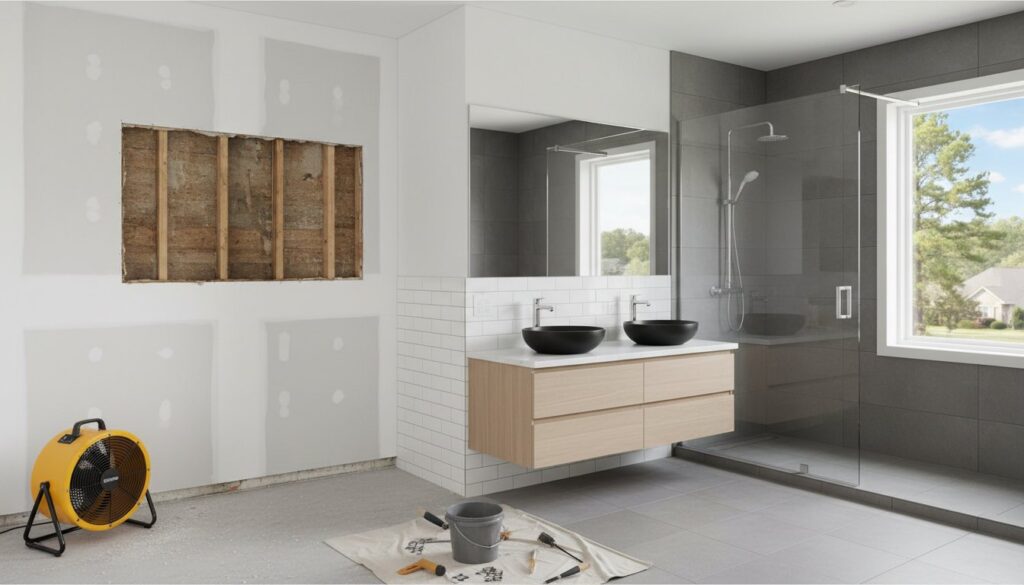
The CDC reports that in a humid climate like Georgia’s, mold can colonize a damp surface in as little as 24 hours. This single fact transforms a simple bathroom leak from a minor inconvenience into a complex threat against your home’s core infrastructure. You’re right to be concerned; the visible damage is often just the surface of a deeper problem, raising overwhelming questions about hidden mold, subfloor stability, and the labyrinth of insurance claims that can leave any homeowner feeling overwhelmed.
This guide provides the strategic roadmap you need for a complete recovery. We will navigate the entire process of professional bathroom restoration after water damage, turning operational chaos into a restored, elevated foundation for your Mableton or Marietta property. From identifying unseen structural weaknesses and securing a seamless insurance approval to ultimately increasing your home’s long-term value, we will detail the critical steps required to not just repair the damage, but to rebuild your space with absolute confidence.
Key Takeaways
- Learn to identify the subtle signs of deep-seated water damage, moving beyond surface-level issues to understand the full impact on your home’s infrastructure.
- Understand the critical difference between immediate mitigation and long-term rebuilding to develop a strategic roadmap for your bathroom restoration after water damage.
- Discover how to document damage for Georgia insurance adjusters and navigate the key differences between ‘Actual Cash Value’ and ‘Replacement Cost’ policies.
- See how a professional restoration partner transforms the recovery process into a structured opportunity to elevate your home’s foundational value and design.
Assessing Bathroom Water Damage in Metro Atlanta Homes
A significant pipe burst in a Marietta bathroom isn’t just a surface-level inconvenience; it’s a multi-layered infrastructure failure. Water penetrates drywall, saturates insulation, compromises electrical systems, and weakens the subfloor that supports the entire room. In communities from Mableton to Roswell, this issue is compounded by Georgia’s climate. With an average annual relative humidity often exceeding 70%, ambient moisture retention creates a perfect breeding ground for mold, which can colonize damp materials in as little as 24-48 hours. Whether the catalyst is a dramatic pipe burst, a slow-leaking toilet wax ring, or a hidden mold colony fed by a dripping shower valve, immediate and intelligent action is the foundation of a successful recovery roadmap.
The first step in any effective bathroom restoration after water damage is a clinical, data-driven assessment. This isn’t a casual glance; it’s a systematic audit designed to define the scope of the problem and build a precise plan for remediation. We analyze, we document, and we strategize before a single tool is lifted.
Identifying the Class and Category of Water Intrusion
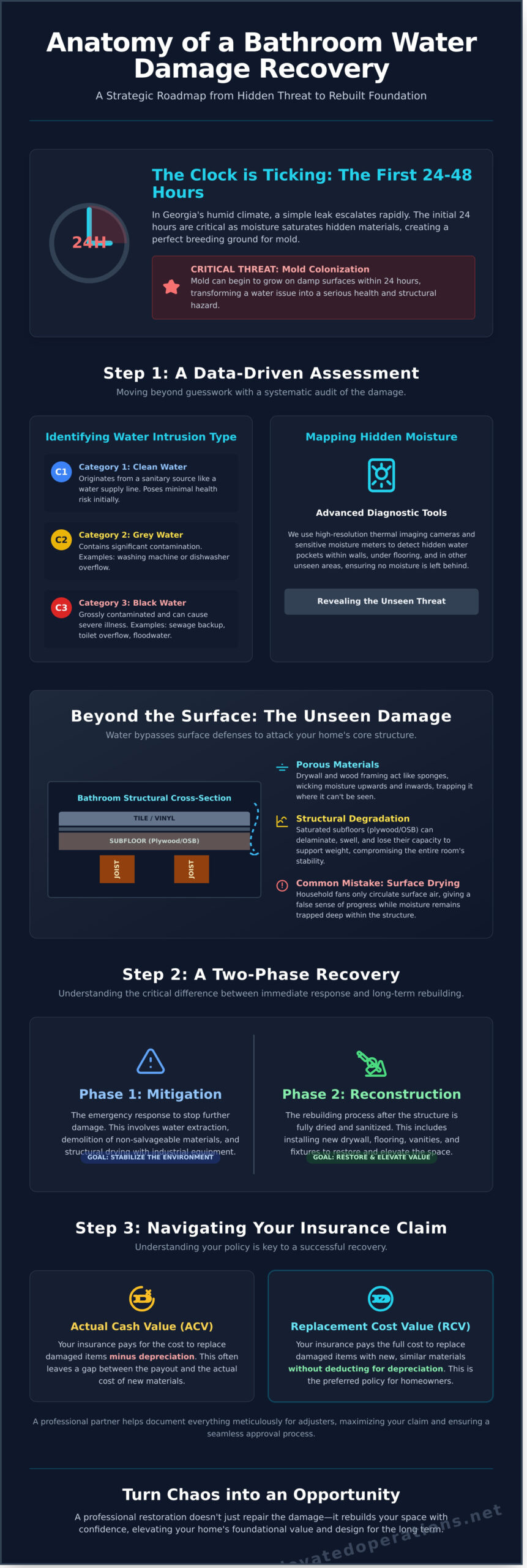
Professionals classify water intrusion to determine the correct response protocol. This initial diagnosis is a critical first step in understanding water damage and its potential risks. The “Class” (1 through 4) measures the rate of evaporation based on how much material is saturated. Class 1 involves minimal absorption, while Class 4 signifies deep saturation into low-porosity materials like concrete. In a bathroom, a toilet overflow is often a Category 3 “Black Water” event, containing dangerous contaminants. This contrasts with a Category 1 “Clean Water” leak from a supply line. Due to runoff and soil contaminants, localized Metro Atlanta flooding almost always requires Category 3 biohazard protocols.
The ‘Operational Audit’ of Your Bathroom
A visual inspection only reveals the most obvious damage. Our operational audit goes deeper, deploying diagnostic tools to map the full trajectory of the water. We use high-resolution thermal imaging cameras, sensitive enough to detect temperature differentials of just 0.1°C, to find hidden moisture pockets behind tile, under vanities, and within wall cavities. This technology allows us to see what the naked eye can’t, ensuring that no moisture is left behind to threaten the home’s framework. In the context of bathroom subfloors, structural integrity refers to the subfloor’s capacity to support its intended load without deflection or failure after being exposed to water, which can delaminate plywood and weaken oriented strand board (OSB).
This meticulous assessment process moves beyond guesswork. It provides a clear, evidence-based blueprint that informs every subsequent step of the restoration. By defining the precise boundaries of the damage, we can execute a targeted, efficient, and complete recovery, elevating your home back to its pre-loss condition with structural and environmental safety at the forefront.
The Hidden Infrastructure of Bathroom Water Intrusion
A major pipe burst presents two distinct problems: the visible water you see on the floor and the invisible saturation that compromises your home’s core structure. While tile and vinyl surfaces appear impermeable, they are part of a larger, more vulnerable ecosystem. Water expertly bypasses these topical defenses, infiltrating grout lines, seeping under baseboards, and finding pathways directly to the wooden subfloor and foundational supports below. This hidden water intrusion is where the most significant long-term damage occurs.
The materials that form your bathroom’s infrastructure are deceptively porous. Drywall acts like a sponge, wicking moisture upward and creating a damp, hidden environment inside your walls. Wooden framing and subfloors, once saturated, lose their structural integrity. In Marietta, where the average annual humidity hovers around 71%, this trapped moisture creates an ideal incubator for microbial growth. Mold and mildew don’t wait; they begin to colonize within 24 to 48 hours, turning a water problem into a significant health hazard. This accelerated timeline makes immediate, professional intervention a critical factor in any successful bathroom restoration after water damage.
A common homeowner response is to aim household fans at the wet area. This strategy represents a critical bottleneck in the drying process. These fans only circulate surface-level air, creating a false sense of progress while moisture remains trapped deep within the wall cavities and subfloor. True structural drying requires a scientific approach, utilizing industrial-grade equipment like low-grain refrigerant dehumidifiers and high-velocity air movers to create a controlled, low-humidity environment that pulls moisture out from within the materials themselves.
Subfloor and Framing Vulnerabilities
In many of Marietta’s established neighborhoods, homes built before the 1980s rely on wood-based infrastructure that is highly susceptible to rot. Once water saturates these older materials, the decay process begins. A “spongy” or soft feeling underfoot isn’t a minor issue; it’s a clear symptom of advanced structural compromise. Professional structural drying is designed to halt this decay, preserving the home’s long-term value and scalability by protecting its foundational integrity.
Mold Remediation in High-Moisture Ecosystems
The dark, damp, and enclosed space within a bathroom wall cavity is a perfect ecosystem for microbial proliferation. The common “bleach-and-scrub” method is a myth; it only addresses surface-level mold and fails to neutralize the root system embedded in porous materials. To ensure a healthy environment for your family and avoid the documented health effects of mold exposure, remediation must follow standardized protocols. Certified professionals contain the area, use HEPA filtration, and remove all affected materials safely.
Ultimately, addressing the hidden consequences of water intrusion is the most important phase of a complete bathroom restoration after water damage. A superficial fix addresses the symptom, not the systemic risk to your home’s infrastructure and your family’s health. A comprehensive assessment is the first step in protecting your investment. Our team can help you establish a clear roadmap for recovery and ensure the job is done right from the foundation up.
Mitigation vs. Reconstruction: Developing a Restoration Roadmap
A successful bathroom restoration after water damage isn’t a single action; it’s a two-phase strategic operation. Many Marietta homeowners mistakenly believe the job is done once the visible water is gone. This overlooks the critical distinction between immediate stabilization (mitigation) and long-term rebuilding (reconstruction). Understanding this roadmap is the foundation for a durable, high-quality recovery. Mitigation stops the downward trajectory of damage, while reconstruction elevates the space beyond its pre-loss condition. The key to a seamless project lies in a partner who can architect and execute both phases with precision.
The Mitigation Phase: Stopping the Downward Trajectory
The first 24 to 48 hours are critical. This phase isn’t about rebuilding; it’s about arresting the damage before it escalates into a catastrophic structural or mold issue. Our teams in Austell and Powder Springs immediately deploy industrial-grade, truck-mounted extraction systems to remove hundreds of gallons of standing water. Following extraction, we strategically place an average of four high-velocity air movers and at least one LGR (Low-Grain Refrigerant) dehumidifier per 150 square feet. These units work in concert to create an optimal drying environment, pulling residual moisture from porous materials like wood framing and subflooring. We meticulously monitor this process, using calibrated moisture meters to ensure every affected material meets its “dry standard”-a state verified against an unaffected area of your home and aligned with professional restoration standards-before any rebuilding begins.
The Reconstruction Phase: Elevating the Space
Once the environment is verifiably dry and stable, the focus shifts from defense to offense. This is where we rebuild with purpose and foresight. We don’t just replace what was lost; we optimize the infrastructure to prevent future failures. This often involves recommending upgrades to materials like cement backer board instead of standard drywall in wet areas and selecting porcelain tile or luxury vinyl plank, which offer less than 0.5% water absorption. A bathroom rebuild requires a unique fusion of expertise, integrating the precision of our licensed plumbers with the craftsmanship of our finish carpenters. This phase also presents a unique opportunity to optimize your bathroom’s layout, perhaps by reconfiguring a vanity for better flow or converting an old tub into a more accessible walk-in shower, truly elevating the final outcome.
At Elevated Operations, we integrate these two distinct phases into one fluid, expertly managed project. We don’t just mitigate the crisis; we architect the comeback. Our process ensures that the emergency response transitions seamlessly into a thoughtful reconstruction, providing a single point of accountability from initial water extraction to the final fixture installation. This holistic approach guarantees that your bathroom restoration after water damage not only resolves the immediate problem but also delivers a stronger, more resilient, and beautifully finished space.
Navigating Insurance and Regulations in Mableton and Marietta
A successful bathroom restoration after water damage is not merely about replacing drywall and tile; it’s an operational challenge that demands a strategic approach to insurance claims and local regulations. The financial outcome of your project hinges on meticulous documentation and a deep understanding of the complex ecosystem connecting your policy, your restoration partner, and Cobb County’s building codes. Without a clear roadmap, homeowners can face significant out-of-pocket expenses and project delays.
The foundation of a successful insurance claim is irrefutable proof. Georgia adjusters require a detailed, chronological record of the damage and the mitigation efforts. This is where the distinction between policy types becomes critical. Most standard policies offer ‘Actual Cash Value’ (ACV), which pays for the damaged item’s value minus depreciation. For example, your 10-year-old vanity might only be valued at $150. A superior ‘Replacement Cost Value’ (RCV) policy, however, covers the cost to replace that vanity with a new, comparable model, which could be $850. Understanding this difference is fundamental to setting realistic recovery expectations.
Filing Your Water Damage Claim
We provide a structured process to optimize your claim and protect your financial interests. Think of it as a three-step operational launch sequence:
- Document the Infrastructure: Immediately photograph and video the source of the burst, the path of the water, and all affected materials. Capture wide shots for context and close-ups of serial numbers on appliances like water heaters. This data is non-negotiable for your adjuster.
- Deploy a Professional Assessment: Contacting a professional restoration firm like Elevated Operations is your next move. We use thermal imaging and moisture meters to create a scientifically backed scope of work, which provides the adjuster with the exact data needed to approve the claim.
- Audit Your Policy: Locate your homeowner’s policy and identify any “water backup” or “sump pump failure” endorsements. These specific riders, often costing less than $50 per year, can be the difference between a covered claim and a complete denial for certain types of pipe failures.
Local Compliance and Building Standards
The reconstruction phase of any significant bathroom restoration after water damage must adhere to a strict set of local and state codes. In both Cobb and Fulton counties, any project that involves altering plumbing supply lines, moving electrical outlets, or modifying structural framing requires a building permit. Attempting this work without one can invalidate your insurance coverage and create major issues when you sell your home.
Your insurance carrier will almost certainly mandate that all mitigation and restoration work is performed by technicians certified by the Institute of Inspection, Cleaning and Restoration Certification (IICRC). This isn’t just a suggestion; it’s a non-negotiable standard (IICRC S500) that validates the work and protects the insurer from future liability, like mold growth. Furthermore, all repairs must meet the 2026 Georgia State Minimum Standard Residential Code, ensuring modern safety and efficiency standards are implemented. A professional partner navigates this regulatory landscape, securing permits and ensuring every aspect of the job, from GFCI outlet placement to plumbing ventilation, is fully compliant.
Managing adjusters, county inspectors, and certified technicians is a full-time job. Let our team manage the entire claims and compliance ecosystem for you. Schedule a comprehensive damage assessment with Elevated Operations and let us build the strategic roadmap for your recovery.
Elevating Your Space: The The Elevated Operations Solution
A sudden pipe burst doesn’t just damage your home; it disrupts its entire operational system. The chaos that follows requires more than a simple fix. It requires executive-level project management. At Elevated Operations, we serve as your home’s “Fractional COO,” applying the same strategic rigor we use to scale businesses to restore your property. With over 20 years of dedicated experience managing complex restoration projects across the Metro Atlanta market, we bring a level of calm, authoritative oversight to an otherwise stressful situation. We don’t just repair damage; we rebuild your home’s operational foundation.
Our commitment begins with our 24/7 emergency response service for homeowners in Marietta and Mableton, ensuring a team is dispatched and typically on-site within 60 minutes of your call. This rapid action is the first step in our end-to-end management process. A successful bathroom restoration after water damage is a complex project with dozens of moving parts, from water extraction and mold remediation to coordinating with plumbers, electricians, and finishers. We manage the entire trajectory, from the initial damage audit to the final implementation of your newly restored space, transforming a potential bottleneck into a streamlined, predictable recovery.
Why a Strategic Partner Matters
Many services simply fix the visible problem. We provide professional property management for your restoration. This strategic partnership moves beyond break-fix solutions to deliver a structured, reliable process that provides true peace of mind. We audit the full extent of the damage, optimize the recovery plan for efficiency and quality, and implement the project with a network of vetted, expert craftsmen. This is how we eliminate stress and guarantee a superior outcome.
Getting Started with Your Restoration
While our emergency team is en route, you can take several immediate steps to mitigate further damage and protect your property. Your safety is the top priority.
- Shut Off the Water: Locate and turn off your home’s main water shut-off valve immediately.
- Cut the Power: If it is safe to do so, turn off the electricity to the affected areas at your circuit breaker panel.
- Document Everything: Use your smartphone to take extensive photos and videos of the damage for your insurance claim.
Once our team arrives, your role in managing the crisis is over. Our initial consultation isn’t just a quote; it’s the first phase of building a comprehensive roadmap for your bathroom’s complete recovery. We’ll assess the damage, explain the process, and establish a clear timeline. Ready to move beyond simple repairs? Elevate your home’s recovery and contact Elevated Operations today.
Elevate Your Home’s Recovery and Resilience
Water damage in your bathroom penetrates far beyond visible surfaces, compromising the hidden infrastructure that supports your home’s integrity. A successful recovery isn’t accidental; it’s the result of a strategic roadmap that distinguishes between immediate mitigation and thoughtful reconstruction. Navigating this process, from complex insurance claims to Mableton and Marietta building codes, requires a level of expertise that protects your investment. This is where professional bathroom restoration after water damage transitions from a simple repair job to a comprehensive rebuilding project.
Our team at Elevated Operations brings over 20 years of dedicated experience to every project. Our IICRC Certified Technicians are not just responders; they are strategic architects of your home’s recovery, available for 24/7 emergency response throughout Metro Atlanta. We don’t just fix the damage; we restore your peace of mind and reinforce your property’s foundation for the future.
Secure your property’s foundation with Elevated Operations’ expert restoration services. Let us handle the operational complexities, so you can focus on moving forward with absolute confidence.
Frequently Asked Questions About Bathroom Restoration
How long does bathroom restoration usually take in Mableton?
The timeline for bathroom restoration after water damage in Mableton typically takes between one and four weeks, depending on the severity of the damage. The initial drying and mitigation phase lasts about 72 hours. Reconstruction, which includes replacing drywall, flooring, and fixtures, can then take an additional one to three weeks. Complex projects involving custom tile or significant plumbing rerouting may extend this timeline, but most standard restorations are completed within 21-28 days.
Will my homeowners insurance cover bathroom water damage?
Most standard homeowners insurance policies (HO-3) cover water damage from a sudden and accidental pipe burst. This coverage typically pays for the cost to access the pipe, repair the resulting damage to drywall and flooring, and restore the bathroom. However, it won’t cover the cost of repairing the broken pipe itself. Policies generally exclude damage from slow, gradual leaks or issues caused by a lack of maintenance, so it’s critical to report the incident immediately.
Can I stay in my house during the bathroom restoration process?
You can typically stay in your house, provided the water damage is contained to a single bathroom. Restoration work, however, generates significant noise and dust, and the affected bathroom will be unusable for the project’s duration. If you only have one bathroom or if the damage has compromised the home’s structural integrity or air quality, your insurance policy’s “loss of use” coverage may pay for temporary housing, such as a hotel, for the duration of the repairs.
What are the signs of hidden mold after a bathroom leak?
The most common sign of hidden mold is a persistent, musty, or earthy odor that you can’t locate. You should also look for visual cues like dark stains or discoloration appearing on walls, ceilings, or baseboards, even after they feel dry. Other indicators include paint or wallpaper that is peeling, bubbling, or cracking without an obvious cause. Warped drywall or buckling floorboards are also red flags that point to trapped moisture and potential mold growth behind the surface.
Do I need a permit for bathroom reconstruction in Marietta, GA?
You will need a permit for bathroom reconstruction in Marietta if the work involves altering the plumbing, electrical, or structural systems. For example, moving a toilet, adding a new shower circuit, or relocating a wall requires a permit from the Marietta Building Department. However, cosmetic updates like replacing a vanity, toilet, or flooring in the exact same location and configuration generally do not require a permit. Always confirm with the city before beginning any major work.
What is the difference between water mitigation and restoration?
Water mitigation is the immediate emergency response designed to prevent further damage. This first phase includes extracting standing water, drying the structure with specialized equipment, and sanitizing affected areas. Water restoration is the second phase, which involves repairing and rebuilding the property to its pre-loss condition. The complete process requires both steps; mitigation stops the bleeding, and restoration performs the reconstructive surgery to make your home whole again.
How do I prevent future water damage in my bathroom?
You can prevent future water damage by performing regular inspections and maintenance. At least twice a year, check for slow drips under sinks and around the toilet base. Inspect visible pipes for corrosion or condensation, and replace aging supply lines, especially those made of plastic, every 5-7 years. Additionally, re-caulk your tub and shower annually to maintain a watertight seal. Installing a smart water leak detector can also provide an early warning by sending an alert to your phone.
Is black mold common in Georgia bathrooms after a flood?
Yes, Stachybotrys chartarum, often called “black mold,” is common in Georgia’s humid climate, especially after water damage. This type of mold thrives on wet, cellulose-based materials like drywall and wood framing. After a pipe burst, mold growth can begin within 24 to 48 hours if the area isn’t properly dried. Given Georgia’s average annual humidity of over 70%, immediate and professional drying is the single most critical step to prevent its colonization in your bathroom.