The fire trucks left your Mableton property two days ago, but the operational chaos is just beginning. You’ve suddenly become the project manager for a recovery you never planned, juggling insurance adjusters, remediation crews, and the persistent fear of what lies beneath the soot. The anxiety over timelines for a Cobb County permit feels just as daunting as the lingering smell of smoke.
It’s a disorienting position, and we understand that restoring your home’s ecosystem is about more than just rebuilding walls; it’s about re-establishing your foundation. This is where a strategic framework transforms the process of a kitchen reconstruction after fire from a bottleneck of uncertainty into a clear trajectory toward renewal. This guide provides the professional roadmap you need to navigate the complex transition, ensuring every decision elevates your home’s safety and value. We’ll outline the critical path for securing permits, eliminating hidden hazards, and optimizing your new kitchen’s infrastructure for a more resilient future.
Key Takeaways
- Understand the critical first steps to stabilize your kitchen’s infrastructure within 48 hours, distinguishing between aesthetic damage and deep-seated structural bottlenecks.
- Discover how professional smoke remediation is essential to protecting your kitchen’s foundational integrity from the corrosive effects of soot over time.
- Learn to transform a crisis into a strategic opportunity by using your kitchen reconstruction after fire to optimize workflow and build with fire-resistant materials.
- Gain a clear roadmap for navigating the complex insurance and permitting ecosystem in Mableton and Marietta to ensure a seamless and compliant restoration process.
Assessing the Scope: Immediate Steps After a Kitchen Fire in Metro Atlanta
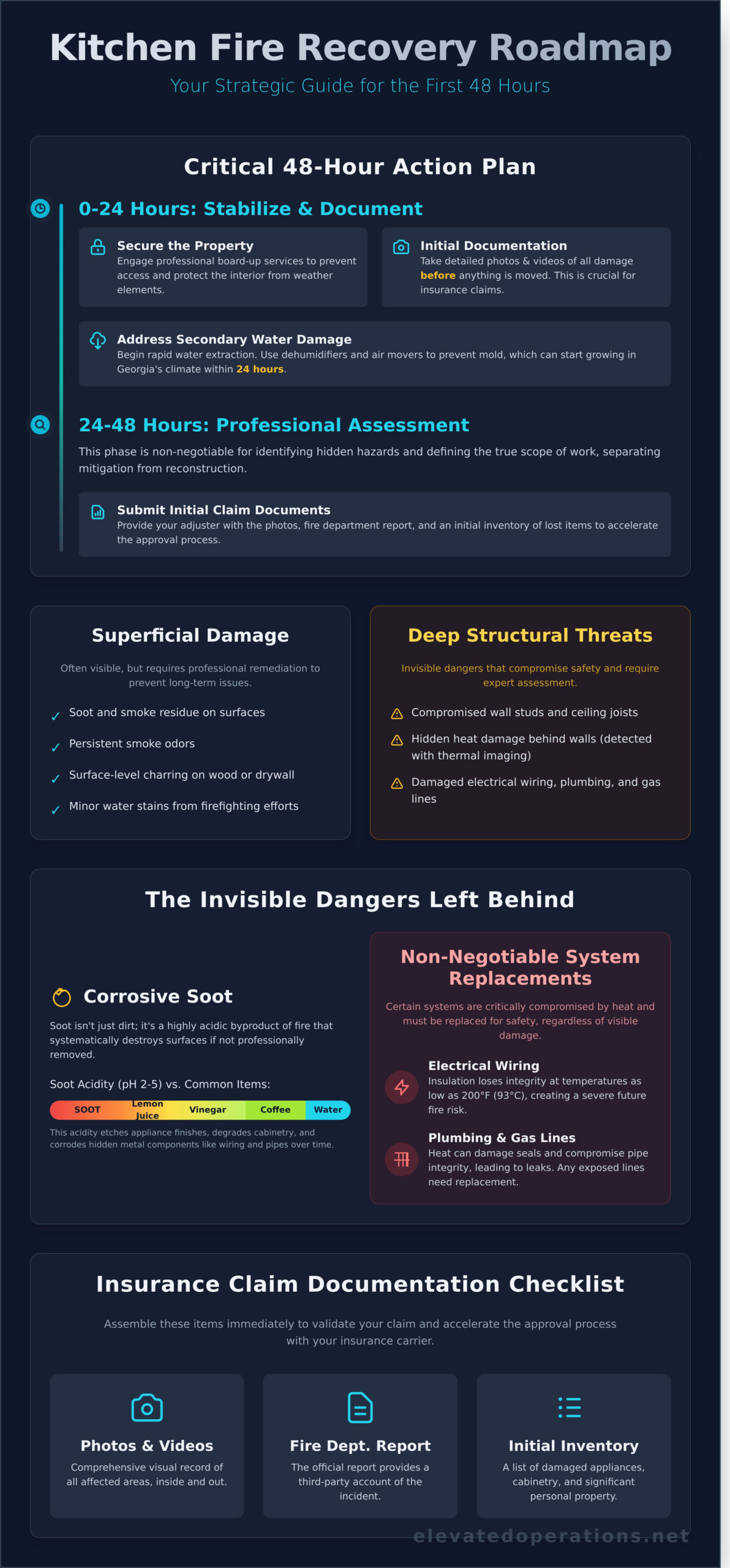
The aftermath of a kitchen fire presents a uniquely overwhelming operational challenge. In the critical 24 to 48-hour window that follows, the actions you take will establish the foundation for your entire recovery and rebuilding process. This initial phase isn’t about choosing new countertops; it’s about stabilizing the infrastructure of your home and creating a clear, strategic roadmap for a successful kitchen reconstruction after fire. It’s the moment to impose order on the chaos.
Your first task is to distinguish between superficial damage and deep-seated structural bottlenecks. Soot, smoke odor, and surface-level charring are aesthetic issues that can often be addressed through specialized cleaning and remediation. Structural damage is a far more complex problem. The intense heat from a fire can compromise the integrity of the structural components of a building, such as wall studs and ceiling joists, long before they show visible signs of burning. A professional assessment is non-negotiable to identify these hidden vulnerabilities that threaten the safety and longevity of your home.
For local Mableton residents, the immediate priority is to secure the property. This involves professional board-up services to prevent unauthorized access and protect the exposed interior from the elements. Simultaneously, for homeowners working with Marietta-based insurance carriers, assembling initial documentation is paramount. Your adjuster will require immediate access to a clear set of records, including: detailed photos and videos of all damaged areas taken before anything is moved, the official report from the fire department, and an initial inventory of lost appliances and personal property. This documentation is the primary tool for validating your claim and accelerating the approval process.
The Triage Phase: Mitigation vs. Reconstruction
This initial triage defines the boundary where mitigation ends and reconstruction begins. Mitigation focuses on preventing further harm; we clean, we dry, and we stabilize. Reconstruction is the act of rebuilding what has been irrevocably damaged. Certain systems are always considered non-negotiable replacements after direct fire exposure. These include electrical wiring, which can lose its integrity at temperatures as low as 200°F, along with any compromised plumbing and gas lines. We utilize thermal imaging technology to detect hidden heat damage behind Mableton drywall, ensuring no structural weaknesses are overlooked.
Securing the Perimeter and Preventing Secondary Damage
The water used by Cobb County fire services to extinguish the blaze, often thousands of gallons, introduces a severe secondary threat. Our first operational step is to address this water damage through rapid extraction and board-up or tarping strategies that protect your home’s entire ecosystem. In Georgia’s humid climate, where ambient humidity often exceeds 70%, mold can colonize damp drywall and wood within 24 hours. Immediate deployment of industrial-grade dehumidifiers and air movers is essential to halt this process and prevent a costly mold remediation project down the line.
These immediate, decisive steps are not just preliminary tasks; they are the strategic framework that dictates the efficiency, cost, and ultimate success of your kitchen reconstruction after fire. By moving with purpose and professional guidance in these first two days, you transform a devastating event into a structured, manageable project with a clear trajectory toward full recovery.
The Invisible Foundation: Structural Integrity and Smoke Remediation
Before a single cabinet is hung or a countertop is templated, the true work of a successful kitchen reconstruction after fire begins. This phase is about restoring the invisible foundation: the structural and environmental integrity of the space. It’s a methodical process of decontamination and reinforcement that dictates the safety, longevity, and ultimate value of your new kitchen. Neglecting this stage is the single most common bottleneck to a successful recovery, leading to problems that manifest months or even years later.
The immediate visual damage is often misleading. The real threat lies in the chemical aftermath. Soot isn’t just a black powder; it’s a highly acidic byproduct of combustion, often with a pH between 2 and 5, making it as corrosive as vinegar or lemon juice. Left unmitigated, these acidic particles systematically etch appliance surfaces, degrade cabinet finishes, and corrode hidden wiring. Similarly, the persistent smell of smoke is more than an annoyance. It’s a clear signal that microscopic, oil-based soot particles have penetrated porous materials like wood, drywall, and insulation, and simple surface cleaning will not remove them.
Decontaminating the Air and Surfaces
True remediation moves beyond what the eye can see. We deploy a two-pronged strategy to restore environmental safety. First, industrial-grade HEPA (High-Efficiency Particulate Air) filtration systems run continuously, capturing 99.97% of airborne particles down to 0.3 microns in size. Then, hydroxyl generators are used to neutralize odors at the molecular level, breaking down volatile organic compounds (VOCs) embedded in materials. This is why the common “seal and paint” strategy fails so spectacularly in high-end kitchens; it merely traps microscopic, toxic particles behind a thin layer of primer, compromising your family’s respiratory health for years to come.
Structural Reinforcement and Framing
A fire compromises the very bones of your kitchen. Our first structural task is to assess every stud and joist. Timber with charring deeper than 1/4 inch is always replaced to restore its original load-bearing capacity. Structurally sound wood with surface-level smoke damage can be meticulously cleaned, abraded, and sealed with a shellac-based primer to permanently encapsulate any remaining odor. This phase also presents a critical opportunity to elevate your home’s infrastructure. We advocate for upgrading electrical panels and wiring to meet or exceed the 2026 National Electrical Code standards, ensuring the framework can safely power modern, high-draw appliances. This is particularly vital for supporting the immense weight of today’s popular 3cm-thick stone countertops, a load that the original framing in many older Marietta homes was never designed to bear.
This deep structural and environmental assessment is the bedrock of a resilient rebuild. While official resources like FEMA’s guide on Immediate Steps After a Fire provide an excellent starting point for homeowners, the technical execution of this foundational work requires specialized oversight. To ensure every structural and environmental detail is meticulously planned and executed, you need an operational partner. We can help you architect the strategic roadmap for your entire rebuild, transforming a catastrophic event into an opportunity to build back stronger, safer, and better than before.
Beyond Repair: Designing Your Elevated Kitchen for Future Resilience
A significant fire loss presents a rare and strategic opportunity. It’s a moment to move beyond simple replacement and instead architect the operational heart of your home for elevated performance and future resilience. The process of kitchen reconstruction after fire becomes a roadmap for optimization, allowing you to correct long-standing workflow bottlenecks and build a foundation of safety and efficiency that wasn’t there before. This isn’t just about rebuilding; it’s about reimagining your home’s most critical ecosystem.
We see this as a chance to implement a clear vision. From rethinking the entire layout to integrating a smarter infrastructure, you can transform a devastating event into a definitive upgrade for your family’s daily life and long-term security.
Optimization of Layout and Workflow
An inefficient layout creates daily friction. We begin by analyzing the classic “kitchen work triangle” connecting the sink, refrigerator, and cooktop. For many Atlanta homes, we evolve this concept into a more modern “workstation” model. This approach creates dedicated zones for prep, cooking, and cleaning, which can improve operational efficiency by over 25%. We then identify opportunities for fractional upgrades, such as integrating a walk-in pantry to declutter countertops or designing a dedicated coffee station to streamline your morning trajectory. For the classic Mableton ranch-style home, whose galley kitchens often measure under 150 square feet, this may involve removing a non-load-bearing wall to create an open-plan ecosystem with a multi-functional island, fundamentally changing how the space is used.
Resilient Material and Appliance Selection
Your material and appliance choices form the bedrock of a resilient kitchen. We guide clients toward non-porous surfaces like quartz and sintered stone, which not only carry a Class A fire rating but are also impervious to moisture and bacteria, simplifying long-term maintenance. This is a critical consideration for ensuring a clean, healthy environment after a fire. Appliance selection is an equally strategic decision. We strongly advocate for induction cooktops as a proactive safety measure. Because induction technology heats the cookware directly, the risk of igniting nearby grease or flammable items is dramatically reduced compared to open-flame gas ranges. Ensuring these new appliances are installed and maintained correctly is just as important; for example, specialist firms like the UK-based FaultFree Engineering Group focus exclusively on this aspect of home infrastructure, highlighting the need for expert handling regardless of location.
In our design process, we build a robust safety infrastructure from the ground up. While residential codes provide a baseline, we often consult the comprehensive framework outlined in commercial Fire-Resistant Kitchen Design Standards by the NFPA to inform our ventilation and material roadmaps. For flooring, options like porcelain tile or luxury vinyl tile (LVT) offer superior durability for a busy Atlanta household. They withstand heavy traffic and are water-resistant, a crucial benefit considering the thousands of gallons of water often used in firefighting. Finally, every element, from cabinets to paint, is specified to be low-VOC (Volatile Organic Compounds), ensuring your new kitchen contributes to, rather than detracts from, your home’s indoor air quality.
Navigating the Permitting and Insurance Ecosystem in Cobb and Fulton Counties
The aftermath of a fire is chaotic. The path forward shouldn’t be. A successful kitchen reconstruction after fire hinges on mastering two parallel systems: municipal permitting and insurance advocacy. These are not separate tasks; they are an interconnected ecosystem where one misstep can cause significant delays and financial loss. We provide the strategic oversight to ensure both are managed with precision, transforming bureaucratic bottlenecks into a clear trajectory for recovery.
Anticipating timelines is critical for planning. Based on 2023-2024 processing data from the Atlanta Regional Commission, we project that by 2026, a standard fire repair permit in Fulton County could take between 4 to 6 weeks for approval. Cobb County currently averages a slightly faster 3 to 5 weeks. These timelines, however, don’t account for the detailed architectural and engineering plans required for submission, which must be completed first.
Local Building Codes and Safety Inspections
In Cobb County, all structural repairs must adhere to the 2018 International Residential Code with Georgia-specific amendments. For homeowners in Marietta or Mableton, this means navigating the Cobb County Community Development Agency’s requirements. Yet, residents in Powder Springs or Austell will find that while they are in Cobb, their incorporated cities maintain separate permitting offices with unique ordinances and fee structures. It’s a localized landscape that demands specific expertise.
Strategic Insurance Documentation and Advocacy
Your insurance policy likely promises to restore your property to “Like Kind and Quality” (LKQ). This is the most common trap for homeowners. An adjuster might interpret your custom 2010 maple cabinets as equivalent to modern particleboard replacements. We reject that interpretation. As your fractional project manager, we build a strategic case for what LKQ truly means: matching material, craftsmanship, and function. Our advocacy ensures your kitchen reconstruction after fire restores true value, not just a bare-minimum version of your home.
Our process is built on a foundation of meticulous documentation and clear communication. We don’t just submit claims; we architect them.
- Line-Item Estimating: We use the same software as major insurance carriers, but with a crucial difference. We detail every component, from the gauge of the wiring to the dovetail joinery in your drawers. This granular detail removes ambiguity and maximizes claim accuracy from day one.
- Proactive Supplemental Claims: When demolition uncovers hidden damage like charred subflooring or compromised plumbing vents, we don’t wait. We document it with photo and video evidence, submitting a supplemental claim immediately to prevent work stoppages while waiting for approvals.
- A Clear Communication Roadmap: You will never feel lost in the process. We establish a clear communication rhythm with weekly progress reports and a shared digital portal containing every document, estimate, and correspondence with your adjuster. We become the single, reliable point of contact.
Don’t navigate this complex process alone. Partner with us to create a strategic roadmap for your insurance claim and restoration.
Why a Strategic Partner is Essential for Your Kitchen Reconstruction
The phase that follows a house fire is a critical inflection point. The decisions you make here will define not only the quality of your restored kitchen but also your peace of mind throughout the process. This isn’t a standard remodel; it’s a complex recovery operation. Choosing the right partner is the single most important variable in the equation for a successful outcome.
Many homeowners assume a general contractor is the logical next call. While skilled in new builds and renovations, a general contractor’s expertise often falls short of the unique demands of fire restoration. The difference lies in the operational ecosystem. A specialized restoration partner understands the complete trajectory, from initial damage assessment to the final handover. It’s the difference between a builder and a strategic architect for your recovery.
Consider the distinct responsibilities:
- A General Contractor typically manages subcontractors for a pre-defined scope of work, focusing on aesthetics and standard building codes.
- A Restoration Specialist orchestrates a multi-disciplinary response. We manage insurance claim documentation, coordinate with structural engineers to assess hidden damage, oversee specialized smoke and water mitigation, and then execute a build-back designed to meet post-disaster code requirements.
At Elevated Operations, we integrate these disparate phases into a single, seamless workflow. We assess the foundational damage, design a strategic plan for recovery, and implement the reconstruction with precision. This unified approach eliminates the communication gaps and scheduling bottlenecks that plague projects managed by multiple, disconnected vendors. You have one point of contact, one source of truth, and one team accountable for returning your home to you, better than before.
A house fire is arguably one of the most stressful events a family can endure. In the midst of that chaos, you need a calm authority. You need a partner who has navigated this terrain hundreds of times and can provide a clear, structured roadmap from day one. Our role is to absorb the operational complexity so you can focus on your family. We establish the project’s foundation, manage its trajectory, and guide you toward the final walkthrough, where we meticulously verify that every detail aligns with our shared vision for your new kitchen.
The Elevated Operations Advantage
With over two decades of experience navigating the Atlanta restoration market, our team has developed an operational discipline that transforms disaster into opportunity. We don’t just replace what was lost; we elevate it. Our commitment to superior craftsmanship and strategic project management ensures your kitchen reconstruction after fire results in a space that is not only beautiful but also safer and more functional than before. Learn more about our fire damage reconstruction services in Marietta and see how we turn a crisis into a lasting asset for your home.
Next Steps: Launching Your Reconstruction Roadmap
Your journey back to normalcy begins with a single, decisive action. The first step is to schedule a comprehensive structural audit of your fire-damaged kitchen. During this initial consultation, our operations team will assess the full scope of the damage, outline a preliminary recovery timeline, and explain how we coordinate directly with your insurance carrier. This audit is the foundational blueprint for your entire reconstruction. Contact Elevated Operations for a Strategic Kitchen Audit and let’s begin building your path home.
Elevate Your Roadmap to a Restored Home
Recovering from a kitchen fire isn’t just about replacing cabinets and countertops. It’s a complex process that demands a strategic approach, from assessing hidden structural damage to expertly navigating the insurance and permitting ecosystem in Metro Atlanta. Your home’s future resilience depends on a foundation built with precision and foresight. A successful kitchen reconstruction after fire requires a partner with a proven track record. With over 20 years of dedicated Atlanta restoration experience, our IICRC Certified Fire & Smoke Technicians provide the expert guidance you need. We manage the entire process, from technical remediation to comprehensive insurance claim assistance, ensuring no detail is overlooked.
Don’t navigate this complex journey alone. It’s time to move from uncertainty to a clear, actionable plan. Elevate Your Home Recovery: Schedule a Professional Fire Damage Assessment Today. The path to a beautifully restored and resilient kitchen starts now.
Frequently Asked Questions About Kitchen Fire Reconstruction
How long does a full kitchen reconstruction typically take after a fire?
A full kitchen reconstruction after fire typically takes 8 to 12 weeks from the start of the build phase. This timeline begins after the initial fire mitigation is complete. The process includes 2-3 weeks for structural repairs, 1-2 weeks for plumbing and electrical rough-ins, and another 4-6 weeks for installing cabinets, countertops, and appliances. Delays in material supply chains can extend this roadmap by up to 25%, a factor we proactively manage.
Can I change my kitchen layout during the fire restoration process?
Yes, changing your kitchen layout is an ideal opportunity during the restoration process. Since demolition is already required, relocating plumbing, electrical lines, and even walls is more cost-effective now than at any other time. This allows you to optimize the workflow and modernize the space’s infrastructure. Our design team creates a new roadmap for your kitchen, ensuring the updated layout meets both your vision and all current building codes for a truly elevated result.
Will my insurance cover the cost of upgrading my old kitchen cabinets?
Your insurance policy will cover the replacement cost for cabinets of a similar kind and quality to what you had before the fire. If you choose to upgrade from laminate to solid wood, for example, you are responsible for paying the cost difference. We provide a detailed, itemized estimate that clearly separates the “like-for-like” replacement value from upgrade costs, which streamlines the approval process with your insurance adjuster and ensures you maximize your claim.
Is it safe to live in my home while the kitchen is being rebuilt?
In over 90% of significant kitchen fire cases, it is not safe to occupy the home during reconstruction. The work area must be professionally contained to prevent the spread of soot, dust, and other contaminants that pose health risks. For projects lasting more than four weeks, we strongly advise clients to arrange for temporary housing. This ensures your family’s safety and allows our teams to execute the restoration with maximum efficiency and precision.
What is the difference between fire mitigation and kitchen reconstruction?
Fire mitigation is the immediate emergency response, while kitchen reconstruction is the process of rebuilding the damaged space. Mitigation focuses on preventing further damage within the first 24-72 hours. This includes water extraction, securing the property, and professional smoke and soot removal. Reconstruction is the subsequent phase, involving structural repairs, new installations, and finishing touches to restore the kitchen to its pre-loss condition or better, forming a new foundation for your home.
How do I get rid of the smoke smell in my kitchen cabinets after a fire?
Completely removing smoke odor from porous materials like wood cabinets is often impossible, making replacement the only guaranteed solution. Smoke particles measure between 0.1 to 4 microns and penetrate deep into the wood grain. While surface cleaning and ozone treatments may seem to work, the odor typically returns during humid weather. For a permanent fix that ensures your home’s air quality, we always recommend a full replacement of smoke-damaged cabinetry.
Do I need a building permit for fire damage repair in Mableton, GA?
Yes, a building permit from the Cobb County Community Development Agency is required for most fire damage repairs in Mableton. According to Cobb County Code Section 18-31, any work involving structural repair, altering electrical or plumbing systems, or with a total value exceeding $2,500 necessitates a permit. We manage the entire permitting process, from application to final inspection, ensuring your project is fully compliant with all local safety and building standards.
What are the first three things I should do after a kitchen fire?
Your first three actions should be to ensure safety, call your insurance provider, and contact a certified fire restoration professional. First, get clearance from the fire department before re-entering the property. Second, immediately notify your insurance agent to initiate the claims process. Third, engage a restoration expert within 24 hours to secure the site and begin mitigation, which is critical for preventing secondary damage like mold growth and structural corrosion.